
The Whispering Gallery
In a forgotten museum, whispers from the past lead a curator to a truth she might not survive


Ellsbury was a town that time had overlooked, its streets lined with sagging Victorian houses and a mill that hadn’t turned in decades. The Ellsbury Museum of Antiquities was the town’s only claim to fame, a crumbling relic packed with artifacts no one visited. Most locals avoided it, muttering about strange noises or lights flickering after hours. But for Lila Everett, the museum was home.
Lila, 34, was the museum’s sole curator, a job she’d taken after her history degree failed to land her anywhere else. With her wire-rimmed glasses and habit of talking to the exhibits, she was as much a fixture as the artifacts. The museum was her refuge, its silence a balm after a life of too many questions and too few answers. But lately, the silence had changed. It whispered.
It started on a rainy March evening, as Lila cataloged a crate of donations from an estate sale. The crate held odds and ends—tarnished jewelry, a cracked mirror, a leather journal with no name. As she lifted the journal, a faint voice murmured her name: Lila. She froze, her heart hammering. The museum was empty, its doors locked. She set the journal down, chalking it up to exhaustion, but the whispers followed her. Find it, they said, soft as wind through dry leaves.
The next day, Lila returned to the journal, its pages filled with spidery handwriting. It belonged to a woman named Margaret Voss, a 19th-century artist who’d lived in Ellsbury. The entries described her work on a mural for the museum, then called the Voss Gallery, and her growing fear of “the voices” that spoke from the walls. The final entry read: The mural hides it. They’ll kill to keep it secret.
Lila’s curiosity, sharper than her caution, led her to the museum’s east wing, a neglected section closed to the public. The walls were bare, but faint outlines suggested a mural had once been there, painted over long ago. She ran her fingers over the plaster, feeling an uneven patch. The whispers grew louder, urgent: Find it.
She spent days researching Margaret Voss. Town records were sparse, but a librarian named Mrs. Tate, with a memory as long as her braid, recalled the Voss family. “Trouble followed them,” she said, pouring Lila tea. “Margaret disappeared in 1872. Folks said she went mad, hearing things. Her brother, Elias, was the last to see her. He sealed the gallery after she vanished.”
Lila’s nights became sleepless, filled with the journal’s words and the museum’s whispers. She started scraping at the east wing’s walls, uncovering flakes of color—blues, golds, a woman’s face with eyes that seemed alive. The mural was massive, depicting Ellsbury’s founders, their faces stern, almost accusing. At its center was a door, painted to blend with the wall, but real. Lila’s breath caught. A hidden door.
She pried it open with a crowbar, revealing a narrow chamber. Inside was a wooden chest, its lid carved with symbols that matched the journal’s sketches. The whispers swelled, a chorus now: Open it. Her hands shook as she lifted the lid. Inside lay a single object—a crystal orb, no bigger than an apple, pulsing with faint light. When she touched it, images flooded her mind: Margaret painting the mural, Elias arguing with her, a shadowy figure watching from the gallery. Then, darkness, and Margaret’s scream.
Lila stumbled back, the orb heavy in her hands. The whispers stopped, replaced by footsteps echoing in the gallery. She hid the orb in her bag and slipped out, heart pounding. The museum felt different now, its shadows deeper, its air thick with intent.
The next morning, Lila found the east wing locked, though she hadn’t touched the door. Her key no longer worked. She confronted the museum’s board, a group of elderly locals led by Mr. Carver, a man with a smile too sharp for his face. “Repairs,” he said dismissively. “The wing’s unsafe.” But his eyes lingered on her bag, where the orb was hidden.
Lila dug deeper, cross-referencing the journal with town archives. Margaret had uncovered a secret about Ellsbury’s founders—a ritual tied to the orb, something that granted influence over the town’s fate. The founders’ descendants, including Elias, had silenced her to protect it. Lila realized the board, all descended from those founders, knew more than they let on.
She returned to the museum late that night, slipping past the new locks. The mural was gone, the wall freshly painted. The whispers were back, softer now, guiding her to a loose floorboard in the gallery. Beneath it was a letter from Margaret, stained and brittle: The orb binds them. Destroy it, or they’ll never stop.
Lila’s phone buzzed—a text from an unknown number: Leave the orb. Walk away. She ignored it, clutching the orb tighter. The museum’s lights flickered, and the air grew cold. Footsteps echoed again, closer now. She ran, the orb pulsing in her bag, its light casting shadows that moved on their own.
In her apartment, Lila studied the orb, its surface etched with tiny symbols. The whispers urged her to break it, but doubt gnawed at her. What if the orb’s power was real? What if destroying it unleashed something worse? She hid it in her safe and tried to sleep, but the whispers followed, now in her dreams: Choose.
The next day, Carver visited her shop, his smile gone. “You’ve been busy, Ms. Everett. Hand it over, and we’ll forget this.” Lila played dumb, but his eyes flicked to the safe. That night, her apartment was ransacked, the safe untouched but her notes on Margaret gone.
Desperate, Lila tracked down Mrs. Tate, who confessed a rumor: the orb was a relic from the town’s founding, tied to a pact that ensured prosperity—at a cost. “They’ll kill to keep it,” Mrs. Tate whispered, echoing Margaret’s words.
Lila knew she couldn’t run. She returned to the museum, orb in hand, and faced the gallery alone. The whispers were a roar now, naming the board members, their ancestors, their sins. She raised the orb, ready to smash it, when Carver stepped from the shadows, a knife glinting in his hand. “You don’t understand what you’re breaking,” he said.
“Then tell me,” Lila said, stalling.
He sneered. “Power. Control. Ellsbury thrives because of us. The orb keeps it that way.”
“And Margaret? Did she have to die for it?”
Carver’s silence was answer enough. The whispers surged, and Lila acted. She threw the orb at the mural’s painted door, where it shattered, light exploding outward. Carver lunged, but the gallery shook, the walls cracking. He screamed, collapsing as shadows swarmed him, then vanished.
The museum fell silent. The mural was gone, the wall blank. Lila’s heart raced, but she felt lighter, as if a weight had lifted. The whispers were gone, and so was the orb’s pull.
She left Ellsbury the next week, the museum shuttered behind her. She didn’t write the story, though her historian’s heartਰ
About the Creator
Shohel Rana
As a professional article writer for Vocal Media, I craft engaging, high-quality content tailored to diverse audiences. My expertise ensures well-researched, compelling articles that inform, inspire, and captivate readers effectively.
Keep reading
More stories from Shohel Rana and writers in Fiction and other communities.
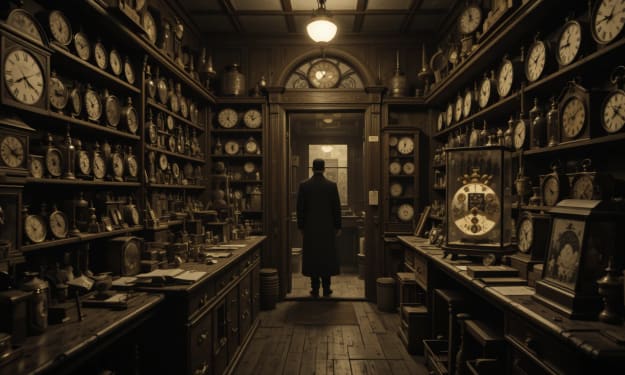
The Clockmaker’s Secret
The town of Haverford was the kind of place where secrets grew like moss—quietly, persistently, unnoticed until they covered everything. Tucked between rolling hills and a river that whispered more than it roared, it was a town that time seemed to have forgotten. And in the heart of Haverford, on a cobbled street lined with sagging storefronts, stood Elias Finch’s Clock Shop, its faded sign creaking in the wind.
By Shohel Rana8 months ago in Fiction
The Hollywood Assassin
The crowd roared as The Crusher jumped off the steel cage and delivered a devastating double ax handle to the back of Jim Connors. The Crusher pinned Jim. The cage raises and out comes The Hollywood Assassin, C-Rob. He is stacked and handsome. He wore blue jeans, black boots, and a long black trench coat. He also wore dark sunglasses and a dark bandana. He gripped the microphone.
By DJ Robbinsabout 8 hours ago in Fiction


Comments (1)
This story's got me hooked. Creepy whispers in an old museum? Sign me up! Can't wait to see what Lila discovers behind the painted-over mural.