
The Clockmaker’s Secret
A forgotten shop in a sleepy town holds a mystery that unravels time itself.

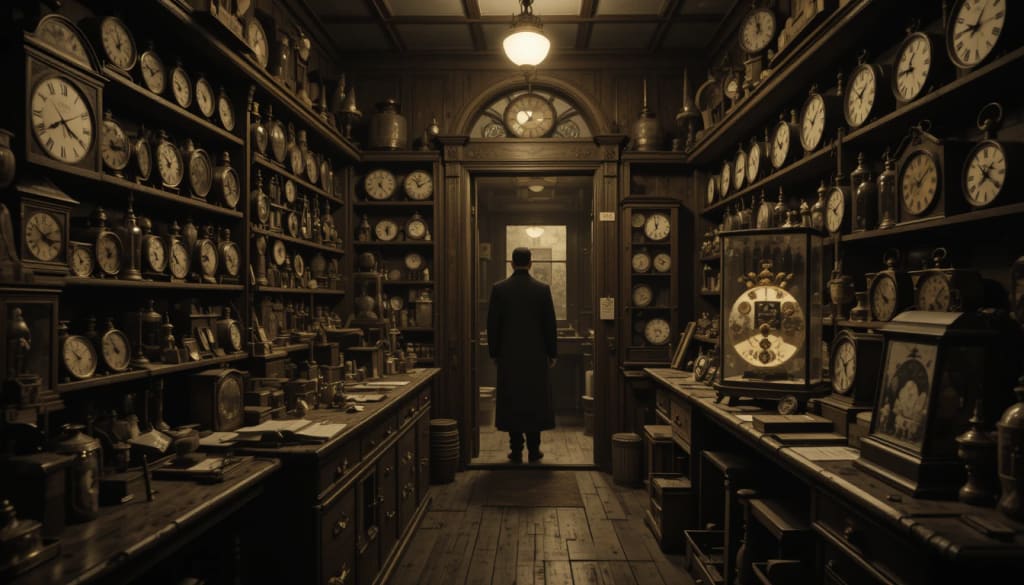
The town of Haverford was the kind of place where secrets grew like moss—quietly, persistently, unnoticed until they covered everything. Tucked between rolling hills and a river that whispered more than it roared, it was a town that time seemed to have forgotten. And in the heart of Haverford, on a cobbled street lined with sagging storefronts, stood Elias Finch’s Clock Shop, its faded sign creaking in the wind.
Elias Finch was a man of precise habits and imprecise age. To the townsfolk, he was as much a fixture as the church steeple or the oak in the square. His shop smelled of polished wood and old brass, and its walls ticked with the heartbeat of a hundred clocks, each one slightly out of sync with the others. Elias, with his wire-rimmed glasses and ink-stained fingers, was always there, tinkering, winding, repairing. But no one could recall the last time anyone bought a clock. Or when Elias last left his shop.
Clara Monroe, a journalist with a knack for finding stories where others saw only dust, arrived in Haverford on a rainy Tuesday in October. She was 29, restless, and chasing a story to salvage her faltering career. Her editor at The Coastal Herald had scoffed when she pitched a piece on small-town mysteries, but Clara had a hunch. Haverford, with its eerie quiet and whispered tales of “the clockmaker,” felt like the kind of place that hid something worth finding.
Her first stop was the town’s diner, a greasy spoon called Mabel’s. The waitress, a woman with a perm and a name tag reading “Doris,” poured Clara’s coffee with a skeptical glance. “You’re here about Finch, aren’t you?” Doris said, wiping her hands on her apron. “Folks say he’s got secrets older than the hills. But you won’t get much out of him. He don’t talk.”
Clara smiled, undeterred. “I’m good at getting people to talk.”
Doris snorted. “Not Elias. He’s like one of his clocks—keeps to himself, always ticking.”
By noon, Clara stood outside the clock shop, peering through its grimy window. The interior was a labyrinth of gears and pendulums, bathed in the soft glow of a single lamp. She pushed open the door, a bell jingling faintly. Elias looked up from his workbench, his eyes sharp behind his glasses.
“Miss Monroe, I presume?” His voice was soft, like the rustle of old paper. Clara froze. She hadn’t told anyone her name.
“How did you—”
“Small town,” Elias said, returning to his work. “News travels faster than you’d think.”
Clara recovered quickly, her journalist’s instincts kicking in. “I’m writing a story about Haverford. People say your shop is… special. I’d love to hear about it.”
Elias’s hands paused over a pocket watch, its face engraved with strange symbols. “Special? It’s just a shop. Clocks, watches, time. Nothing more.”
But Clara wasn’t so sure. Over the next few days, she returned to the shop, each visit revealing a new layer of mystery. Elias was polite but guarded, answering her questions with vague pleasantries. Yet she noticed things: a clock that ran backward, its hands spinning counterclockwise; a ledger on the counter with names and dates stretching back centuries; and, most curiously, a locked door at the back of the shop that Elias never opened.
One evening, as rain battered the windows, Clara lingered past closing time. Elias was distracted, adjusting a grandfather clock that chimed an unsettling melody. She seized her chance, slipping behind the counter to peek at the ledger. The pages were brittle, the ink faded but legible. Names like “Abigail Harrow, 1743” and “Thomas Vane, 1821” were scrawled alongside cryptic notes: “Fixed, time restored” or “Lost, time forfeit.” Her pulse quickened. What did it mean?
“Miss Monroe,” Elias said, his voice startlingly close. She slammed the ledger shut, her face flushing. He didn’t look angry, only… sad. “Some things are better left alone.”
“What are you hiding?” Clara asked, her voice steady despite her racing heart. “What’s behind that door?”
Elias sighed, his shoulders sagging. “You’re persistent. Too persistent, perhaps.” He hesitated, then pulled a key from his pocket. “Come. But don’t say I didn’t warn you.”
He led her to the locked door, its wood carved with symbols that matched the pocket watch. The key turned with a heavy click, and the door creaked open to reveal a narrow staircase descending into darkness. Clara’s stomach churned, but curiosity pulled her forward.
The basement was nothing like the shop above. The air was thick, almost liquid, and the walls pulsed with a faint, golden light. In the center stood a massive clock, its face the size of a wagon wheel, its hands frozen at 11:59. Gears whirred softly, not like machinery but like something alive. Clara’s breath caught. “What is this?”
Elias’s voice was barely a whisper. “The Chronomancer’s Clock. It doesn’t just keep time—it controls it.”
He explained, his words slow and deliberate. Centuries ago, a clockmaker named Alaric Finch, Elias’s ancestor, had discovered a way to manipulate time. Not just measure it, but bend it, stretch it, even steal it. The clock in the basement was his creation, a machine that could grant extra hours, days, even years to those who paid a price. But every gift of time came at a cost—someone else’s time was taken. Alaric had used it sparingly, helping those in desperate need, but his descendants weren’t always so noble.
“I’m the last,” Elias said. “I swore to guard it, to keep it from falling into the wrong hands. But people still come. They beg, they plead. And sometimes…” His voice cracked. “Sometimes I can’t say no.”
Clara’s mind raced. The ledger, the names, the cryptic notes—it all made sense. “You’re giving people time? Stealing it from others?”
Elias nodded. “It’s a balance. A life for a life. A day for a day. I try to choose wisely, but it’s a heavy burden.”
She thought of the pocket watch, the backward-running clock. “And the clocks upstairs? Are they part of it?”
“Some,” he said. “They’re… anchors. They hold the stolen time, keep it stable. But they’re breaking down. Time is leaking.”
Clara’s journalistic instincts screamed to expose this, to write the story of a lifetime. But another part of her, the part that saw the pain in Elias’s eyes, hesitated. “Why show me this? Why trust me?”
“Because you’re here,” he said simply. “The clock chooses who sees it. It brought you to Haverford.”
Her heart pounded. “What happens if it breaks completely?”
Elias’s face darkened. “Time unravels. Past, present, future—they collide. Haverford would be the epicenter, but it wouldn’t stop there.”
Clara spent the next week digging deeper, torn between her duty as a journalist and the weight of what she’d learned. She interviewed townsfolk, piecing together stories of miracles and tragedies—people who’d lived impossibly long, others who’d vanished without a trace. At night, she dreamed of the Chronomancer’s Clock, its ticking echoing in her skull.
Then, one morning, the shop was empty. Elias was gone. The clocks were silent, their hands frozen. The ledger was missing, and the basement door was sealed, as if it had never existed. Clara searched the town, but no one seemed surprised. “That’s just Elias,” Doris said at the diner. “He comes and goes.”
Desperate, Clara broke into the shop that night, prying open the basement door with a crowbar. The clock was still there, but its light was fading, its gears grinding sluggishly. A note lay on the floor, written in Elias’s precise hand: “The clock is yours now. Guard it, or destroy it. Choose wisely.”
Clara stood frozen, the weight of centuries pressing down on her. She could destroy the clock, end its dangerous power forever. Or she could guard it, like Elias, and bear the burden of choosing who gained time and who lost it. The journalist in her wanted to expose it, to let the world decide. But what if the world wasn’t ready?
As dawn broke, Clara made her choice. She didn’t know if it was the right one, but it was hers. The clocks upstairs began to tick again, softly, like a heartbeat.
About the Creator
Shohel Rana
As a professional article writer for Vocal Media, I craft engaging, high-quality content tailored to diverse audiences. My expertise ensures well-researched, compelling articles that inform, inspire, and captivate readers effectively.
Reader insights
Nice work
Very well written. Keep up the good work!
Top insights
Easy to read and follow
Well-structured & engaging content
Excellent storytelling
Original narrative & well developed characters
On-point and relevant
Writing reflected the title & theme
Keep reading
More stories from Shohel Rana and writers in Fiction and other communities.
The Library of Unread Books
Wren Harbor was a town that clung to the edge of the world, its cliffs battered by salt and storm. The kind of place where the sea told stories and the townsfolk pretended not to listen. Tucked behind the main street, where fishermen swapped lies and tourists bought overpriced lobster rolls, stood the Wren Harbor Library. It wasn’t on any map, and most locals swore it didn’t exist. But Nora Caldwell, a bookseller with a nose for trouble, had heard the whispers.
By Shohel Rana8 months ago in Fiction
Tall Timmy & the Top Hat
Timmy wasn’t just short—he was the shortest seventh grader in his class. In his school. In his town, even. He had to stand on his tippy toes to reach the faucet in the restroom. He had to suck in his breath and reach for his lunch tray until his back cracked. He had to find small windows of space in the horde of classmates during dismissal, just to spot his mom’s car. She frequently circled the pick-up line, as if she were a fixture on the worst carousel ever.
By SUEDE the poet5 days ago in Fiction




Comments (2)
I like the concept behind this, I wished to see what choice Clara made, but leaving it ambiguous is interesting.
This town sounds mysterious. Can't wait to see what Clara discovers about Elias and his shop.