
The Room That Moved On
A man finally enters the room he has avoided since his father's death, only to discover not a shrine to the past but a space that has quietly continued living without him — forcing him to face a grief that moved forward while he stayed still.

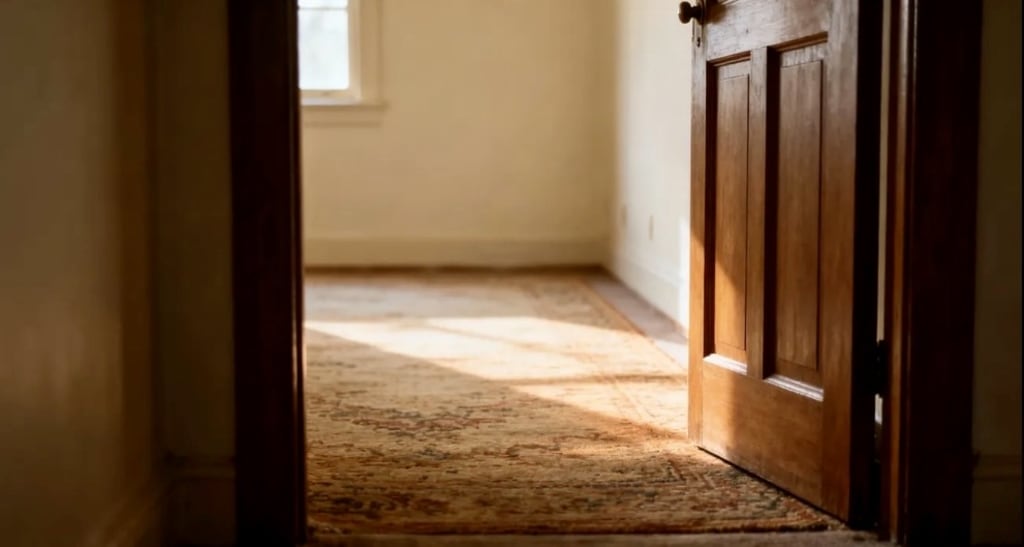
I hadn't opened the door in six years.
It wasn't because I couldn't. The handle still turned. The hinges still worked. I knew this because I checked sometimes — late at night, when the house went quiet and my hand drifted to the brass knob the way a tongue finds the socket where a tooth used to be. I'd feel it give, feel the door ready to swing open, and then I'd walk away.
No one locked the door.
No one needed to.
It was the estate agent who forced it. She stood in the hallway with her clipboard and sensible heels, looking at the house the way people look at weather — politely, impersonally, expecting no complications.
'And this room?' she asked.
'Storage,' I said.
'I'll need to photograph it for the listing.'
I could have lied. Said it was unsafe, full of asbestos, structurally compromised — anything to make her step back. But she was already reaching for the handle, and I understood, in a sudden quiet way, that this was how it would happen. Not with courage.
With someone who didn't know there was something to fear.
'Wait,' I said. 'I'll do it.'
She stepped aside with the soft, practised patience of someone who has seen grief pressed invisibly into door frames, bannisters, and the places where people pause before entering kitchens.
'Take your time,' she said.
I thought it would smell like him.
That was the thing I had braced for all these years: his aftershave trapped in the fibres, the tobacco-and-woodsmoke scent that clung to his coats, the ghost of him reaching through the air to close a fist around my chest.
But the room smelled like nothing.
Like air.
Like a window left open in a house that no longer belongs to anyone.
I stood in the doorway and understood.
The curtains had faded — not dramatically, not the sepia rot of abandoned houses — just softened. Navy surrendering into something closer to dusk. Six years of afternoon sun had done what afternoon sun does. The curtains had accepted change.
I had not.
The books on his shelf had shifted. Humidity, seasons, the slow respiration of a house left to its own devices. A paperback had pitched forward, resting against the others like a commuter asleep on a train.
A spider had claimed the corner. He'd never have allowed it — he patrolled ceiling corners with a duster, waging small, earnest wars against disorder. Now a web stretched across the plaster, catching the light like spun glass. The spider didn't know this room used to belong to someone else.
Why would it?
The carpet had changed its mind too. Lightened where the sun touched it, darkened where the furniture used to cast shadows. A quiet map of years spent rearranging itself in my absence.
I walked to the window. The light fell across my hands in a way it never had when he was alive; the tree outside had grown, shifting the angle of everything. The room was receiving a different sun now — one he never saw.
The room had aged.
The room had grieved.
The room had kept going.
I sank into the armchair. The leather gave differently — soft in new places, stiff in others — reshaped not by his body, but by the slow forgetting of his weight.
I realised, with a small, clean pain, what had truly terrified me.
That he hadn't been here for a long time.
That the room had done the thing I couldn't —
it had let him become past.
I opened the desk drawer.
The letter was waiting.
I don't know how I missed it in those early days when I touched everything he touched, searching the house like a diver running out of air. Maybe I wasn't the right person yet. Maybe the letter needed to wait for the version of me who could bear to open this room.
Son,
If you're reading this, I'm gone, and you're still standing in doorways. I know you. I know you'll try to keep this room exactly as it was — the books precisely aligned, the chair angled just so, the cobweb you'll ignore because I'm not there to knock it down.
Don't.
Let the curtains fade.
Let the light move.
Let the room change into something I never got the chance to see.
That isn't forgetting.
That's living.
And I need you to live.
Rooms move on.
They have to.
They're for holding life, not freezing it.
Go with it.
Please.
Let the sun in.
The estate agent was still waiting when I stepped back into the hallway. She looked at me — whatever version of me I'd become — and lowered her clipboard.
'We can list it next month,' she said softly. 'There's no rush.'
'No,' I said. And I meant it in a way I hadn't meant anything in years.
'It's ready.'
I turned back to the doorway. The room was just a room now. Faded fabric, a settled carpet, and one brave spider who would never know the history of its chosen corner.
I opened the window.
December air swept in — sharp, alive, indifferent. It moved through the room like a held breath released at last. Dust rose, danced, landed in new places it had spent years waiting to discover.
The room hadn't been waiting to be preserved.
It had been waiting to be opened.
He'd been waiting.
I stepped out into the hallway.
And for the first time in six years, I left the door open behind me.
The sun moved. This time, I moved with it.
About the Creator
Edward Romain
BBC-featured poet | Author of Lost Property | 10.9K+ on Instagram | Writing for the ones who still feel everything.
Keep reading
More stories from Edward Romain and writers in Fiction and other communities.


Comments
There are no comments for this story
Be the first to respond and start the conversation.