

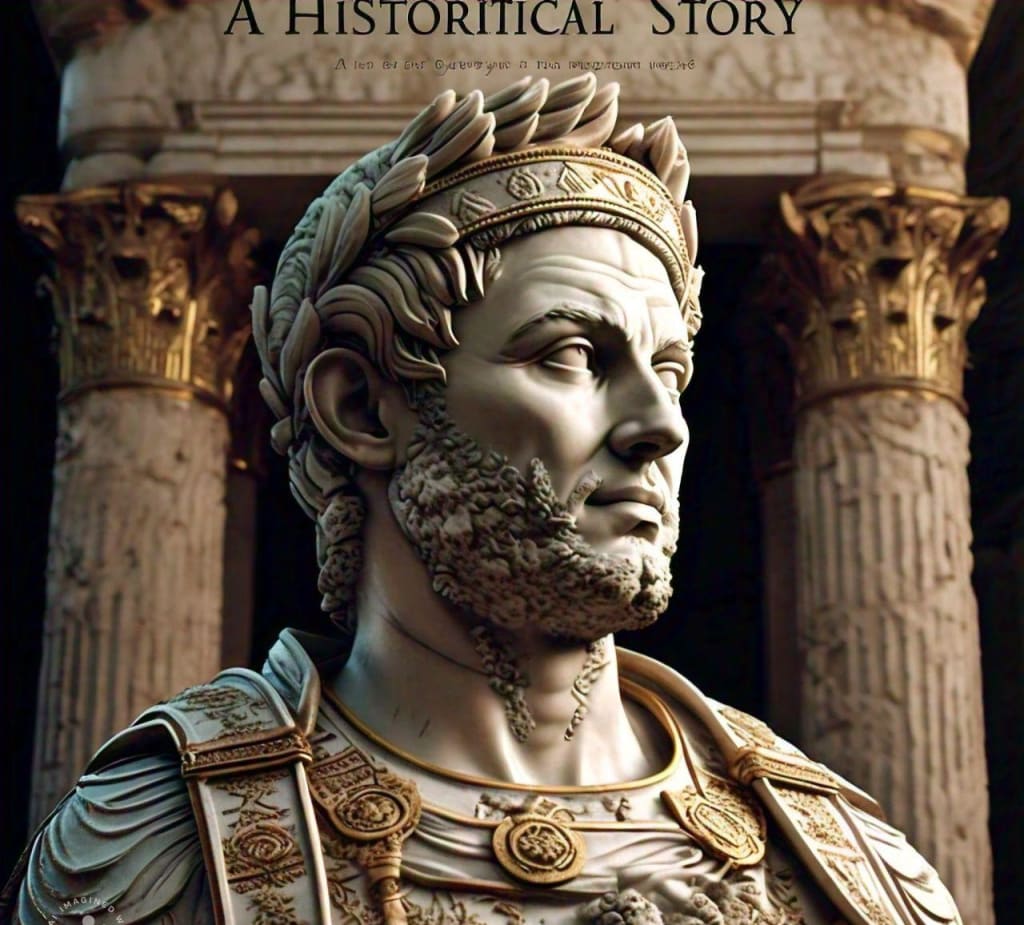
The light from the candle flickered in front of me, casting shadows that danced across the walls of my chamber. The silence was oppressive, broken only by the soft rustle of parchment. I was alone, yet the weight of the empire bore down on me.
Before me, maps of our vast territories lay spread, marking the places where our control was faltering. The Barbarians from the north grew stronger by the day, their threats a constant reminder of our vulnerability. The plague that had ravaged our cities left death and despair in its wake.
But it was not the external chaos that troubled me most — it was the tempest within. I had studied the teachings of the Stoics, learned that nothing in this world could be controlled, not even the wind or the sea. The only thing I could command was my own actions, thoughts, and soul.
A faint creak of the door announced the arrival of one of my most trusted generals, Caesar. His heavy footsteps betrayed his unease.
“The council awaits, Caesar,” he said, his voice low and respectful.
I nodded, but remained seated, lost in thought. The council had debated for hours, each member convinced their solution would restore the empire. But I knew better. There were no simple answers.
“Tell me, Caesar,” I asked, my gaze still fixed on the candle, “do you ever feel the weight of everything — the responsibilities, the threats, the endless battles?”
He hesitated, clearly uncomfortable. “Yes, Caesar, but I have faith in your leadership and that of your men.”
I smiled wryly, the gesture feeling empty. Faith in myself or faith in the illusion that I could control the uncontrollable?
A brief silence hung between us before Caesar spoke. “You have led us through many trials, Caesar. We will overcome this too.”
I turned to face him, his expression etched with concern. “Strength, yes, but what does strength mean? Is it the ability to vanquish our enemies or to remain unbroken in the face of adversity?”
Caesar shifted uncomfortably. “Perhaps it’s both.”
I rose, walking to the window, and gazed out at the city below. The streets were quiet now, but I knew chaos lurked beyond the walls.
“They understand something most men do not,” I whispered. “We cannot control the events that befall us, but we can control how we react to them.”
Caesar’s eyes reflected confusion.
As I entered the council chamber, the room fell silent. Senators, generals, and advisors waited for my words, their faces tense with anticipation.
“The situation is dire,” Perx, one of my advisors, broke the silence. “The plague spreads, and the Northern tribes advance. We must act decisively.”
Murmurs of agreement rippled through the room, but I remained still, studying the map before me.
Another general spoke, advocating for an early attack against the northern tribes. “We must show Rome’s strength and crush their threats.”
I met his gaze. “Defensive action may be necessary, but it won’t address the root of our problems. The world will continue to throw obstacles in our path, no matter how many battles we win or how severe the pandemic.”
I turned to Caesar. “What do you think?”
He paused before responding, “We should attack, Caesar. We cannot appear vulnerable.”
I regarded him thoughtfully. “Strength is not measured by the number of battles we win, but by how we endure the battles we cannot.”
The room fell silent once more, each man lost in contemplation.
To determine Rome’s future, a new generation of leaders arose, forged in the furnace of conquest and corruption.
PHASE ONE END
SUMMARY
Caesar, a powerful leader, finds himself feeling the weight of the empire’s collapse as the North’s Barbarians become more powerful. The plague has destroyed cities and left a path of death in its wake. Caesar, however, has faith in his leadership and the strength of his men. The council discusses methods and plans to restore the Empire, but Caesar acknowledges that the world is beyond their control. The council agrees on a course of action, but they must accept that the world will act as it will and prepare for the inevitable.
Perx, a powerful leader, believes that the only way to conquer a difficulty is to crush it beneath one’s heel. Caesar, however, argues that strength is measured by how they endure the battles they cannot win. The rest of the council considers Caesar’s proposal, but some still remain unsure. To determine Rome’s future, a new generation of leaders arose, forged in the furnace of conquest and corruption.
AWAIT PHASE TWO: “BEYOND THE WALLS”
COMING SOON…
About the Creator
Timothy Emeh
"sunset chaser / storyteller / Fuelled by curiosity & coffee"
Keep reading
More stories from Timothy Emeh and writers in Fiction and other communities.
The Weight Of Empire
The light from the candle flickered in front of me, creating shadows that moved along the walls of my room. I was by myself, and the only sound that broke the thick silence was the faint rustle of parchment. The empire was enormous, with borders that stretched far beyond what any human could manage, but even so, here I was, feeling its weight pressing down on me. I stared at the maps that were laid out on the table, hastily marking the locations where the empire had started to break apart.enemies from the north's Barbarians were becoming more powerful by the day.
By Timothy Emehabout a year ago in BookClub
The Devil's Cut
“Comrade, finally you’re awake.” The voice was smooth, sensual. A flickering incandescent bar was all that lit the white, sterile room. All Vladimir remembered was everything going black. He tried to move his arms and found them strapped to the gurney.
By Matthew J. Fromm4 days ago in Fiction
How To Save Your Life With A Glass of Water
Step 1. Acknowledge the smallest solvable problem I can tell you are reaching for the big stuff, saying something like—“If I could just quit drinking…” or “If my mother had never died…” or “If I wasn’t single…”—these are not what I am talking about.
By Aubrey Rebeccaa day ago in Fiction


Comments (3)
This edition is for the learned
When is coming?
This is nice can't wait for phase 2