
How To Save Your Life With A Glass of Water
The Instructions That Saved Me

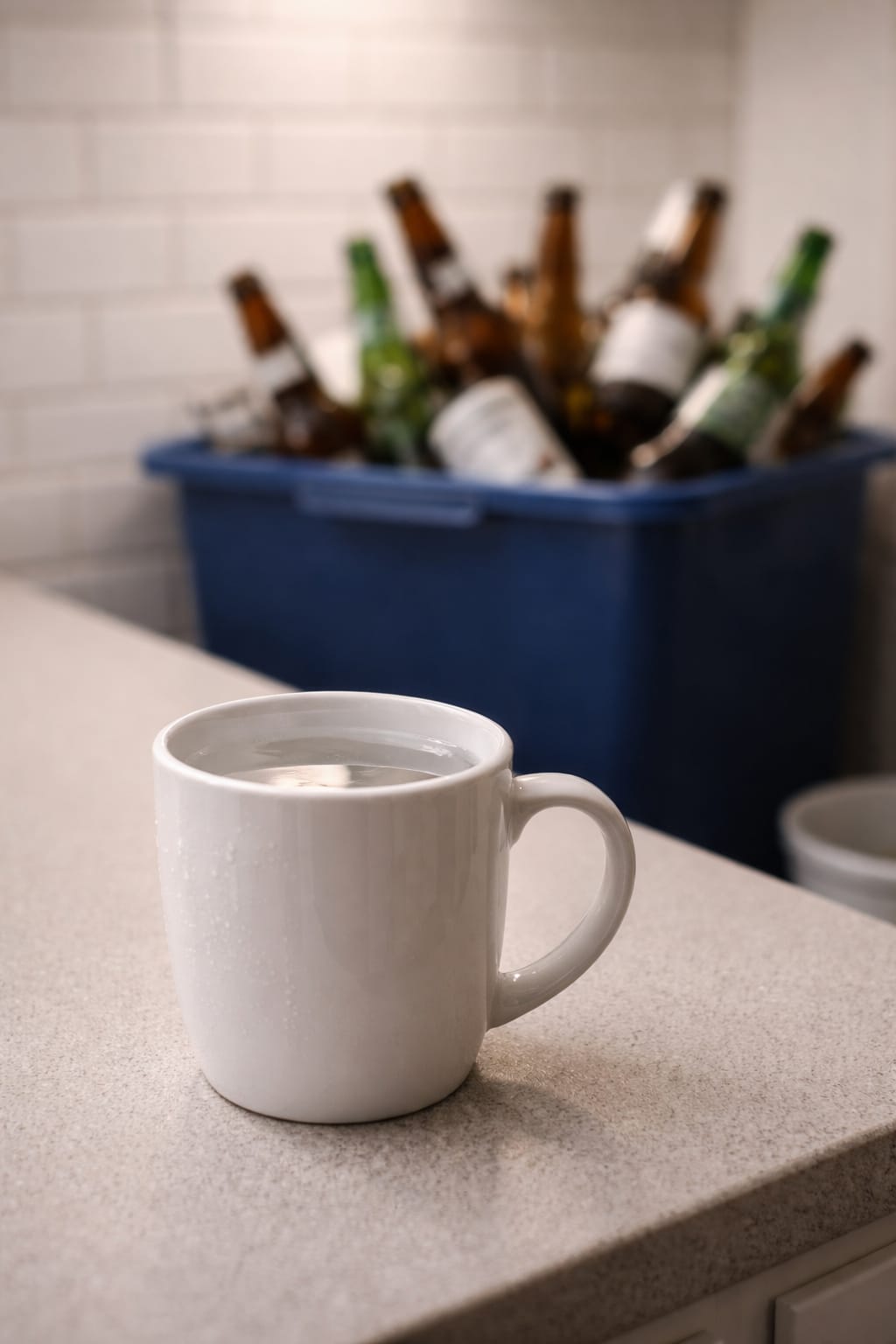
Step 1. Acknowledge the smallest solvable problem
I can tell you are reaching for the big stuff, saying something like—“If I could just quit drinking…” or “If my mother had never died…” or “If I wasn’t single…”—these are not what I am talking about.
Think tiny.
Perhaps such a problem is that each morning you wake up hungover beyond belief—headache, nausea, the whole nine yards. Now, the hangover is too big to tackle here, but amidst the hangover, you notice you are so thirsty. You stumble into the kitchen and pour a cup of coffee, but it doesn’t help ease the thirst.
Start there.
Problem: I am so thirsty when I wake up.
Step 2: Choose the smallest, easiest possible intervention.
This is not a time to dream up sweeping solutions.
Throw the ideas of IV drips, green juice, or becoming someone new in the trash.
If you are waking up hungover every day, I’d recommend that you start with a glass of water.
Step 3: Make it impossibly easy
You are judging this step, rolling your eyes, saying, “Aubrey, it’s just a glass of water; how hard can that be?”
Before you click away, I ask: if it were that easy, why haven’t you done it?
Make it easier.
List out the steps of your proposed solution—every. tiny. step.
Steps to a glass of water:
- Wake up thirsty
- Walk to the kitchen
- Open the cabinet
- Choose a glass
- Close the cabinet
- Turn on the sink
- Wait until the water is at the desired temperature
- Fill the glass
- Turn off the faucet
- Drink the water
That’s ten steps for a single glass of water—not as easy as you thought.
Now, consider how you can reduce the steps to as few as possible.
We know you already drink coffee in the morning, so you decide you’ll drink water out of the coffee mug while the coffee brews.
That decision saves you 4 steps. Drinking room-temperature water saves you 5.
The fewer steps required, the more likely this is to save your life.
So, you drink tepid tap water from a coffee mug each morning.
Step 4: Find Your Body in the Experience
A glass of water before your coffee can bring up a lot of feelings—indignation, petulance, relief, gratitude, nausea. Pay attention to them for just a second.
No need to write them down or catalogue them. Just a fleeting awareness is enough.
Maybe your dry mouth is less sticky, or you notice how bad your breath tastes.
How exciting to notice!
If it would make you feel better, you can brush your teeth. But you don’t have to. We are not solving the teeth-brushing right now.
You are focused on drinking a glass of water.
Step 5: Don’t Stop.
Make a point to drink your glass of water every day.
Now you have paid attention to what drinking water feels like. That will make the rest of this a little easier. After all, your body wanted the water; you know that now.
What a relief to meet your own needs.
When you are in a rush or sleep somewhere else and are out of your routine, you might forget to drink water. At 10 am, your mouth is unusually dry, your head is pounding, and you realize you’ve had no water.
You drink some and move on.
But you felt in your body how thirsty you were, and you did something about it in the moment. Remember all those years when you didn’t?
Without meaning to, you drink more water throughout the day because you understand how your body tells you it is thirsty.
You might realize Diet Coke and water are not the same thing.
That’s fine, great even, but your goal is still just to drink the first glass of water.
Anything else that happens is extra. Don’t focus on it. Not yet.
You are learning that care and hydration are allowed. You didn’t know that before.
If you had, you would have been drinking water all this time.
Give yourself time.
Step 6: Find Another Problem
When you really, really have the routine of drinking water down, you can think of another problem. Choose something you can tie to that first solution.
For example, your mom has been telling you for a decade that you should take a multivitamin because you don’t eat well, and all the drinking isn’t helping your health. Next time she brings it up, you want to be able to tell her you already take multivitamins.
So you choose that.
You know what to do; you map the steps.
Plan: You will put the bottle of vitamins on top of the coffee maker and take one with your morning glass of water.
Step 7: Try Your New Solution On
Use your new system, note if there are places it falls apart. Most importantly, check in with your body.
Multivitamins don’t induce euphoria, but you might feel gratitude or relief. Or maybe a newfound moral superiority over everyone who doesn’t take vitamins. After all, you’ve been taking them for three days now.
Later, you’ll learn your decisions aren’t moral indicators.
For now, you are allowed superiority because it helps you take your vitamins. And taking your vitamins gives you one less thing to accuse yourself of.
Step 8: Ask For Help
When the new, new habit is automatic, and you find you haven’t dropped the first one, go back to the list of the tiniest problems.
The more problems you solve—in this slow, sustained way—the more confidence you will have in your own abilities.
It’s possible you now notice that you want to read more. You consider your solutions and decide to get a library card and check out one novel.
You are anxious that you won’t actually read it, but you do it anyway.
Now that you are building a little self-confidence, you might stop using every action as a barometer for your worth. You realize that you may bring the book back unread if you don’t get to it, and that doesn’t make you bad.
After a few times checking out and returning books unread, you realize that sitting down to focus and read is hard because of your schedule or your dyslexia or your screaming children.
This is where you ask for help for the first time. You won’t even realize you are asking for help at first; you will think you are complaining, but someone will notice that you are asking for help and offer some solutions.
Someone might show you the library audiobook app, or offer to babysit the children, or buy you noise-cancelling headphones. You’ll try these solutions begrudgingly, even if you pretend to be grateful.
But then some solutions help, and you really are grateful.
Step 9: Trust
Now you’ve been doing this for a while—a year, possibly more. An incremental internal shift has happened. You’ve shown yourself to be trustworthy. You listen to what you need (water, enrichment, community involvement) and find solutions consistently.
Maybe you still fall prey to wanting to overhaul your life, but you’ve realized that those attempts don’t work. So, you maintain these tiny habits.
You always start your day with a glass of water and vitamins.
You realize you are at least a little trustworthy because you keep doing it.
With that self-trust, you start to hear the voice in your head and how it speaks to you. You listen to your normal voice and realize how you speak about yourself.
You hear how often you say “I’m sorry” when you mean “Pardon me” or “Thank you for your patience,” or nothing at all, because actually the other person walked into you.
Or perhaps you notice how nasty you are to yourself. How you tout that people call you a bitch because you don’t know what else to say about it.
You realize you insult yourself to make others laugh.
The voices, internal and external, propel you through the world, shaping your reality, and until now, you probably haven’t spent a lot of time actively listening to them.
When you do, you find you talk about yourself unkindly.
Just as you notice you are thirsty when you get out of bed, so you drink the water, you notice your self-talk, and you try on solutions.
You start sarcastically saying nice things about yourself when you normally would be mean. Or you don’t say the word “sorry” when you don’t mean it. Or you try to make yourself say three nice things about yourself every time you have a mean thought.
You might say that you have solved no massive problem, but I promise you have solved the biggest one —you are learning to question your inner dialogue.
Step 10: Fail without collapse.
Now that you have learned to listen to that mean little voice in your mind, you might see how many of the stories you tell yourself revolve around failure. You consider most of your life a failure, even though you have done many things that disprove this.
You must address this before continuing with the final steps. If you buy into the narrative of failure, you will eventually discard all the progress you have already made.
It doesn’t matter what your mom, or grandma, or 5th-grade teacher said. Your decisions do not make your soul good or bad.
When you focus on “failure,” or “badness” (yours or others), you are deciding it’s decided, immovable. It is a scapegoat used to justify not changing anything. It lets you say, “I am allowed nothing good because…I did bad things/my mother died/my husband left/the world is a big, terrible place and I have no control.”
So, consider a scenario where you will want to reach for the failure narrative.
Let’s say you realize you want to be more active.
The big problem is that you want to lose 40lbs, or your doctor told you your heart is under stress from your sedentary lifestyle, or all your friends have inexplicably started running marathons, and you’re left out.
The smallest problem: you want to move more.
So, you start at the beginning and make a plan. Then you hate it. You avoid it and procrastinate. You complain about every run you force yourself on.
This is where you need to remember: decisions that do not harm anyone else are always morally neutral.
If we see things as ethically neutral, you can shove the running shoes in the back of the closet and try something else—walking, yoga, spin class, CrossFit, Pilates, pole dancing.
Listen to yourself when you hate something. Then move on.
Step 11: Unexpected Forgiveness
You will hate me for this one, but I would be remiss not to bring it up. You need to know it’s coming.
Once you have built enough self-trust, you will start to forgive yourself.
You won’t realize you’re doing it at first. You’ll fight against it. Somewhere in your mind, you had a rule that you could not forgive yourself or consider yourself good or trustworthy because if you did, that means everyone could. Even your abusive ex-husband, or your lying sister, or that person you saw on TV who did heinous things.
You are not the moral adjudicator of the world. Your self-forgiveness has no impact on others.
Against your will, forgiveness will creep in.
At first, you will forgive yourself only for not enjoying running.
Eventually, you will forgive yourself for much greater wrongs. Without setting out with this intent, you realize that even when you did things wrong; you were doing your best with the tools that you had.
Of course you were, because look at how you try your best now.
You forgive yourself for your mother dying, or your father beating you, or your classmates not liking you. You’ve been holding yourself responsible for these things for a long time.
Then, one day, you wake up and you aren’t.
I won’t speak on the forgiveness of others here, though I expect that in self-forgiveness you will also find unexpected forgiveness for all those people who broke your heart and bones.
Right now, we are focusing on you.
When you forgive yourself, it allows you to try more new things with less shame. It becomes easier to identify the problems in your life and tackle them because a problem no longer feels like it makes you “bad.”
The problems you trust yourself to solve get bigger. You realize maybe you can stop drinking, or find a new job, or ask for a divorce.
But your action—your focus—remains: when you wake up, you drink your mug of water.
Step 12: Notice All the Love
This will happen long after you’ve forgotten this manual, when all the routines and work you did in steps 1-11 have become rote.
But one day you will look around at a group of people who treat you a little better than before. They always loved you, but it feels different now. You realize you ask for help automatically when you used to insist on doing everything yourself. You will go through a difficult time, and people will be there to hold you through it.
This will startle you. You might automatically revert to your old thinking, rehashing how you aren’t worthy of all this love and care.
Then you will remember the water, the vitamins, the day you got sober, and the first day you cried without fighting it. You will remember the trust you’ve built.
It will dawn on you that this version of your life is irreconcilable with who you used to be. Your body will remember you taught it to accept care, to trust.
And someone will tell a joke, or your dog will want a treat, and life will move on, but in your heart you will know you are loved.
And without thinking, in the morning, you will pour yourself a glass of water.
About the Creator
Aubrey Rebecca
My writing lives in the liminal spaces where memoir meets myth, where contradictions—grief/joy, addiction/love, beauty/ruin—tangle together. A Sagittarius, I am always exploring, searching for the story beneath the story. IG: @tapestryofink
Keep reading
More stories from Aubrey Rebecca and writers in Fiction and other communities.
Remediation Required. Honorable Mention in The Forgotten Room Challenge.
My hangover throbs behind my eyes, and my breath tastes sour. I take a swig of water and collapse on the couch, craving rest and relief. As soon as my eyes close, time and space melt away, and I am falling.
By Aubrey Rebecca2 months ago in Fiction
How to fill a hot water bottle. (Or, How to get through the night.)
1. Go to the cupboard where you keep all the towels and sheets. It's at the top of the stairs. Take a deep breath and roll your shoulders back. For this will take some effort. Reach up and dig into the mountain of materials. Past the scratchy towels, the creased sheets, the mismatched pillowcases, the marooned sock. Keep feeling until you find something somewhat soft. There might be a bit of matting from lack of use. With a slight hardness underneath. Grab onto it. Firmly. Begin to start pulling it out of its hole. Like a game of Jenga, don't let the mountain get on top of you. It helps to use one hand for steadying the mountain and the other hand for gripping on to the hot water bottle. Carefully slide it out. Take your time.
By Sarah O'Gradya day ago in Fiction




Comments
There are no comments for this story
Be the first to respond and start the conversation.