

The Weaver’s Secret
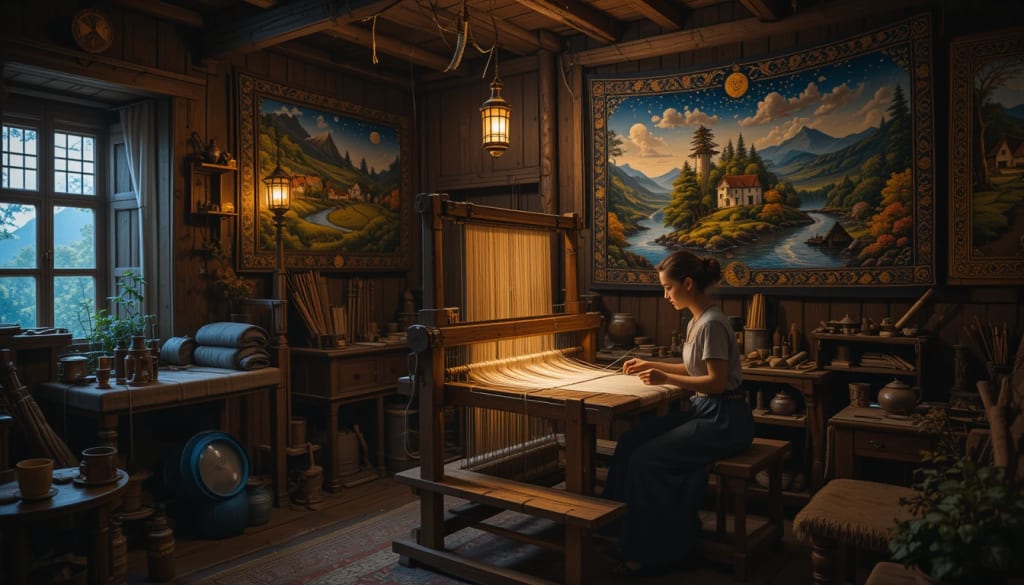
The air in our village always carried the faint hum of looms, a rhythm as steady as the river that curved through the valley. I was Anika, seventeen, with ink-stained fingers and a habit of daydreaming. My mother, Amma, was the village’s best weaver, her hands dancing over her loom like they were casting spells. Her tapestries hung in every home, their colors so vivid they seemed to breathe—scenes of festivals, forests, and skies that held stories no one could fully unravel.
“Anika, pay attention,” Amma would scold, her eyes sharp but kind as she taught me the craft. “The threads don’t just make cloth—they hold memories.” I’d nod, half-listening, my mind wandering to the city, where life seemed brighter, louder, freer. But every evening, when the sun dipped low and painted the valley gold, I’d sit by her loom, watching her fingers weave magic into warp and weft.
One autumn evening, when the air was crisp and the leaves glowed like embers, Amma told me a story I’d never heard before. We were alone in our small workshop, the loom’s creak mingling with the crackle of the fire. “Long ago,” she began, her voice soft as the silk she wove, “there was a weaver named Saira. She wasn’t just skilled—she was chosen. The threads she touched came alive, not with dye, but with time itself. Her tapestries could show the past, the future, even secrets the heart forgot.”
I leaned closer, the firelight flickering in her eyes. “What kind of secrets?” I asked.
Amma smiled, a rare, secret-keeping smile. “Saira wove a tapestry for a grieving widow, showing her husband’s last unspoken words. Another for a lost traveler, guiding him home through a storm. But her greatest work was a cloth that held the village’s soul—every joy, every sorrow, every dream. They say she hid it, fearing its power, and only a true weaver could find it.”
I laughed, thinking it was one of her tales to keep me at the loom. “So, where’s this magical tapestry now?”
Her eyes held mine, steady and serious. “Some say it’s still here, Anika. In the threads. Waiting.”
That night, I dreamed of a loom that glowed under starlight, its threads shimmering like rivers of silver. A woman—Saira, I knew—stood beside it, her hands guiding mine. “Weave with your heart,” she whispered, and I woke with a start, my fingers tingling as if they’d touched something alive.
Life went on, but Amma’s story lingered. The village was changing—factories in the city churned out cloth faster, cheaper, and people bought less of Amma’s work. She didn’t complain, but I saw the worry in her eyes, the way her hands lingered on the loom as if saying goodbye. I wanted to help, but I also wanted to escape—to study art, to see the world beyond the valley.
At nineteen, I left for the city, my sketchbook tucked under my arm. The city was a whirlwind—neon lights, crowded streets, galleries full of colors that rivaled Amma’s tapestries. I studied, I painted, I chased dreams. But at night, when the city grew quiet, I’d sketch her loom, the valley, the river. I missed the hum of the threads, the way Amma’s stories made the ordinary feel extraordinary.
Two years later, a letter came. Amma was ill, her hands too weak to weave. I returned to the village, the familiar scent of earth and river hitting me like a memory. The workshop was dim, the loom silent. Amma lay in bed, her face pale but her eyes still bright. “Anika,” she whispered, “the threads are calling you.”
I didn’t know what she meant, but I sat at her loom that night, the wood warm under my hands. The threads felt different—alive, almost, like they were waiting for me. I started weaving, clumsy at first, my fingers remembering lessons I’d half-forgotten. As I worked, something strange happened. The cloth began to shimmer, faint images forming in the weave—a child running through the valley, a festival under lanterns, Amma’s face smiling. I gasped, my hands trembling. Was this Saira’s gift?
I wove through the night, the images growing clearer. I saw the village’s past—weddings, harvests, storms that had shaped us. I saw Amma teaching me, her hands steady and sure. And then, a glimpse of something else—a future where the valley thrived, looms humming again, children laughing as they learned the craft. Tears stung my eyes. This wasn’t just cloth. It was us.
By morning, the tapestry was complete, glowing softly in the dawn light. Amma saw it and smiled, her hand squeezing mine. “You found it,” she said. “Saira’s secret. It’s not in the cloth—it’s in you.”
Amma recovered, slowly, and I stayed. The tapestry hung in the village square, drawing people from far and wide. They came to see the “miracle cloth,” but stayed for the stories, the community, the life we’d nearly lost. I started teaching the children to weave, their small hands eager and quick. The looms hummed again, and the valley felt alive.
Sometimes, when I weave late at night, I feel Saira’s presence—her quiet strength, her love for the craft. The threads still sing, carrying memories, dreams, and secrets. And I, Anika, am their keeper, weaving the past and future into every knot, every loop, every thread.
About the Creator
Shohel Rana
As a professional article writer for Vocal Media, I craft engaging, high-quality content tailored to diverse audiences. My expertise ensures well-researched, compelling articles that inform, inspire, and captivate readers effectively.
Keep reading
More stories from Shohel Rana and writers in Fiction and other communities.
The Clockmaker’s Gift
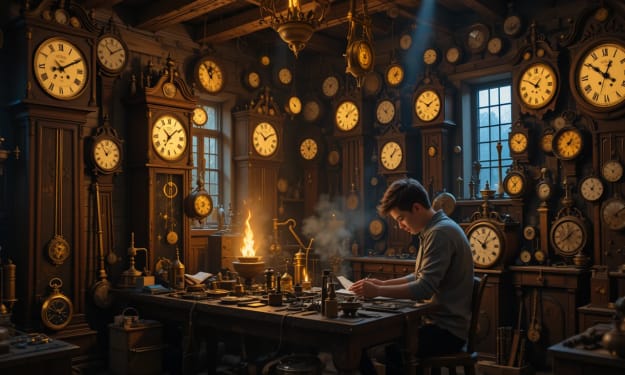
The Clockmaker’s Gift The village of Elderglow was tucked in a valley where time seemed to move slower, as if the mountains themselves held it gently in place. I was Ezra, sixteen, with a knack for fixing things—bicycles, radios, anything with gears. But my favorite place was Papa’s workshop, a cramped room filled with the tick-tock of clocks. Papa was the village clockmaker, his hands steady as they coaxed life into brass and wood. His clocks weren’t just timekeepers; they were art, each one humming with a rhythm that felt alive.
By Shohel Rana8 months ago in Fiction
The Devil's Cut
“Comrade, finally you’re awake.” The voice was smooth, sensual. A flickering incandescent bar was all that lit the white, sterile room. All Vladimir remembered was everything going black. He tried to move his arms and found them strapped to the gurney.
By Matthew J. Fromm7 days ago in Fiction


Comments
There are no comments for this story
Be the first to respond and start the conversation.