

Next morning, the global news was buzzing with the coverage of the Atlantis and the mostly finished housing. No one seemed to know how this new development was built there and why. News reports had not a single mentioning of the homeless solution disaster.
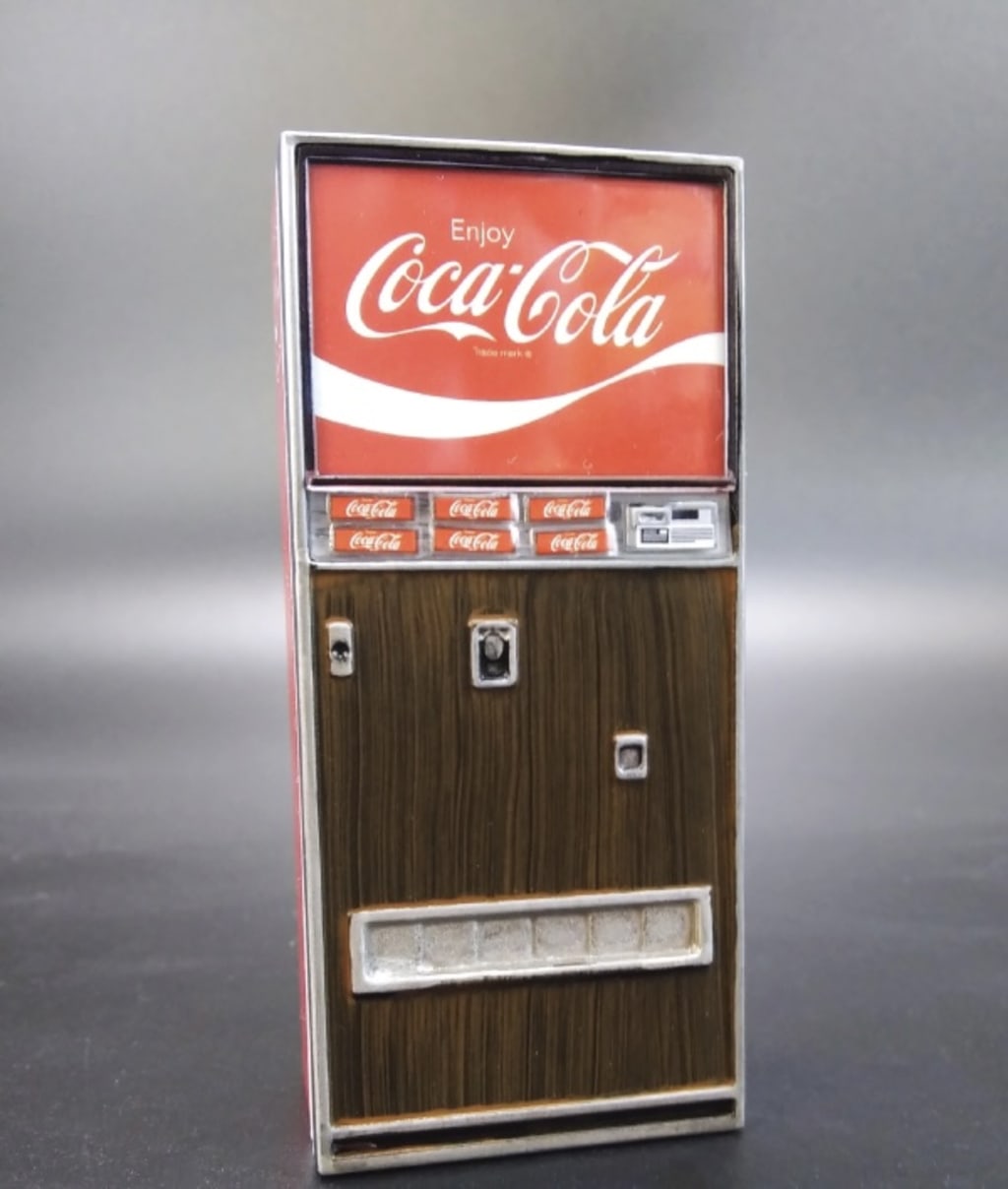
Ashton’s girlfriend Alice came back from Syracuse where she was visiting her parents. She was a little surprised when Ashton asked if she noticed any homeless people while changing trains in Manhattan. Because she didn’t remember, Ashton thought they must have been here. Alice was perceptive and observant, she probably would have noticed the absence of the homeless in the city streets. Ashton didn’t tell her anything about the vending machine as she had to run to her summer class. Besides, he didn’t know how to tell her, “Hey, babe, I’ve got my own Zoltar Fortune Telling Machine, but better. It gives out vintage Coke and global problem solutions!”
Ashton’s summer class had a field trip to Manhattan that day. As their train pulled into into the railway station, Ashton was relieved and breathed easier. “Who would have ever thought I’d be happy to see homeless people!” he thought to himself. He gave them money whenever they passed by a homeless person, and on the way back, while the class was waiting for the train, he ran into a Macdonald’s and bought a couple of meals for the two homeless guys he saw near the entrance.
When he returned to his dorm room, Ashton started to work on the field trip report right away, while it was still fresh in his mind. Without even thinking about it, he drank the Coke he’d bought from the vintage vending machine. Only when it was done, he turned it up and around and saw that small font again, “solve global poverty.” He wondered what magic trick that could involve.
In the evening, after he came back from work, and shared dinner with Alice, Ashton turned on the news on his computer. As he was searching through the news reports on YouTube, Alice noticed the two empty Coke cans next to Ashton’s computer.
“I thought we decided to lay it off with the Coke,” Alice reminded him gently of the agreement they both came to about three months before after they realized they were addicted to Diet Coke.
“Yeah, this one’s different, look closer” Ashton said, holding his breath for her not to notice the small font.
“Oh wow, it’s an old Coke, made in 1972!” Alice said, looking at the first can she held in her hand. “Where did you get it?”
“Long story,” Ashton said, “I’ll tell you later. Let’s watch the news.”
He clicked to play the local news report and was stunned to see the following:
“Breaking News: Global Poverty Solved!
Lead: In a stunningly unanimous decision, the International Tax Authority resolved to confiscate 95 percent of the wealth of one million richest people in the world, to create a 200-trillion-dollar Global Poverty Fund (flashy graphics showing one million people in the world owning over half of the world’s wealth estimated at 450 trillion dollars). Those billionaires and millionaires who did not want to part with their assets or tried to hide them in offshores are being sent to the resurfaced Atlantis and settled in its new housing [aerial images of the beautifully luscious continent with parts of its thick Amazon-like forests cleared off for the new multi-story apartment buildings and townhouses]. The United States and China took the initiative of arranging for the transportation of the resisting rich to the Atlantis, where they will start their lives anew. All the governments of the world are wasting no time stripping their rich off their assets and sending the stubborn ones by sea to the Atlantis [images of tax police forces in New York, Delhi, Cape Town, London, Amsterdam, Tokyo, Singapore, Sao Paolo and other global financial centers rounding up the rich, putting them on the busses and boarding them onto chartered cruise and military ships with American and Chinese flags]. Tune in for later reports on how the Global Poverty Fund will be distributed.”
“Oh, boy, there seems to be a pattern to these quick ‘solutions.’” Ashton thought to himself. “What do you think about this?” he asked Alice, who was a sociology major also keenly interested in society and politics.
“Honestly, I know I should feel bad about the rich being sent off to the Atlantis. But I don’t. They had it coming. Even though we all know there’s no limit to human greed, I’m appalled by the rich hogging so much wealth for themselves.”
“Right? It’s probably because they never learned history and what happened to those who didn’t want to share their riches and continued to widen the inequality gap. It always ends in violent revolutions in which desperate people strip the rich of their wealth by force, often killing them while doing it.”
“…and often as a spectacle,” Alice finished his thought.
“Exactly! At least for now, everything seems to be civilized and non-violent. I’d love to see how the rich would adapt to their new life on the Atlantis.”
“From riches to rags,” they both said at the same time. They’ve been together for almost a year now and often finished each other’s sentences and thought in unison.
***
Next morning, the world was stunned by the Global Poverty Fund solution to poverty: It compiled the exhaustive lists of all people in the world who lived on less than five dollars a day of income. The global list included over four billion people in lower middle class and poverty income brackets. Then, an AI program randomly selected two billion names from the list to receive 100,000 dollars tax-free from the Fund.
It was truly a lottery, and many people were unhappy and angry with its approach: Why not give 50 thousand to every person on the four billion list? – many policy makers and media asked. Why do random selection? Why not do a more equitable distribution, according to the real needs of poor families? There were endless questions, and no one in the Fund administration could give good answers to them. They couldn’t even explain from where the idea of the lottery with random selection came.
Within two days after the lottery money reached its new owners, the reports started to come in that some poor families received five or even six prizes while others – none. Some of the families that won multiple prizes started to pull and “grow” their money, entering “quick rich” schemes and shady investment “opportunities.” Others went overboard with buying consumer products and things of their dreams such as luxury cars and yachts. Yet others squandered their new riches in gambling and partying.
Meanwhile, the rich on the Atlantis attracted global attention as well. Some entrepreneurial TV producers packed the island with the cameras broadcasting the 24/7 reality show they titled “From Riches to Rags and Back.” It was so popular that the producers opened it up for betting and established a one-million-dollar prize for the correct prediction on who among the rich will adapt to the new life faster and will be the ultimate winner of the best dwelling on the Atlantis, a large Italianate mansion on top of the hill. It was entertaining at first, to watch how the rich were undermining and backstabbing each other while performing various skills-and-wits tasks designed by the TV show producers. But then one night it all went horribly wrong when a group of the most physically fit and strongest men went around the encampment and brutally murdered, with rocks, sticks, and ropes, most of the island residents.
Ashton and Alice watched the aftermath of the massacre on the news, both horrified. Given that the world was nowhere near resolving the global poverty, Ashton decided it was enough.
“Do you have a dime?” he asked his girlfriend.
“Maybe. Why?” Alice said, going through her wallet and fishing out a dime.
“Let me show you something. Come with me,” Ashton said and led her to the basement. On the way, he tried to prepare her by telling the story of the vending machine. Alice thought he was just pranking her or pulling her leg. Until they both faced it, that is.
“Wow!” Alice said as Ashton plugged the machine in. “Does it really perform global miracles?”
“See this?” Ashton said, pointing at the tag line “To undo ‘solve global poverty,’ make another selection.”
“What are the other selections?” Alice asked.
“Four left,” Ashton pointed out at the other tags. Alice read through them and said, “What if you don’t make any selection?”
“I’d suspect it would get only worse. You’ve seen how the lottery funds were wasted, and now most of the rich on the Atlantis are dead. I don’t want to wait for another calamity.”
“Alright, which one do you want to select?”
“Which one would YOU select?” Ashton asked. It was kind of a game between them, bouncing ideas off each other.
“I don’t know, solving global warming sounds like something that might benefit the humanity,” Alice said. “What could go wrong with that one?”
“That’s what I thought about global poverty,” Ashton said, relieved that Alice did not select personal happiness. She was not a selfish person either, and he loved her for that. “Global warming it is then,” he added as he put in the dime and made the selection.
The can rolled down the shoot, Ashton picked it up and offered to Alice.
“No thank you, it’s your burden,” Alice said.
“That it is. What if I don’t drink it?” he asked hopefully.
“I don’t think you have that option. You’ve made your selection, now you have to go through with it. That’s how magic works,” Alice said. She was so wise.
“I won’t do it right now any way. Let’s go to bed, we both have classes tomorrow.”
Credit: This story is inspired by a 1972 short comedy film “The Vending Machine” written and directed by John Ewing, a long-time director of Cinematheque of the Cleveland Institute of Art.
Part 1 is here:
About the Creator
Lana V Lynx
Avid reader and occasional writer of satire and short fiction. For my own sanity and security, I write under a pen name. My books: Moscow Calling - 2017 and President & Psychiatrist
@lanalynx.bsky.social
Keep reading
More stories from Lana V Lynx and writers in Fiction and other communities.
A "Wolf", a Girl and Her Grandmother
The Observer's eyes had no whites; they were simply two glowing red points in the dark. His face, which a human might describe as unmistakably wolf-like, was covered in luxuriant red fur. An elegant, black-tipped nose — moist with his breath — and a long lipless mouth with a double row of white teeth completed his visage.
By Brian Loo Soon Hua5 days ago in Fiction
Hottest in the Office
Dear Rafi, You’re very distracting to work around. For the first second I saw you the other day, I thought you were some type of executive. It took a moment to realize no, you were just the new guy, dressed up for the job he wants. Be still, my heart.
By Gabriel Shames4 days ago in Pride



Comments (9)
Brilliant work Lana! 🌸
That's cool: " It gives out vintage Coke and global problem solutions!”😂 And it's true, you cannot solve the problem of poverty by simply giving money to poor people. Even more so when you take it from the rich and give it to the poor.
Another great installment, I'm looking forward to getting my teeth into #3!
Mmm, let's see how the global warming scenario goes. I'm not predicting great things...
I agree with Novel 😂 and Dharr. The evil rich get richer and their #1 rule is don’t share. Jealousy too - he has more, 😏😏 I did notice a couple typos: Stripping the rich off (should be of) Started to pull (pool) money 🤗🤗 Now I’m off to read the next!
It appears that no matter what option is chosen, humans will find a way to wreck it. HMMM! Global warming should work. Fingers xxd. Great imaginative work here.
Another very well-crafted story around this topic. As much as I wish people would be better off with a redistribution of funds like that, I believe the Reality would be much closer to what you wrote... and potentially worse. Sadly, looking at what happens with most lottery winners, the results are not typically "great".
You have written in an interesting way. Good one.
That lottery with random selection was so dumb, lol. Okay, so now let's wait to see what could go wrong with solving global warming