
The Varrow: Part 1
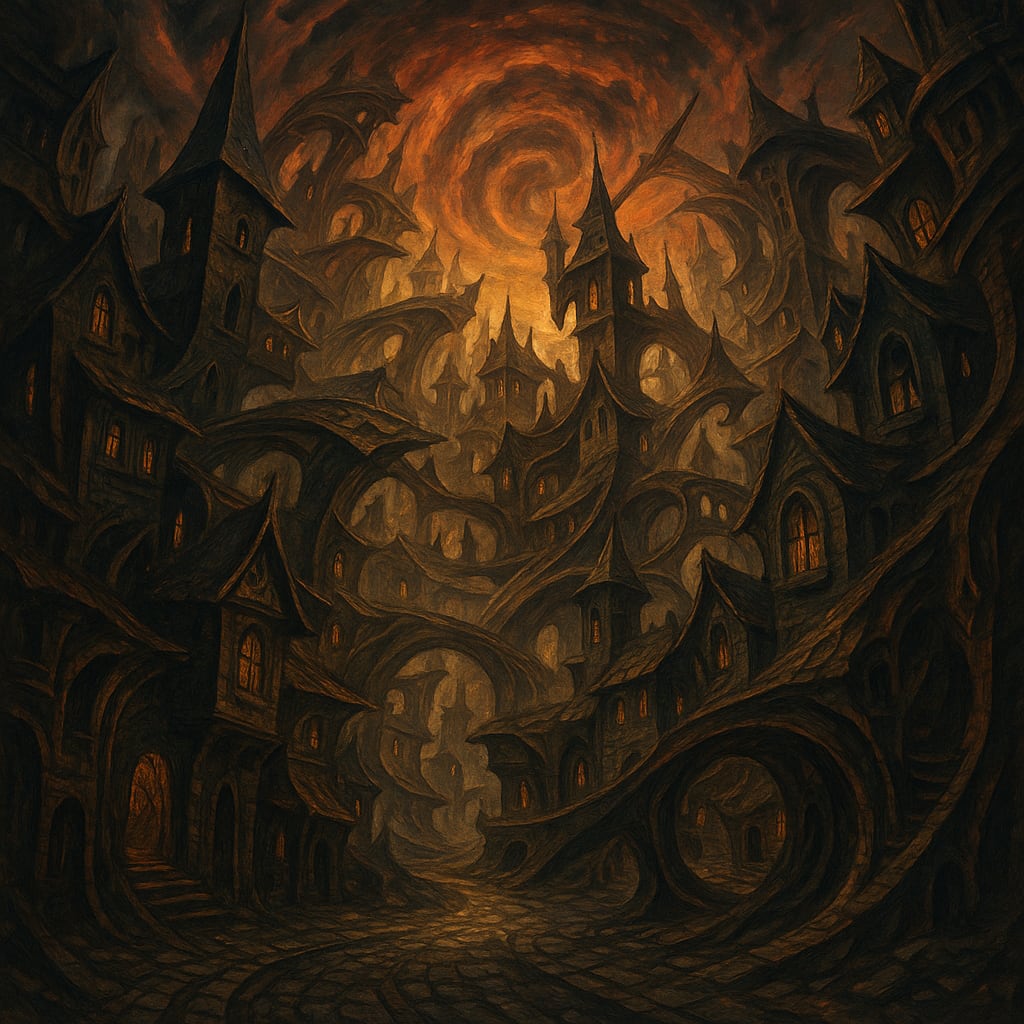
In a city where the laws of physics are more like suggestions, Varrow is a living, ever-morphing landscape of chaos, memory, and recursion. Yet, it is broken.

Rheyn
Varrow was having one of its moods again.
The alley she walked down was getting narrower every few steps, like it thought she'd be more comfortable in a coffin. The walls pulsed like they were breathing through its own damp structure. Something in the bricks groaned.
“Real welcoming as always,” Rheyn muttered, lighting a match.
The flame immediately defied logic and burned sideways, getting sucked into a crack in the wall that hadn’t been there before. She rolled her eyes. The laws of physics do not apply in the Varrow.
“Yeah, sure. That’s normal.”
She checked the photo again. Calven Marr, looking way too pleased for a man who was supposed to be very dead. Smiling at a newspaper stand like he hadn’t already died in front of twelve witnesses and a priest.
She turned the photo over. Ink shimmered despite the lack of light, clearly still deciding what colour it wanted to be.
"Find him. If he’s alive, kill him. If he’s dead again, burn everything he touched." — Varden
Of course it was Varden. He had the moral compass of a drunk with withdrawals and yet the financial budget of the greatest empires. She stuffed the photo back in her coat, stepped over a puddle that whispered her name, and kept moving.
Crate Street used to be a marketplace. This week, it was a row of semi-permanent structures arguing with each other. One sign said “Laundry”; the window showed a butcher shop. She stopped reading after a door labelled “DO NOT EXIST” hissed at her.
Locals claimed they’d seen Calven here yesterday. He’d walked down the street, talking to himself, or maybe the buildings. Hard to tell in Varrow as both are considered normal. She preferred buildings herself, they are more direct.
She ducked into a coffee shop called The Wound and the Warden, which had definitely been a temple last week and probably a gun shop the week before that.
Inside, time was lagging a bit. A ceiling fan jerked in short bursts like it was buffering reality but had some latency issues. The woman behind the counter was stirring tea that refused to steam and when she blinked at Rheyn, it was very slowly.
“Heard a dead man came through,” Rheyn said, leaning on the counter. “Wore too much religion, paid with something weird, left everyone uncomfortable. Real subtle kinda guy.”
The woman finally spoke but her voice arrived a second after her mouth moved.
“He asked if I thought the world was real,” she said. “Then he screamed, silently, for 23 minutes.”
“Yeah, I get that every Tuesday but normally only for 19.”
The woman ducked under the counter and came back with something small.
A tooth. Human molar and still warm. It pulsed faintly like it was trying to feel more important than just a discarded tooth.
“Wonderful. A haunted tooth. Just what I needed.”
She dropped it into her pocket and walked out. The air outside tasted like static if you know what I mean. Crate Street was now a staircase that hadn’t existed before and was leading into fog. Of course it was.
She sighed and started down the steps.
“If this ends with another undead ex-priest having an existential crisis, I’m billing extra.”
The stairs tried to change behind her but she ignored them. Let them spiral, stretch, shrink and so on, if she didn’t turn around then it never happened.
At the bottom was the edge. Not a metaphor or a cliff. Just… the end. White static hummed in the air, like the city had run out of power or the graphics card was outdated.
Rheyn lit a second match out of habit. The flame stayed still and that was never a good sign.
Then she saw him.
Calven Marr, standing exactly where reality stopped. Even though he was wearing the same coat from the photo, he looked like someone had reassembled him wrong. Not in any visible way though, just… off. Like the idea of him didn’t match the shape, a bit like Varrow itself to be honest.
“You’re dead,” she said, because why not, someone had to.
He turned, smiled in that vague “I’ve seen too much and now eat sound for breakfast” way.
“I remembered something I wasn’t supposed to,” he said.
“Oh great. So, you have unlocked some forbidden lore. That’s always fun.”
“It’s stuck now. I can’t forget. It changed me.”
He looked over his shoulder at the noise. It was a flat white wall of humming, flickering pixels. She had never liked it, there was no depth, no texture. Just end.
“You ever wonder what’s past this?” he asked.
“I usually assume tax audits and eldritch nightmares.”
Calven didn’t laugh. He stepped forward, and vanished.
No sound, no flash. Just, gone.
“Right,” Rheyn muttered with a sort of defeated sigh. “Totally stable behaviour from a corpse.”
She stayed there a few minutes longer, flipping the tooth in her pocket like a coin. Then she turned around to go home.
The stairs were gone, obviously.
Eventually making it back in to the city (we won’t question how), Rheyn broke into her own apartment and found three mirror-faced priests already inside.
She drew her gun and got a polite bow in return.
“We seek the tooth,” said one. His voice echoed despite the clutter in the room.
“Yeah, well, I seek personal space and a working memory. We don’t always get what we want.”
Another priest held up a sigil which made her head hurt just looking at it.
“It opens a vault,” he said. “Calven breached it. We need you to help us reseal it.”
“And here I thought you were just lonely.”
The third priest stepped closer. “Varden is dead. Killed yesterday. Publicly.”
“Pretty sure I got a job from him... yesterday.”
They all nodded, synchronized. The bloody creeps.
“You’re forgetting things,” one whispered. “So are we.”
That part stung.
She checked her pocket again. The tooth felt colder. Heavier.
“Fine. Let’s go crack open the vault and doom the city. What else was I doing tonight?”
They took a tunnel through the Underskin, where architecture made no promises and the air was thick with wrong.
“Why does this place smell like burnt hair?” Rheyn asked, lighting her last match.
No answer.
The tooth reacted to a door deep underground. Twisting in her hand, it started pulling toward a seam in the stone that unzipped faster than a man on his third date.
Behind it: a room that should not have fit in the space. A large vault of mirrors, all cracked but still reflecting. And Calven.
Or maybe just something wearing his shape, probably the newspaper stand he was looking at in the picture.
He turned. His eyes were wide, like he’d forgotten what they were for.
“I thought if I looked deep enough,” he said, “I’d understand the lie.”
“Look, I get it. Reality’s broken, you’ve got trauma, and now you want to monologue. But I left my empathy in my other coat.”
He pointed to the central mirror. “This is the first lie. It reflects what could’ve been.”
The mirror showed Rheyn, dozens of her, all shifting through the glass at different stages of imagination. Alive, dead, monstrous, godlike and broken.
Then one version smiled.
Then it stepped forward.
Then it walked out.
“Nope,” Rheyn said, drawing her weapon.
But it was too fast and oddly too real. The other Rheyn moved with such a swift precision, like she belonged more than Rheyn herself.
The mirror shattered and the priests screamed. Calven laughed, but his face cracked like porcelain and spilled black fog.
Everything went sideways.
Rheyn woke up in a gutter she didn’t remember falling into. Her hands were clean, wait, all of her was clean.
No sign of the priests or of the walking corpse. Just sirens overhead, half-muffled, and whispers in the concrete below her boots.
She looked at her reflection in a rain puddle. It didn’t blink when she did.
“Well, that’s not ominous at all.”
Varrow moved on like it always did. New disasters with new names on new streets that may have already existed. The vault got sealed, or eaten, no one knew. She didn’t ask.
She lit another match and watched it dance. It spun clockwise this time. That probably meant something.
“Dead men walking, churches lying, and now I might not even be the original me. Lovely.”
But she smiled anyway. It was just another day in Varrow.
Desh
Desh was not good at his job but in Varrow, that didn’t really matter. He watched a film once that said, “rules are more like guidelines”. Nothing could be more appropriate when describing the “rules” of reality here. He wasn’t supposed to be an architect and he certainly wasn’t supposed to be a Reality Forger. Reality doesn’t care about what you’re supposed to be. It only cares about whether or not you’re in the way.
He liked to think of himself as a problem solver. His job was to patch the holes in space and time. To fill in the cracks where causality went haywire and convince things like gravity and time to get in check for once. But in a city like Varrow, where nothing stayed intact long enough to matter, it was a bit like trying to fix a leaky dam with chewing gum. He didn’t even like gum.
To complete this amazing task, Desh had the finest piece of equipment you could get. He carried chalk. You see, the chalk had its own set of rules. It didn’t need to be sharpened and it didn’t need to be cleaned. All it needed to do was make a mark on reality and then watch the Varrow scramble to either make it work or fail in spectacular ways. He liked it that way. Simple and direct.
But even for a city as fractured as Varrow, the sheer number of things that couldn’t be explained by chalk were overwhelming. One day, he found himself looking at a wall that wasn’t supposed to exist. And then the wall turned into a staircase.
Not a staircase that led anywhere. Not a staircase that went up or down. It was a staircase that hung in the air like a broken idea. A staircase without a reason. A staircase that made no sense.
Desh, naturally, climbed it.
He knew better than to ask why. There was no answer in Varrow that ever-made sense, and the city preferred it that way. So, when he found the top, he just shrugged and kept walking.
At the top of the staircase, Desh stepped into a room that shouldn’t have been there. The air smelled stale, like it had been trapped for hundreds of years. The floor creaked under his weight, and the wallpaper peeled upwards as if it had given up on pretending it was real. In the center of the room stood a mirror. Not a mirror that showed his reflection but a mirror that showed someone else. Someone familiar and yet strange. Someone who was him but wasn’t.
Desh stepped closer to the glass, his breath fogging up the surface. He reached out. The reflection didn't move.
"Great," he muttered, "a haunted mirror. What’s next? A chair that insults me?"
The reflection smiled back. And for a second, Desh felt a jolt in his chest. The face in the mirror wasn’t him. Not completely. It had his eyes, his jawline, his general shape, but it was older. It was tired. The lines around the mouth were deeper. The eyes, empty, not a hint of recognition in them.
"Great," Desh said again, stepping back. "My reflection’s become a stranger. Just what I needed today."
He turned away from the mirror and tried to leave. But the reflection didn’t stay behind. It followed him.
For the next three days, Desh couldn’t escape it. Everywhere he went, there it was. In windows, in puddles, in the gleaming surface of any reflective object. It moved out of sync with him. Sometimes, it blinked before he did. Other times, it didn't blink at all.
Finally, the mirror spoke. Not the one on the wall, the one that followed him. The voice came in fragments, like a cracked radio.
"You’re breaking it wrong."
Desh blinked. "Well, that’s helpful. Thanks for the tip."
Desh’s chalk stopped working. It wasn’t a dramatic failure. No exciting explosions or fiery storms. It just… stopped. He was drawing lines on a wall one moment, and the next, the chalk shattered in his hand. The bits of it evaporated into the air like dust, leaving no trace. He tried again, only to have the next piece of chalk swirl into the surface of the wall like liquid.
It didn’t make sense. That was the thing about Varrow. It always made less sense the harder you tried to make it. So, Desh, in the best way he knew how, just kept going. He pulled out another piece of chalk, drew a line, and watched the space ripple and bend. The city hissed at him in response, annoyed and irritated at the audacity.
And then, in the midst of his futile attempts, he noticed the others.
There were always others in Varrow, whether you saw them or not. They lurked in the corners of perception, slipping in and out of reality’s gaps. But these were different. They weren’t just flickers of time or ghosts of the forgotten. These were people who had long since stopped trying to make sense of the city.
One of them was a woman wearing a burnt coat. She walked across the street, leaving perfect footprints in concrete that never filled. A boy flickered between seconds, as if he couldn’t decide if he was there or not. A girl stood still, staring at a wall that seemed to pulse with meaning no one could understand.
Desh didn’t speak to them. What was the point. He didn’t have the words for it anymore. Instead, he drew another line, this one bolder, wider and the space around him warped, groaning with pressure. Reality didn’t like his presence, and the city was making it clear.
It was when he drew the line across an empty street that the world answered.
"You’re not fixing anything," the voice said. "You’re just patching up wounds that need to bleed."
Desh didn’t know what it meant. But the mirror was still there, and the city was still full of cracks. He wasn’t fixing it, he was only delaying the inevitable.
Desh stopped trying to fix anything after that. Instead, he started following the breaks. Not fixing, just tracing. Each fracture, each gap in the world, pulled him deeper into the city’s labyrinth. The Logic District where the libraries resided (sometimes). The Weatherless Alleys and The Subdepths, where time and memory were nothing more than whispers in the dark.
The deeper he went, the more he realized that he wasn’t just seeing the city’s flaws. He was seeing its soul, well, what was left of it.
He found himself in the center of it all, in a place where reality folded in on itself like a tattered book. The buildings were twisted, bent at odd angles. Streets looped around in impossible patterns. Time didn’t tick here, it screamed.
And there, in the middle of it all, was the mirror. Bigger now with its frame stretched across the entire room, its surface like a vast pool of black ink. Inside it was the version of Desh he had seen before. But this time, he wasn’t alone. There were others, shades of himself, versions he had never known. One Desh was standing in the center, drawing circles on the floor, another was burning with chalk dust. Another was just a shadow, nothing more.
Desh stepped closer, but the mirror didn’t show him his reflection. It showed him the truth.
"You’ve been fixing the wrong thing," the voice said again. It wasn’t his voice. It was the city’s voice.
And for the first time, Desh understood. He wasn’t meant to fix the city. He was meant to let it break.
Desh drew one final line. This time, he didn’t try to close it, or to fix it. He let the line spill across the surface, across the cracks in the world. He let it bleed out, uncontained.
The chalk caught fire. And the city… It hiccupped.
Time rippled as the walls groaned. Desh watched, detached, as the entire city trembled. It wasn’t a collapse or a restoration. It was a release.
And for the first time, he didn’t feel the need to explain it.
He didn’t feel the need to fix anything.
Reality was no longer his responsibility, and he felt slightly embarrassed to acknowledge that it never had been.
Varrow wasn’t broken, just a little but unstable. And that was enough.
Desh smiled to himself. He drew a final line across the horizon.
The city didn’t collapse. It didn’t heal. It simply continued.
And in that moment, Desh realized: he didn’t need to fix it.
It would break again. And that was exactly how it was meant to be.
Marrow
Marrow was born in a place that shouldn't have existed, at least not in any of the ways a sane person would think about existence. Varrow was a city of contradictions, a city where laws of physics weren't laws, just suggestions. It had no center, but it had too many edges. No direction, but far too many wrong turns. And in this city, Marrow was an artifact of a forgotten time, a relic walking without memory.
She didn’t remember her parents. Or if she had any. In fact, she didn’t remember the moment she learned her name, the moment she first walked, or the first time she spoke. What Marrow remembered, though, was always the sound, the distant hum of something waiting to collapse, like the constant buzzing of a broken light. The hum wasn’t comforting as it was a reminder. The city was going to break again. Sooner or later. It always did.
Her job was simple, though: collecting memories. Sometimes they were her own, but mostly they weren’t. Varrow had a tendency to lose things, and what it lost, Marrow found. It was a dangerous job, but one that suited her skillset. You had to be good at forgetting if you were going to find what others couldn’t.
Memories weren't real in this city, not like they were supposed to be. They were made of something more like smoke than flesh. They were wisps, threads of thought that clung to people and places but never fully stuck. Marrow’s job was to gather them, to hold them in jars, to make sure they didn’t slip through the cracks. But today, today felt different.
If you are to learn anything about Varrow, then understand this. Varrow was a place built on nothing. No stable ground, no steady hand that guided it. Instead, it sat in the middle of a vast void, pulled by the gravity of a thousand mistakes. The streets twisted back on themselves. The buildings were made of an architecture that defied every law of nature, except, of course, for one: they couldn’t hold on forever.
And yet, Marrow continued to walk through it, gathering memories. The rules were simple. When you found a memory, you took it and placed it in a jar. No questions. No remorse. The city didn’t care about your empathy.
One afternoon, she passed a shop with a sign that read, "We Sell Your Dreams." It wasn’t a new store. It had always been there, tucked away between two alleyways like a secret. Marrow didn’t stop. She never did, but today, something changed. A person was inside, hunched over a glass counter, holding a jar that was cracked in a way that made the world feel off.
She stopped.
The shopkeeper didn’t acknowledge her, didn’t even look up. But as Marrow reached for the door, the sound of a doorbell rang out. Not a real bell. A distorted version of one, as if the city couldn’t decide how sound worked anymore.
“Looking for something?” a voice croaked from behind the counter.
Marrow froze.
It was the first time anyone had spoken to her in days.
“I’m just” she hesitated, trying to find the words. The words felt wrong in her mouth. “I’m just collecting memories.”
The shopkeeper smiled, his teeth too white in the dim light. “I have something for you, then. A memory that doesn’t belong to anyone.”
It was a jar unlike any other. The glass was clear, not cracked. The lid, smooth. The label, written in a language she didn't understand, though she knew it was meant for her.
“Take it,” the shopkeeper said.
She didn’t ask why. She didn’t ask how. It felt as if the jar had been waiting for her. Marrow extended her hand, and the moment her fingers touched the jar, a shiver ran up her spine. She wasn’t supposed to take it, but she did.
The city didn’t care about rules, not really. The jar hummed in her hand, vibrating with the weight of something forgotten. And when Marrow opened it, the room darkened.
The memory spilled out like liquid smoke, weaving into the air, clinging to the walls. It was as if the jar had been holding something back, and now, all at once, it had been set free.
“Do you remember?” the shopkeeper asked.
Marrow’s hand shook, the jar slipping from her fingers. The air around her thickened with the weight of the memory. For the first time in years, she thought she might remember something.
“I…” she couldn’t speak. It was too much.
But then it hit her.
The memory wasn’t her own. It wasn’t even real. It was a piece of the city itself, an echo of something that had never existed. A history not lived, but imagined: twisted, contorted, created.
The walls of the shop pulsed as the memory unravelled itself.
The shopkeeper didn’t wait for her to recover. His face had disappeared behind the jar, a figure that flickered like a faulty projection.
"You weren’t meant to take that," he said, his voice distorting as though speaking through a veil. "It was never meant to be found."
The memory was unraveling before her eyes. Threads of nothing woven into something that once was. The fabric of time itself was starting to twist, and the city’s pulse grew louder, faster.
Marrow stepped back. She didn’t understand. She was never supposed to remember this.
And then she saw the threads. They were everywhere, hanging in the air like cobwebs. Each thread was connected to a part of the city, pulling it all together. A web of broken memories, fractured pasts, and unspoken truths. Varrow was built on these. And Marrow had just stumbled upon something far more dangerous than she could have imagined.
The shopkeeper’s face flickered once more, and then he was gone.
Marrow didn’t run, she couldn’t. The moment she touched the jar, the city had shifted. Its pulse was faster now, more desperate. The threads were alive. The city was breathing, pulling at her, trying to drag her into the very web she had unwittingly disturbed.
But it was too late. The threads had found their way into her, and she could feel the city now. Its heart and its pulse. The memory of the things that should never have existed.
She couldn’t let it happen again. She couldn’t let the city consume itself.
And so, Marrow did the only thing she could think to do. She cut the thread.
With a flick of her wrist, the world trembled. The fabric of Varrow itself snapped as the thread unravelled. The city screamed, and for a moment, Marrow could hear the memories being torn apart, pulled from her, and scattered into the void.
But Varrow didn’t fall. It didn’t collapse. Instead, it did what it always did.
It changed.
And Marrow?
She was finally free.
Elyr
Elyr had never been good at the practical things. He couldn't mend broken objects, couldn’t solder circuits or bind things back together. His hands, to be blunt, were never designed to build. They were designed to break, and break they did.
It wasn’t an intentional thing. Elyr didn’t wake up in the morning and think, Today, I’ll break something important. But things broke around him, and that was a fact of life in Varrow. Where the city shifted, where the world bent, Elyr was never far behind, watching it all tear apart. Sometimes he felt like the city was broken before he ever showed up and that was perhaps the only reason he had survived so long.
He wasn’t sure how old he was anymore. The years, like the rest of Varrow, didn’t add up. The only thing that mattered was the weight of dreams. Dreams that weren’t his own. He didn’t control them, they controlled him.
And he had the feeling that he had been sleeping for longer than he knew. That someone or something, was trying to wake him up.
It happened one morning, though mornings are never actually mornings when time isn’t time. It was one of those impossible instances where the city decided to introduce an oddity. Elyr had learned to ignore most of them, the floating fish in the air, the sideways trees, the cobblestone streets that had a mind of their own. But today, it was different.
There was a door.
And Elyr knew it wasn’t supposed to be there, in fact, it was wrong.
It stood in the middle of a street that had no business being there either, between two buildings that looked like they were neither on the ground nor floating. The door was old, worn down, and the wood seemed to pulse with an energy that made his skin crawl. There was no handle, no sign. Just the door.
He stared at it for a long moment, trying to decipher its purpose. But his thoughts were interrupted by the sound of footsteps behind him.
"Don't touch it," a voice called out.
He turned to find a figure standing at the edge of the street, a person he’d never seen before. The man was tall, with a coat made from shadows, his face hidden beneath a wide-brimmed hat. Elyr wasn’t surprised by this.
"Why?" Elyr asked, a strange curiosity creeping its way in.
The stranger didn’t answer immediately. Instead, he stepped forward, his eyes flicking between the door and Elyr. “Because it’s the way out.”
Elyr raised an eyebrow, unable to suppress a chuckle. "And that’s a bad thing?"
The man’s eyes hardened. "Nothing in Varrow is ever really 'out.' It's a trap. It always has been."
He wasn’t convinced, but something in the stranger’s tone made him hesitate. The door had a peculiar aura about it, like it was waiting for something, waiting for him. It was a feeling that gnawed at the edges of his mind, a half-forgotten dream that you scramble to remember.
And for reasons Elyr couldn’t explain, he reached out and touched it.
The instant his hand made contact, the door opened.
At first, he thought he had stepped through into another place, a new section of the city. But no, this was something different. The space he entered was entirely disconnected from Varrow. It was vast, cold, and metallic, though the walls were slick with something that resembled shadow more than metal. The ground was solid, but the air felt… thick, a slight static hung in air, like the very fabric of space had changed.
Before him stood a single, spherical object floating in mid-air. It pulsed with a faint, blue glow. The sensation of power surged through Elyr, and for the first time, he felt something stir within him.
"What is this place?" he whispered to himself.
As soon as the words left his lips, the sphere reacted. The glow intensified, and he felt the pull of it as an almost magnetic force drawing him closer. His hands twitched, and before he knew it, he was standing before the orb, reaching out with his fingers brushing the surface. A jolt of energy surged through him, and the world around him fragmented.
The sphere dissolved, revealing a shifting mass of images and voices. It was like a memory chamber, one that didn’t just store memories but pulled them from the very air around him, weaving them together like some kind of haunted tapestry. Elyr saw flickers of things; people, places, moments, none of them connected by time or logic. Just flashes.
However, in the sea of disjointed visions, one image stood out. It was a city, the city, Varrow. The streets, the buildings, the broken reality… but it was different. It was whole.
For the briefest of moments, Elyr saw a city that wasn’t dying. A city that lived.
Then it vanished, leaving nothing but the silence of the chamber. The walls seemed to close in, and his chest tightened. He was alone again, alone with the memory of something that could never exist, not here.
Stepping away from the orb, his mind swirling with fragments. He had seen something, he had felt something. But it didn’t make sense. Varrow was broken and it always had been. So why had he seen that vision? The city, whole, perfect. How was it possible?
The stranger’s voice echoed in his mind. Nothing in Varrow is ever really 'out.' It's a trap.
A trap? He had never thought of the city like that. It had always been his home, in its fractured, chaotic way. But now… now, he wasn’t sure anymore. The city had done something to him. It had whispered something in his ear, shown him something he could never unsee.
The sphere had been a memory, yes, but whose? And what was the city hiding?
He turned to leave, but the door was gone. In its place, the memory chamber remained, unchanged, its surface still flickering with the residue of whatever he had witnessed.
And then, just as he thought he might understand what had happened, the world around him shifted again.
Varrow always shifted.
Elyr stood in the street once more, blinking against the sudden return to the familiar chaos. The buildings, the crooked streets, the disjointed reality, it was all here. But something was different. The hum that had always vibrated through the city was… quieter. Almost as if it had been suspended.
He looked around. No one seemed to notice. No one seemed to care.
It was just another day in Varrow.
But he could feel it, something had changed. A fragment of the city had slipped through his fingers. The door had been a glimpse of something else, something real. And that would be enough.
For the first time, Elyr didn’t feel like the city was merely a thing to observe. He felt its pulse in his bones, its rhythms embedded deep within his chest. It was as though the city itself had shown him the truth, that it wasn’t broken by accident. That it had always been this way, its very existence a cycle of constant decay and rebirth.
And so, Elyr walked on. His burden was one of knowing, not fixing. But in the end, the city would break again. And perhaps, that was how it was always meant to be.
Threads
There was a moment, somewhere in the ever-shifting landscape of Varrow, when the city stopped moving. For just an instant, it was perfectly still. The air didn’t move, the streets didn’t bend, and the noise that always hovered in the background; the soft, persistent whir of the city’s broken mechanisms, vanished entirely.
A single figure stood at the heart of it, unnoticed by all but the city itself. He wasn’t supposed to be here. But then again, in Varrow, nothing was supposed to be.
The figure was a stranger, with a face that no one would ever recognize. He had no name, not one that could be understood in any language, at least. His presence didn’t bend reality so much as it frayed it, as if he existed on the edge of something that wasn’t quite real.
He was a collector, like Marrow, but he didn’t collect memories. He collected something far more dangerous, he collected threads.
The Loom was something no one understood. It was an object, but it was also an idea. The Loom wasn’t a thing that could be touched, nor was it a place that could be found. It existed in the spaces between reality, and it wove the fates of everything in Varrow, or so the story went.
The Stranger knew this. He had seen the Loom before, or at least, he’d seen the traces of it. Threads that drifted from nowhere to nowhere, stitching the very fabric of the city together, holding it in place.
And yet, no one ever saw them. Only the Stranger.
It was on the third day of his journey that he found it, the thread. It was thinner than a spider’s silk, but its pull was undeniable. It shimmered in the air, glowing faintly with an otherworldly light. He could feel it pulling at the edges of his consciousness, as if it was trying to make itself known.
The Stranger had been looking for it for years, but he had never been able to touch it. It was always just out of reach.
Until now.
He reached out, and when his fingers brushed against it, the city trembled. Not with the violent shakes that signalled an explosion of chaos, but with the subtle hum of something old, something forgotten, something unravelling.
And then, the thread snapped.
When the thread snapped, Varrow screamed.
The city didn’t collapse. It didn’t die. Instead, it shuddered.
Buildings fell into themselves and streets disappeared. The sky warped and folded in on itself. The Stranger stood, watching the chaos unfold before him, as the city began to unravel.
But it wasn’t the end. It never was.
For in that unravelling, something new began to take shape.
And the Stranger, standing in the center of it all, knew that Varrow was not the broken thing he had thought it was. It was a tapestry, one that could be rewoven. And he was the one who would do it.
As the pieces of Varrow swirled around him, the Stranger felt the threads of fate begin to twist again. The city would rebuild, as it always had. It would break, and it would be remade.
He began to pull at threads. A tug here and a slight movement there. A quick door in the middle of nowhere, reflections shimmering, the occasional magically appearing staircase.
It was time to move the pieces in place, it was time to break the city.
--- The End of Part 1
About the Creator
Daniel Millington
A professional oxymoron apprentice whose mind is polluted with either bubbly grimdark romances or level headed chaos. Connect on:
https://bsky.app/profile/danielmillington.bsky.social
https://substack.com/@danielmillington1
Keep reading
More stories from Daniel Millington and writers in Fiction and other communities.
Chapter 1: Whispers at Twilight
Note: This is a completely new genre for me and I wanted to write in a way that makes people contemplate their own life. I hope this shows in the first chapter, however, please comment with any advice as I did enjoy writing like this and I would like to fully refine the first book draft.
By Daniel Millingtonabout a year ago in Fiction
Bomb Scare
It was 2027, and the world never thought it would happen. A missle hit the United States, but it wasn't where they had anticipated. A little town in the northeast was hit by a missile strike, they didn't know why, and they didn't know exactly where it hit, but they did know it was a coastal community, somewhere between Maine and Delaware.
By Gregory Payton7 days ago in Fiction



Comments (1)
Awesome!!!