
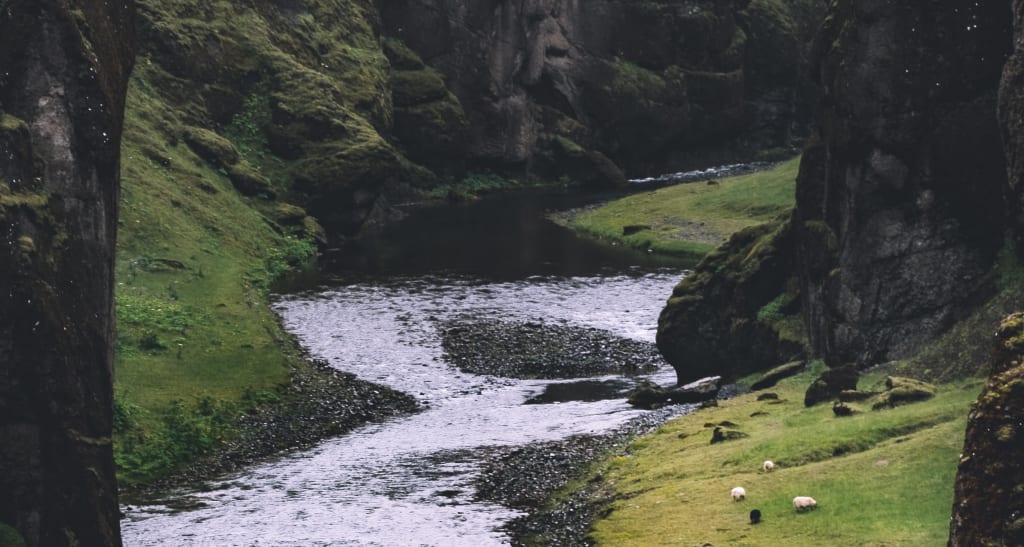
There weren’t always dragons in the Valley.
It was a mantra of the older inhabitants of the Valley. Hana had heard her elders say as much many times, though she wasn’t sure that even the Valley’s oldest inhabitants were old enough to remember a time before the dragons. It was understood as a simple lesson passed down through the generations, a reminder that, though this was the normal way of life for her people, there had been a time before. It also felt to Hana like a warning: the dragons had come to the Valley once, and though it was so very long ago, they could just as easily depart. And where would the people of the Valley be then? The dragons were part of the fabric of their lives. They wouldn’t know what to do without them.
Hana had only to step out her door to see their presence and influence everywhere, if not the dragons themselves. The river that ran through the heart of the Valley was the work of Uedd, who freed the spring from its place beneath the mountain, purified the water and made sure it was clean for the people of the Valley to drink and water their crops. It bubbled up from a gap in the mountain wall to the north. Uedd could often be found there, at the fountainhead, lying beneath the water and allowing it to rush over his iridescent scales. Er had made the land bountiful, tilling it with her claws when it was too hard for the people, and every season still walked to every field to bless the seeds with her breath. She dwelt in the center of the Valley, in a barrow that Hana’s ancestors had built out of rocks and sod. It had long ago become overgrown, and wildflowers bloomed on its dome throughout the year. Uedd’s sister, Skeu, lived above in the cliffs that surrounded the Valley. Her silhouette could be seen often at twilight, walking the edge of the cliffs as she kept the Valley safe from intrusion. Her roar could summon the rainstorm or drive it away again, and her wisdom kept the Valley in balance, ensuring that they had enough rain to sustain their crops, but never so much that flooding became a risk. To the west, the base of the cliffs opened into caves, within which dwelt the brothers, Isro and Paewr. Isro, small and energetic, dug the rock for useful minerals. His hard skin and tough claws were able to break even the strongest stones. Paewr was large and lazy, often sleeping, but the prodigious warmth from his body radiated into the stones and upward, keeping the Valley a pleasant temperature even in the winter. And then there was Kailo, eldest and fairest of them all…
But there weren’t always dragons in the Valley.
It was a lesson to be mindful and grateful. The dragons might not have made life in the Valley possible, but they certainly made it easier and more pleasant. Without them, the people of the Valley would struggle and toil to scrape together a basic living, if they didn’t die out altogether. And they asked so little in return for their largess.
Hana was jolted awake as the sound of Skeu’s roar rippled through her body. It wasn’t the roar of rain-calling, or of sunlight. Those were mighty, but pleasant to the ears. They were songs of life. This was a harsher roar; a louder and more intrusive call intended to wake and alert every inhabitant of the Valley at once.
This was Skeu’s alarm.
There was an intrusion in the Valley. And if Skeu was sounding this alarm, it was an intrusion that she needed the inhabitants of the Valley to help with. Hana knew from experience what type of intrusion that was likely to be.
“It’s an ichneumon,” her mother confirmed as she opened the door to Hana’s room. She tossed Hana her coat, bow, and belt. “Old Oras spotted it in his garden not five minutes ago. They think it’s making for Er. Hurry!”
Hana scrambled out of bed and pulled the coat over her nightdress. Her mother was already fully outfitted, but she had clearly been awake for some time already. Hana wondered if she’d had the night watch; she couldn’t recall. She followed her mother out of the house, not bothering with shoes. The Valley was out in force, and not just the archers and other guards like Hana and her mother: the farmers (Hana’s father among them) stood in the fields, armed with rakes and hoes and sickles. Some of them were making their way down the Valley toward Er’s barrow. The miners, Isro’s helpers, had come out of the caves with shovels and pickaxes to defend the entrance. Woodcutters stood at the edge of the woods to the south with axes and saws. Hana saw old men brandishing cudgels and hatchets, old women armed with carving knives and kitchen pans, and children carrying sticks and rocks and any makeshift weapon they could find. No one was spared this conscription, not when there was an ichneumon about. They were the biggest threat to the dragons, and though Hana had never laid eyes on one personally, she had been trained from a young age what they looked like and how to kill one.
The whole Valley was in a state of tension. In the wake of Skeu’s roar, there had been clamor and shouting, but now everything was hushed and anxious as the Valley’s inhabitants combed every inch of terrain for the intruder. The other dragons were hidden, staying out of sight lest they make themselves a target of the ichneumon, but Hana could see Skeu nervously pacing the cliffs above as she scanned the Valley. Hana nocked her bow, and she heard her mother do the same.
“There!” one of the hunters shouted. A bowstring snapped, but Hana heard the arrow thud into the earth. She pivoted toward the sound and pulled back on her own bowstring, ready in case the creature leapt out at her. People were pointing and shouting toward the eastern side of the Valley. Hana caught a glimpse of a long brown shape as it darted between one garden and another. She and half a dozen others loosed arrows at it, but all missed. The creature was gone as quickly as it had appeared, hidden under the foundation of a house. Had that been it? It was smaller than Hana had imagined. She hurried around the perimeter of the garden, hoping to cut it off as it came out the other side of the foundation. She nocked another arrow and waited.
When it did not immediately appear, Hana began to cautiously approach. There was a single small gap in the foundation on this side; if the ichneumon was coming through this side, it was the only way out. Others had been rushing up behind her, but they hesitated when they saw what she was doing. Hana lowered her bow as she neared the foundation—getting a shot through that gap and hitting the creature in the narrow space under the house’s floor would be difficult—and drew the knife from her belt. The dirt was soft and made no sound beneath her bare feet as Hana crept up to the side of the house and crouched beside the house, one hand on the wall to steady herself. Even before she lowered herself to the gap in the foundation, she could smell the creature. It was an acrid animal funk, much harsher than the livestock that she was accustomed to smelling. Even the smell felt wrong. No wonder these creatures were so dangerous.
As she glanced through the gap in the foundation, she saw it.
The ichneumon was about two feet long, with its bushy tail adding another foot. Its body was long, roughly cylindrical, and covered with brown fur speckled with gold. Its four legs ended in black claws. Its bright tawny eyes met Hana’s pale green, and she saw an intelligence that she did not expect coupled with an animosity that seemed prodigious for a creature so small. She had barely a moment to process all of this, however, for the creature’s small rounded ears folded back, its muzzle opened to reveal dozens of needle-sharp teeth, and it struck like lightning.
Hana’s survival instincts overtook her combat instincts as the long brown shape flew toward her. Rather than raising her knife to strike, she dropped it and raised her hands to shield her face. With her eyes shut tight, she could feel the claws raking against her hands and cheek. She screamed and flailed her arms to shake the creature off, and somewhere nearby she heard her mother order the others not to shoot.
Something quick and heavy whooshed near Hana’s ear, and suddenly the weight of the creature and the scraping of its claws were gone. Bowstrings twanged and arrows thudded into everything but flesh.
“Hana!” her mother cried. She was close. Hana felt warm hands on her shoulders, her arms, her face as her mother inspected the damage. A wet cloth was being rubbed against her face and over her hands. “Hana, are you all right? Can you open your eyes?”
She could, and she did. Her mother knelt in the dirt before her, a heavy club laying at her side. As their eyes met, her mother sighed with relief. “Are you all right?” she repeated.
Hana took quick stock of her own body. There was pain in her hands and face. Her palms had been scratched by the ichneumon, some of them deep enough to draw blood. She could feel some blood on her face as well. Her sight was fine, however, and though there were small stabs of pain as she flexed her fingers and made a fist, it wasn’t anything serious. She nodded, but the look of concern in her mother’s eyes made it clear that she wasn’t convinced.
“Yes,” Hana insisted. “I’m fine. Where did it go?”
Her mother inclined her head, and Hana followed the gesture. She couldn’t see it, but its path from her was clear. After being thrown from its attack on Hana, the ichneumon had made directly for Kailo’s temple, the magnificent stone structure at the Valley’s east. A volley of arrows embedded in the ground before the temple had been used to deter it, she assumed, since the small, agile form of the ichneumon was proving so difficult for them to hit. A growing crowd was assembled at the base of the cliff near the temple. Hana’s mother helped her daughter to her feet and the two of them hurried to join the group.
“What’s happening?” her mother asked. “Where’s the ichneumon?”
The crowd parted to allow the two women passage—a perk of her mother’s standing among the archers—and they swiftly reached the cliff face. One of the other archers, a bald man with a thick black mustache named Jera, apprised them of the situation.
“It’s gone into a hole,” he explained, gesturing to a narrow opening in the rock. “Too small for you, me, or any of our archers.”
Hana’s mother shrugged. “So it’s trapped,” she said. “We can block up the hole, or set a fire at the mouth and suffocate it.”
“What if it goes deeper into the rock?” Jera asked. “We don’t know where that hole goes. It might come out in another part of the Valley. It might connect to the mines, and by blocking it here we may drive it right to Paewr or Isro.”
“What do you suggest then, Jera? We can’t send a child down there after it.”
“I can fit,” Hana suggested. Her mother, Jera, and many of the others assembled looked at her as she spoke. Hana was crouched near the hole, taking stock of its size relative to her own. She wasn’t a child, certainly, but she was skinny (despite her father’s determined efforts to put more muscle on her) and she was confident in her ability to crawl through the tunnel.
Her mother shook her head. “Hana, you’re hurt—”
“It’s a few scratches,” she insisted. “It won’t stop me from using a knife. I’m small enough that I can make it through here, and unlike anyone else in the Valley who might fit, I know how to fight.”
“It’s already attacked you once,” her mother pointed out.
“So I’ll be ready if it tries again.”
Her mother was about to protest further, but stopped as Jera put a hand on her shoulder. “It’s our best option, Sowil,” he said. “We can’t risk losing another dragon. Not after Dheu.” He looked at Hana. “If she says she’s ready, I believe her.”
Hana’s mother thought for a long moment. “Bring me rope,” she called. After a few moments of hurried activity from the crowd, someone stepped forward with a long coil of rope. Sowil took it and motioned her daughter over. Hana allowed her mother to wrap the cord around her waist. “It’s for the good of the entire Valley,” her mother muttered as she tied the rope. “Be careful. Be smart. Remember what you’ve been taught.”
Hana nodded. “The belly and the neck.”
“The belly and the neck,” her mother confirmed. She gave the rope a few tugs to test it. “If it goes badly in there, call out and we’ll pull you back. Understood?” Hana nodded again. Sowil kissed her forehead. Jera handed her a small lantern.
Hana drew her knife, crouched down, and began to crawl into the hole. It was low, forcing her to creep along on her stomach, but not so narrow that she had to tuck her elbows in. Hana was grateful for that. If it came to a confrontation here, she had room to swing her arms effectively. The occasional points of the rock pricked her through the thin cloth of her nightdress, but they weren’t rough or jagged. She’d come out of this dirty, but it was unlikely that the clothing would be torn or ruined. Hana tried to listen beyond the sounds of her own breathing and movement through the tunnel, hoping to hear the scrabbling of the ichneumon’s claws on the floor, or the brush of its fur against the walls, or some other sound that would indicate she was not alone in this crevice. She heard none, and pressed on.
Jera had mentioned Dheu—Hana had only heard the name spoken aloud a few times, and always in reverent tones. She knew there had been a seventh dragon; it was something that was told to every child in the Valley, to remind them that despite their power and long lifespans, the dragons were not immortal. When exactly Dheu had been killed and how it had happened was something that she was never entirely able to determine, and she was too afraid of broaching the subject to press anyone about it. What had it been like, she wondered, for those people? What had they felt seeing one of their protectors die? She thought of the dragons that still lived, the ones that she and her people interacted with every day. They were so majestic, so powerful. They were even terrifying at times, usually when they displayed the full extent of their magic. But most of all they were alive. Not in the sense that the crops or the livestock or even Hana herself was. There was an electricity to the dragons, a sensation of being in their presence that conveyed energy and vigor and life. Her being alive felt passive in comparison. Being alive was something that she was. It was something that the dragons did. To think of any of them as dead felt like a profanity. What could do such a thing?
But she knew that answer, Hana reflected as she continued to crawl. She was pursuing something that had the power to do that. It seemed incredible that something so small could bring down something so mighty. Hana suddenly found herself doubting. What was she, a young girl with a knife, going to do against something that could kill a dragon? She hesitated and looked at the hands before her in the dim light of the tunnel: knife in one, lantern in the other. The bleeding had stopped, but her hands were still crisscrossed with deep red lines from her earlier encounter with the ichneumon. It hadn’t done much harm to her—very little at all, really. The scratches would heal in a matter of days. And as far as Hana could tell, the creature hadn’t poisoned her. Maybe there was something about her and her people that made them resilient against the ichneumon? Perhaps that was why the dragons needed them.
Hana tightened her grip on both the knife and the lantern and pressed forward.
After a few more minutes of crawling, the crevice began to widen, and Hana was able to get up from her stomach. The narrow tunnel through which she had come opened up into a small chamber about the size of Hana’s bedroom. The walls of the chamber were high and steep, and angled sharply a few feet up to a narrow chimney in the ceiling. Hana held the lantern up and squinted at the opening. Could the ichneumon have escaped through there? It seemed unlikely that even a creature like that would have been able to scale the sheer walls and ceiling of this room.
She turned her attention instead to the floor. It was pockmarked and uneven, with plenty of places that a creature the size of the ichneumon could hide itself, but as far as Hana could tell the only exits were the vertical shaft and the tunnel she’d crawled through. As she scrutinized every divot and rock in the floor, she was unable to find any evidence that the ichneumon had come this way at all. Had there been a side path that she had missed? Had it somehow slipped past her as she crawled, and made its way back to the opening?
Hana did a double-take as the scant light from her lantern passed over a discolored patch of rock. The stone around her was dark, but for a brief moment the lantern had illuminated a paler section of the wall. She turned back, slowly, and found not only that a portion of the rock was brown flecked with gold, but within that patch two bright eyes glinted in the lantern light.
The ichneumon was curled into a ball against a depression in the wall not three feet from where she stood, watching her intently and likely hoping she wouldn’t notice it if it remained entirely still. Hana froze herself, appraising her enemy but wary of making any sudden movements that would indicate that she was on the offensive. It was keeping itself so perfectly still, Hana wasn’t even able to tell if it was breathing.
Controlling her own breathing and moving slowly and more deliberately than she ever had in her life, Hana set down the lantern and began to remove her coat. How smart was an ichneumon, she wondered as she wriggled an arm free. Would it recognize what she was doing? Would it pounce before she had a chance to execute her plan? Or would its instincts assume that it was as invisible as it would have been to a predatory animal? She kept her eyes on it, alert for any changes in its behavior.
As she twisted her other arm free of the coat and returned the knife to her right hand, it seemed to her that the ichneumon’s breathing became more pronounced. She could see its body moving now, as if its breath had quickened in response to her actions. Still, it had not moved. It must suspect that she was up to something, but was likely unable to determine exactly what that something was.
The ichneumon tried to leap away in the same moment that Hana flung her coat out as a makeshift net. It collided in midair with the well-worn leather and the entire bundle slumped to the ground, an oblong lump struggling to find its way out of the trap.
Hana pounced before it could find its way to the edge of the coat, using her greater size and weight to keep it trapped. The ichneumon began to panic, and Hana could feel its claws scratching frantically against the underside of the coat as it tried to free itself. She raised her knife. It was a good coat; it had been her mother’s before her. Was she really going to destroy it? Yes, she decided. It was just a coat, after all. This was for the good of the Valley. This was for the dragons. This was for her entire way of life.
She stabbed.
The ichneumon shrieked, a sound that was chillingly human from such a creature. It twisted the pit of Hana’s stomach as she heard it, and the lump beneath her began to thrash and spasm more violently than before. She stabbed again, and again, and again and again and again until the spasms ceased and she was holding a limp bundle.
Hana’s breathing was heavy. Had she screamed, or was that just the ichneumon? It was impossible to tell. Her coat was slashed to pieces, the leather wet and stained, the blade of her knife coated in emerald green blood.
She unrolled the bundle and let the corpse thud onto the ground. The blood was indeed a vivid green. Hana had never seen that before—her own and that of the livestock was red, and the dragons (she was told) bled thick black.
What kind of monster bled green?
As she contemplated this mystery, the ichneumon’s jaw fell open with a crack. Hana started, and held up her knife, but the creature did not mover further. Instead, a thick yellow smoke began to billow up out of the ichneumon’s mouth. Hana instinctively covered her mouth and nose with her sleeve, but the smoke did not fill the cavern, nor did it waft up through the chimney. It hovered above the corpse in a small cloud. Despite the obvious lack of eyes or any other kind of facial features, Hana had the distinct impression that it was watching her. She also had the unshakable feeling that, as this faceless smoke surveyed her, it was speaking. Not with something so crude as a voice—after all, it had no mouth or tongue. It was the sensation of words, as if Hana herself were imagining them in her head, but with a voice that was not her own internal monologue. Like the smell of the ichneumon, it had a wrongness to it, this alien voice in her brain, and like the smell, it left her powerless to its invasion of her senses.
WHY DO YOU PROTECT THEM?
Should she speak? Was it enough to simply think? She didn’t know. “Because they protect us,” she replied aloud. “Because they make our lives better.” And then, almost as a reflex, she repeated the phrase she had heard over and over again for her entire life: “Because there weren’t always dragons in the Valley.”
THERE WEREN’T ALWAYS DRAGONS IN THE VALLEY?
Without bothering to skip a beat for the voice’s question, she sputtered, “They bring us rain. They purify our water and help our crops grow and keep us safe and heal our sick.”
BUT. THERE WEREN’T ALWAYS DRAGONS IN THE VALLEY.
About the Creator
Keep reading
More stories from Nicholas Galante and writers in Fiction and other communities.
The Haunting of Jonathan Jones
The rain was just starting as Jonathan Jones pulled up in front of the library. I’m not supposed to be here, he thought, staring at the harsh fluorescent glow spilling out of the windows into the October night. I should be home with my feet up, drink in hand, TV blaring, with a fat Scottish Terrier asleep on my lap. He ducked his head into the collar of his coat and hurried across the road before he could get too wet. The place was deserted, which was par for the course for a Friday evening.
By Nicholas Galante4 years ago in Fiction
🅼🅸🅳🅽🅸🅶🅷🆃 🆂🅽🅰🅲🅺🆂
"It's 10 in Tuscon! We all know what that means... It's Time for Midnight Snacks with your man, Gerald Gee! Ready to spend the night together? Me too! I'm full of snacks and can't wait to regurgitate them all back into your hungry ears. Crack a brew! Pop some corn! Anything to get ready for one hell of a show where the talk maybe cheap but the words cut deep...
By Lamar Wiggins7 days ago in Fiction
This Is Not a Drill
Attention valued Mermaid Cruise Line passengers. Thank you all for returning to your staterooms as requested while we address some minor inconveniences. In a moment, we will be magnetically locking all staterooms and turning off all power except for emergency lights. If you are in an external room, please open the porthole ventilation above your windows. If you are in the center of the ship, we will be activating the manual ventilation ports between staterooms.
By Penny Fuller6 days ago in Fiction


Comments
There are no comments for this story
Be the first to respond and start the conversation.