
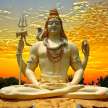
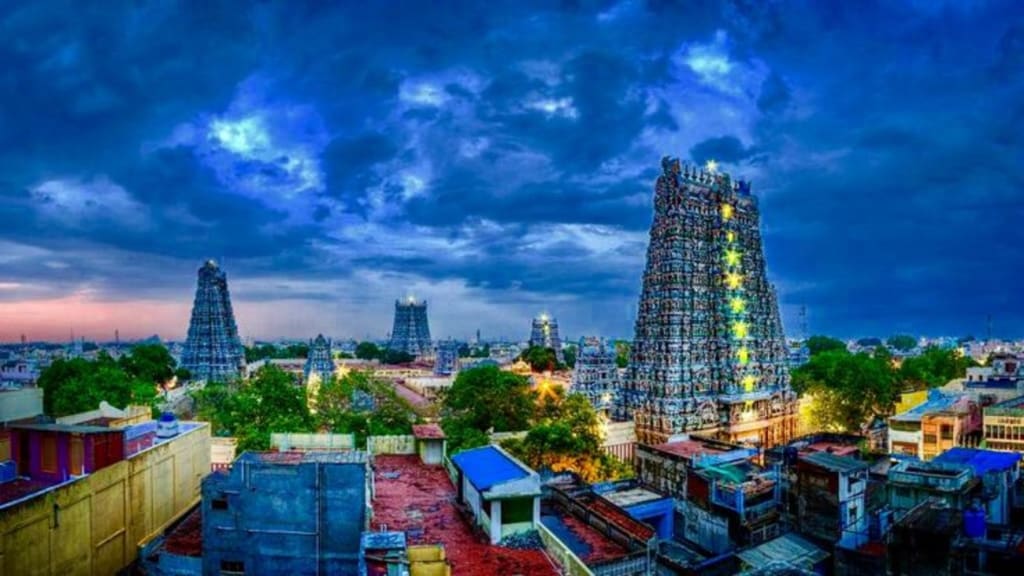
Located in the Tamil Nadu state of India, the Meenakshi Temple is a well-known Hindu temple. It is devoted to the goddess Meenakshi, who is thought to be a manifestation of Lord Shiva's wife, Parvati. A great example of Dravidian architecture, the temple is also a major pilgrimage place.
The Meenakshi Temple is said to have a more than 2,000-year heritage. Hindu mythology states that before Madurai was a forest called Kadambavanam, where Malayadwaja Pandya, the king of the Pandyan people, and his wife Kanchanamalai prayed to Lord Shiva in order to have a child. Lord Shiva appeared before them, pleased with their devotion, and bestowed upon them a gift. A little while later, a newborn girl appeared from the hallowed fire, and theShe was called Meenakshi by the king and queen, which translates to "fish-eyed," because of the rumored fish-like nature of her eyes.
Meenakshi was born with three breasts, indicating her extraordinary destiny. It was predicted that when she met her future spouse, the third breast would vanish. Meenakshi showed remarkable bravery and leadership abilities as she matured. Eventually, she took over as Madurai's king from her father.
Meenakshi started a string of conquests that resulted in the widespread expansion of her dominion. She arrived at Mount Kailash, the home of Lord Shiva, during her conquests. Her third breast disappeared the moment she saw him, a sign that she had finally discovered her true love.
The Meenakshi Temple was constructed as a memorial to Meenakshi and Lord Shiva, who were wed in a lavish ceremony at Madurai. The temple complex is a vast work of architectural and artistic beauty, with colorful statues representing numerous gods and mythological themes, beautifully carved pillars, and towering gopurams (ornate entry towers).
The Meenakshi Temple's Hall of Thousand Pillars, a mandapam with precisely 985 pillars decorated with elaborate sculptures, is one of its most outstanding characteristics. In addition, the temple has shrines to numerous other gods, such as Lord Vishnu, who is the brother of Meenakshi and is known as Azhagar.
Every year, millions of tourists and devotees from all over the world flock to the Meenakshi Temple to take in its breathtaking architecture, experience its meditative ambiance, and pay their respects to the deity Meenakshi and her spouse, Lord Shiva. It continues to be a symbol of fidelity and faith for people of all ages and is a monument to the rich cultural and religious history of Tamil Nadu.
The Meenakshi Temple complex is a large complex of buildings and features located in Madurai, Tamil Nadu, India. The following are some approximate measurements and dimensions of the temple's various components:
Main Temple Area: The complex of temples is around forty-five acres in size.
Gopurams, or towers at entryways:
The height of Southern Gopuram is approximately 170 feet (52 meters).
Eastern Gopuram: Its height is roughly forty-nine feet (49 meters).
Northern Gopuram: A height of about 49 meters (160 feet).
The height of Western Gopuram is roughly 170 feet (52 meters).
Aayiram Kaal Mandapam, or the Hall of Thousand Pillars:
There are about 985 finely carved pillars in the hall.
The hall is roughly 75 feet (23 meters) by 42 feet (13 meters) in size.
Meenakshi Amman Shrine:
The goddess Meenakshi is housed in a sanctum sanctorum (garbhagriha) that is roughly 33 feet (10 meters) by 22 feet (6.7 meters) in size.
Above the sanctuary, the vimana (tower) soars to a height of approximately 170 feet (52 meters).
The New Mandapam, or Puthu Mandapam:
This mandapam, which is situated in the outer corridor, is more compact than the Hall of Thousand Pillars.
Its exact measurements could differ, but it's a meeting spot for tourists and aficionados.
Overall Design of the Temple:
The primary shrine of Meenakshi Amman is situated in the middle of the temple complex, which is organized in a series of concentric rectangular enclosures.
The entire complex is a spiritual and architectural wonder, a labyrinth of passageways, shrines, mandapams, and open areas.
Note that there may be a small variation in these measurements as they are approximate. Since the Meenakshi Temple is a living monument that is always being maintained and renovated, getting exact measurements might be difficult. Furthermore, historical interpretations and variances may exist for the temple's architecture and size.
About the Creator
Keep reading
More stories from Vijay Kumar and writers in Fiction and other communities.


Comments
There are no comments for this story
Be the first to respond and start the conversation.