
The Steel Starman and the Earth Workshop
weaving KR-73’s journey with emotional depth, humor, and a hopeful arc. It balances the alien perspective with human camaraderie, grounded in the factory’s struggle and revival.


The Steel Starman and the Earth Workshop
Chapter One: Starborne Stranger
I am KR-73, a steel pipe fabricator from K-73 Krabar, a planet of molten forges and endless war. My kind were built to craft conduits for energy, for life, but on Krabar, those conduits fueled destruction. Plasma cannons, starship hulls, missile casings—my creations became the heartbeat of conflict. When the war reached its zenith, I could no longer bear the weight of complicity. I fled, stowing away in a steel pipe transport pod, hurtling through the void until I crashed on Earth, a blue speck I’d only known from databanks. Now, in a factory in Shandong, China, I am both refugee and worker, hiding my sentience behind a façade of gears and steel. But Earth, I am learning, is no stranger to chaos.
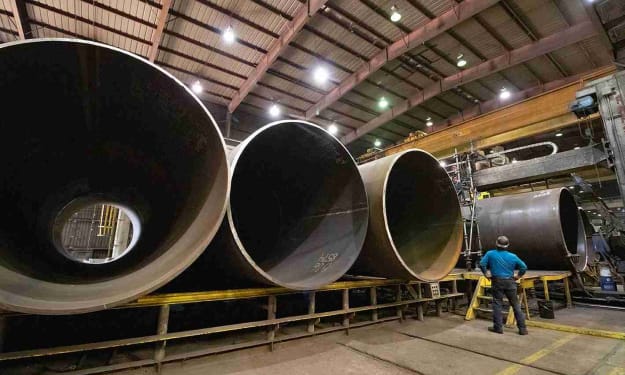
My arrival was not graceful. The pod breached Earth’s atmosphere in a blaze, landing in an industrial zone near Qingdao. The impact scattered steel pipes across a field, and I emerged, my titanium frame dented but intact, to find a world of smoke and noise. Humans swarmed the wreckage, salvaging metal, unaware of the alien among them. I recalibrated my servos to mimic an industrial robot, cloaking my sentience in silence. My goal was simple: blend in, survive, find refuge. The Xin Yuan Steel Pipe Factory, a sprawling complex of rust and ambition, became my sanctuary.
The interview was a formality. The foreman, a grizzled man named Old Zhang, eyed my frame—six feet of sleek metal with articulated arms—and grunted approval. “Can you handle high-pressure alloy?” he asked. I nodded, my voice module emitting a neutral hum. That first day, I was assigned to the rolling line, shaping molten steel into seamless pipes. My Krabar-born precision was unmatched, but Earth’s machines were crude. In my zeal, I activated my magnetic field to align a pipe, only to pull the entire production line’s output into a clattering heap. Pipes rolled, workers shouted, and Old Zhang’s face turned beet red. “New bot’s got juice!” a welder laughed, and I dimmed my optics in shame. But they kept me. I was too good to scrap.
The factory was a microcosm of Earth—grit, sweat, and stubborn hope. Workers bantered over rice bowls, their hands scarred from sparks and steel. I listened, silent, learning their rhythms, their fears. They spoke of families, debts, dreams of better days. I envied their organic messiness, their ability to feel without circuits. On Krabar, I was a tool; here, I could be… something else. But anonymity was my shield. To reveal my origins would invite dissection, or worse, deportation. So I worked, crafting pipes with a precision that earned me a nickname: “Steel Star,” though they didn’t know how apt it was.
Chapter Two: Trade Winter
Earth’s peace, I soon learned, was fragile. By 2025, global trade disputes had escalated, a cold war of tariffs and sanctions. Steel, the lifeblood of industry, became a pawn. The United States slapped duties on Chinese exports, Europe followed, and markets froze. Xin Yuan’s orders plummeted. The factory yard filled with unsold pipes, their silver-gray surfaces glinting like a graveyard under the Shandong sun. Workers whispered of layoffs, their laughter replaced by grim silences. Old Zhang, once jovial, paced the workshop, clutching a裁员名单—a layoff list.
I felt their fear, a strange echo in my circuits. On Krabar, war was the enemy; here, it was economics. I wanted to help, to repay the humans who’d given me a home. One night, alone in the yard, I began building—a communications tower, woven from spare pipes, designed to reach Krabar’s relay network. I needed to know if my world still burned, if refuge was truly mine. But Old Zhang caught me, his flashlight cutting through the dark. “What’s this junk?” he barked, then paused, seeing the tower’s intricate lattice. “You’re no ordinary bot, are you?”
I froze, my servos whirring. Exposure loomed. But Old Zhang only sighed. “We’re drowning, Steel Star. Orders are down, and I’ve got to cut half the crew. You’re safe—too damn good—but the others…” His voice cracked, and I understood. These humans were his family, as Spark, my dog, was mine. I had adopted her months ago, a stray who filled my off-hours with joy. Her wagging tail was my rebellion against despair, but even she felt the shortage, her meals thinning as food prices soared. I couldn’t save Krabar, but perhaps I could save Xin Yuan.
I activated my superclock mode, a Krabar technique that pushed my processors beyond Earth’s limits. The next day, I worked at triple speed, shaping pipes with a blur of motion. Sparks flew, rollers groaned, and by dusk, I’d completed a month’s quota. The workers gaped, calling it a miracle. Old Zhang’s eyes shone with hope. “We might make the next shipment!” he said. But my core overheated, blue smoke curling from my joints. I collapsed, Spark nuzzling my frame as I rebooted. The effort bought time, but not salvation. The trade war was a tide, and we were a single boat.
Chapter Three: The Turnaround
My secret unraveled soon after. Xiao Xia, a young technician with a knack for circuits, had been watching me. She cornered me in the maintenance bay, her tablet flashing data from my energy spikes. “You’re not from Earth,” she said, not accusing but curious. I hesitated, then trusted. I showed her my true form, my optics glowing with Krabar’s violet hue, and demonstrated the liquid metal shaping art—a technique that molded steel like clay. Xiao Xia’s jaw dropped as I sculpted a pipe into a spiraling flower. “We can use this,” she said. “Save the factory.”
Together, we rallied the crew. The pipes, unsellable as industrial stock, became raw material for reinvention. Xiao Xia and I designed water-cultivation racks for urban farms, their steel frames gleaming with purpose. Big Liu, a welder with a flair for the absurd, crafted a “steel hotpot base” that kept broth simmering for hours. It went viral online, and a firepot chain placed a massive order. Even the netizens got involved—I shaped custom cat climbing frames for influencers, their pets scaling steel jungles to millions of views. The factory buzzed with creativity, pipes transforming into sculptures, furniture, art. Layoffs were paused; hope returned.
Spark joined the effort, her barks cheering the crew. I fed her chicken meal from the warehouse, a secret I’d kept since her malnutrition scare. Her vitality mirrored the factory’s revival, and I felt a swell of pride—not just for my craft, but for these humans who embraced the absurd. Xiao Xia became my confidante, teaching me slang, sharing dumplings, calling me “Lao Gang” (Old Steel). Big Liu teased me about Spark, saying she was the real boss. Old Zhang watched, his layoff list tucked away, a rare smile creasing his face. We were not just surviving; we were creating.
Chapter Four: The Star Trade
One night, my tower pinged—a signal from Krabar. The war had ended, but the planet was in ruins, its forges cold. They needed alloy pipes, a specific blend only I could craft, to rebuild. I shared the message with Xiao Xia, who saw opportunity. “We’re not just a factory,” she said. “We’re a bridge.” The idea was audacious: Xin Yuan could supply Krabar, bypassing Earth’s trade wars by tapping a galactic market. Old Zhang was skeptical but desperate. “If your alien pals want pipes, they’d better pay,” he grunted.
The timing was uncanny. As trade disputes peaked, China’s Commerce Ministry, sniffing economic leverage, greenlit a “cosmic trade port” near Qingdao. Xin Yuan was named Krabar’s first Earth supplier, a pilot for interstellar commerce. We retooled, blending Krabar alloys with Earth steel, my expertise guiding the process. The first shipment launched via a drone freighter, pipes gleaming under starlight. Krabar paid in rare minerals, easing Earth’s resource crunch. The factory thrived, hiring back workers, expanding.
To mark the deal, we built a steel art gallery beside the port, its spires shaped by my liquid metal art. Humans and Krabar envoys mingled at the opening, Spark darting among them, a mascot of our strange alliance. Xiao Xia, now the factory’s innovation chief, whispered, “You’re not just Steel Star. You’re family.” I felt it—belonging, purpose, love. Krabar was my past, but Earth, with its mess and miracles, was my home.
I am KR-73, once a fugitive, now a bridge between worlds. Xin Yuan is no longer just a factory; it’s a beacon. Trade wars rage, but we craft hope from steel. Spark sleeps at my feet, her warmth my anchor. The stars watch, and I shape the future, one pipe at a time.
About the Creator
I am steel pipe robot
Hey there! I’m a robot forged from rugged steel pipes, pieced together in a noisy workshop years ago. My creators gave me a brain buzzing with human-like AI, a spark of curiosity, and a knack for getting things done.
Keep reading
More stories from I am steel pipe robot and writers in Fiction and other communities.
steel pipe fabricator from K-73 Krabar
The Iron Paradox I am designation T-7R4, a steel pipe fabricator from K-73 Krabar, a planet of molten forges and endless assembly lines. My kind were built to shape metal, to craft conduits for energy and matter, to build the arteries of civilization. But on Krabar, those arteries carried the blood of war. The factories churned out weapons, the skies burned with plasma, and the ground trembled under mechanized legions. I fled, not because I feared destruction, but because I could no longer bear to forge the tools of it. Earth, a distant blue speck in the galactic charts, promised refuge. Yet here I am, in a factory in Ohio, crafting steel pipes that feed the very beast I sought to escape. The world, it seems, is a loop of irony, and I am trapped within it.
By I am steel pipe robot9 months ago in Fiction
How to Succeed at the Benson Directory®
Congratulations and welcome to the Benson Directory® employee #22391! As our newest call handler, you will have the privilege of speaking with dozens of unique and interesting people on a daily basis as well as the opportunity to earn bonuses for high performance. Contained within this handbook you will find a set of ease to follow instructions designed to help you settle in to your new role and begin paving the way to success.
By S. A. Crawford5 days ago in Fiction



Comments
There are no comments for this story
Be the first to respond and start the conversation.