
The Split
How much manufactured misery can one stand?

The outside world was unknown to her, but she could see a glimpse of it through the window in his room. At least this current outside world was, the newborn one she had been deposited in after the Split, after some men decided that others were just too...other.
She had grown up under pine, hickory and beech trees on the side of a mountain older than bones. It was one of the last mountains that hadn’t been blown to bits for some mineral or other before the Split. When they had come for her mountain, the world was already too far gone for more extraction. When they had come for her mountain, they had come for her, her and the other women and men who didn’t want the Split.
From her mountain, only the women had made it to the prison here. Each Splitter had to have a woman, they had said, to repopulate the world after the Split. She didn’t really understand why the world needed repopulating, since the Splitter men had manufactured it to be this way, full of hunger and hate. Why industrialize misery?
Now there was only one of the Splitter men left at the compound. All of the other of these men, exasperated from starving and unawareness, had either taken a women and left the cement cell in one final, deadly attempt to find food to steal, or had given in to madness. The remaining man had kept her as his woman.
This last Splitter had apparently grown up by a beach. He confusingly grieved the death of the sea as he knew it, the one once populated with fish and whales and all manner of Earth-sustaining beings that he could kill for sport. The pine trees outside the window were like the bars of a prison cell, he moaned. A man should have a horizon without obstacle, he groaned.
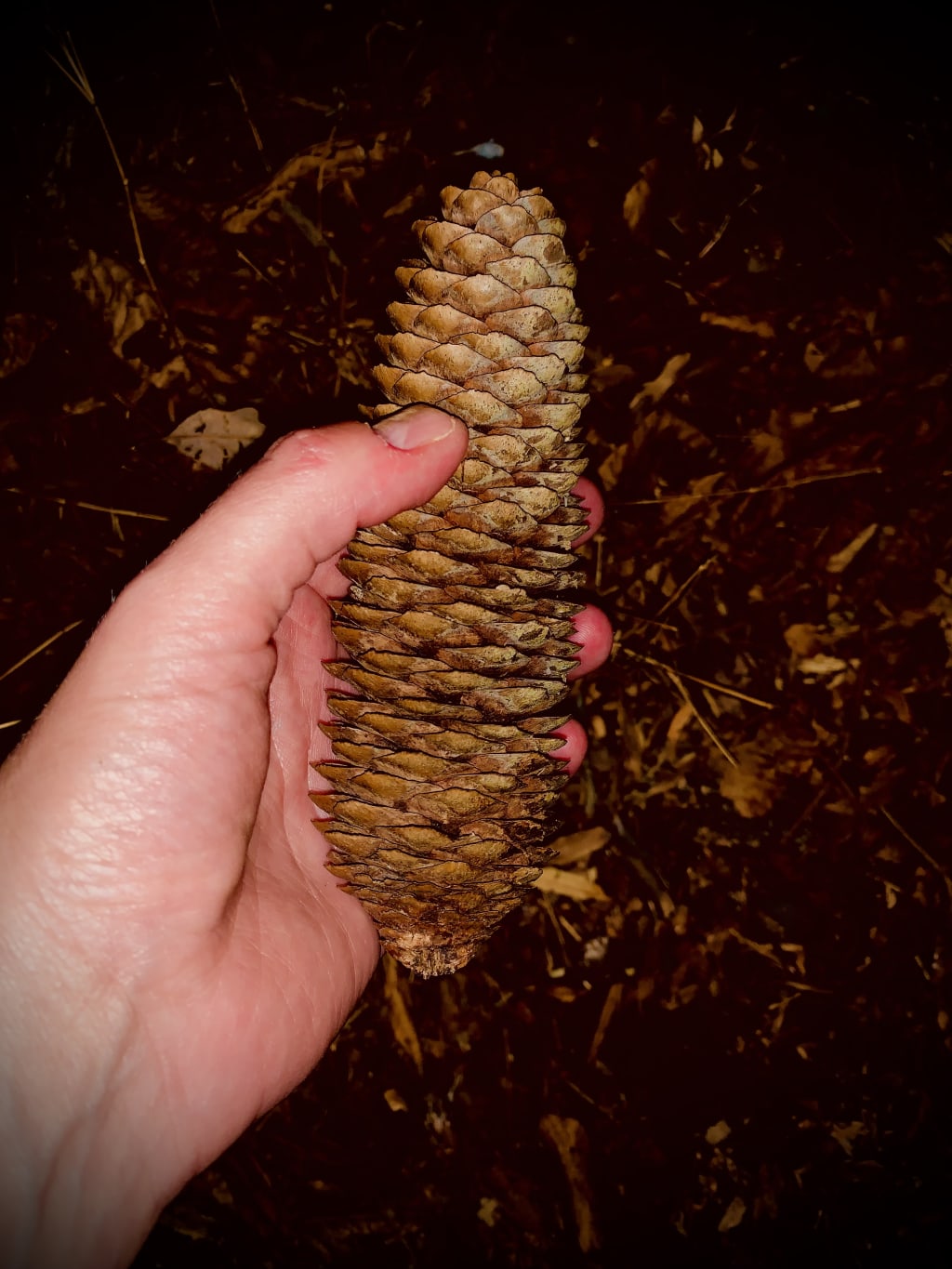
But the trees outside the window were her only friends. Nearly all else had been eliminated. The music of flitting birds, leaping deer, crunching squirrels, screaming fox – gone for good. All that remained were the silence - only ever broken by an empty, bullying wind - and the pines. They danced and jigged up from the earth, twirling around each other, sometimes in jolly conversation, sometimes in argument, but never hitting. Pine needle fingers made jazz hands for her, and when the pinecones were young, still golden and tender as the warmer air began to replace the cold and light began to replace the darkness, they flipped off the man when he came for her. These silent sitcoms broadcast through his window were her only relief, her only comfort after the Split.
The man’s only friends were his guns. He had all kinds: some long, some short, some heavy, some so light it couldn’t possibly have the strength to pry someone’s life away, but it had. All of the guns were cold and steely and dead. The man had even hidden some from the other men – a secret stash of weapons in case the other Splitters became too other. When the others of the compound had all gone, he had stalked from room to room, discovering they too had formed secret stashes. “Now we know who he really was” she had heard him huff from each room.
As dusky evening arrived, she continued her gazing out at the pines, wondering if she could grow her hair like Rapunzel and throw it to one of their outstretched arms; if they could hold on so taut that when the man returned to his room to steal her from the moonlight, he’d be unable to move her. Oh, how the pines called for her, begged her to forsake that stupid window, to run and run and run. The man would shoot her though – she didn’t have to wonder about that.
***
The next morning, she felt the rising sun tap her arm through the window. She opened her eyes from the sleepless night but couldn’t see for the sun admiring its reflection in her tears. She wiped away the mirrors in her eyes and peered out across the pines. There lay the closest, the pine she would’ve thrown Rapunzel hair too, crashed upon the earth, roots mangled and struggling in foreign air. It must have finally had enough of one of the hectoring winds – it not having as much cover as the other pines since it was closest to the tree line, to her and the compound. The branches of the pines standing over the fallen were broken, as if they had tried to catch their sibling as it finally succumbed. At least they had been able to say goodbye – she hadn’t been given the chance to say it the night before.
Suddenly the rays through the window grabbed her tight, twisted her into an ant under a magnifying glass. She had never felt them burn like this before, even when she had fallen asleep on a golden bale bed and awoken with tomato skin on her ancient mountain. Could this be the sun? Was she ill?
She slid slowly around the room, thinking she could quietly evade the burning by slipping along the cold, ashen concrete. Letting the shadows of a corner pull her in, she dragged the charcoal fleece blanket from his bed over her to camouflage further. But the burning kept on, surging until she felt hissing and popping, her eardrums popcorn kernels, her scalp a stove, her lungs a pot boiling over. It snapped her like one of the branches that had tried to save her fallen friend.
She began to scream and wretch – it burns, it burns, IT BURNS! She cried to the pines, at the sun. She screamed until she felt her veins verge on bursting, until her plight could be carried far enough to perhaps reach even the ears of the mountain older than bones. Until the whole of this stale world would be repopulated by her cries alone.
The man exploded into the room, but his temper was hosed by his unpreparedness for the sight before him. She lay clawing at the concrete, clawing at the blanket, clawing at her chest, screaming, screaming, screaming – for hours, then days, she wailed.
She wailed when the man pretended to console her. She wailed when he tried to beat her into silence. She wailed when he attempted to smother it out of her with the charcoal blanket, but was unable to stand her howling long enough. She wailed when he pushed his fingers so far in his ears that little red rivers flowed down to his collar. And she wailed when he lifted a cold, steely, dead muzzle to her forehead.
***
She awoke to the pines caressing her face with forest fingers, reaching down taupe arms to lift her. The moon wrapped her in a cooling glow and ignited a path through rollicking trees. The hoo-hoos of doting owl mothers and shy crunching of fours on a forest floor reverberated against a midnight sky, a protective womb speckled with stars, enveloping everything.
A gentle whoosh flowed through her fingers as she tenderly touched the breathing bark of each tree as she passed, the way one touches the cheek of a long, lost friend, finally found. She felt pine needles, and perhaps other leaves too, spring under each step as she walked indefinitely, rolling a pinecone in her unused hand, seemingly outside of time, until a kaleidoscope dawn began to blossom over the horizon. This new sun didn’t grab her or burn her, only softly took her hand, leading her to a clearing ahead that housed a crescent of bright little shelters.
Others dotted the lea, but they weren’t the Splitters, the misery manufacturers. This was a bustling prism of people, all genders between young and old, all shapes between tall and small – each adult tending their own plant or practicing their own art, addends of a sum, as the children laughed and learned and everyone tuned to the fauna songs floating around. Their steely tools glistened in a way she had seen before, but with more warmth, more life. She approached, wishing for caution but unable to hide. Or perhaps she was too drawn to hide?
“Come on.” Someone beckoned her over.
“Your tools. The plants. They didn’t have those anymore where I was. Where did you get them?”
“We valued smithing and growing more than shooting and owning.”
“How did you escape the Split?”
No one answered. They all just looked at her, nurturing faces reassuring her that she already knew. She rolled the pinecone a few final times in her fingers, feeling its tawny little claws grab at her fingertips as it passed through.
“I’d like to plant a pine.”
About the Creator
E. L. Stacy
E. L. Stacy’s love for writing began at childhood’s first stroke of a pen. Now 20 years into adulthood, E. continues to write as a means of confronting the world around her - past, present, and future.
Reader insights
Outstanding
Excellent work. Looking forward to reading more!
Top insights
Compelling and original writing
Creative use of language & vocab
Easy to read and follow
Well-structured & engaging content
Excellent storytelling
Original narrative & well developed characters
Heartfelt and relatable
The story invoked strong personal emotions
Masterful proofreading
Zero grammar & spelling mistakes
On-point and relevant
Writing reflected the title & theme
Keep reading
More stories from E. L. Stacy and writers in Fiction and other communities.
Pearl
1980 something. we all hung out at Pearl and you and i were nothing special, or so i thought. i mean we all danced, drenched in our own sweat, our own saline solution of fear, too many beers, shots, laughter, tears, fucks in the bathroom and i don't know when we began to be afraid. do you?
By ROCK aka Andrea Polla (Simmons)5 days ago in Fiction
Dr. Seuss Wrote Children's Books But He Had No Children
If I asked you who Theodor Seuss Geisel was, you would probably shake your head in dismay. However, if I told you I was referring to Dr. Seuss, you would say, "Oh, yes, my children have books written by Dr. Seuss."
By Margaret Minnicksa day ago in Fiction



Comments
There are no comments for this story
Be the first to respond and start the conversation.