
The Sparrow Who Fooled the King
This story draws on traditional folk motifs where small voices challenge great power, reminding us that wisdom lives among the people, not above them
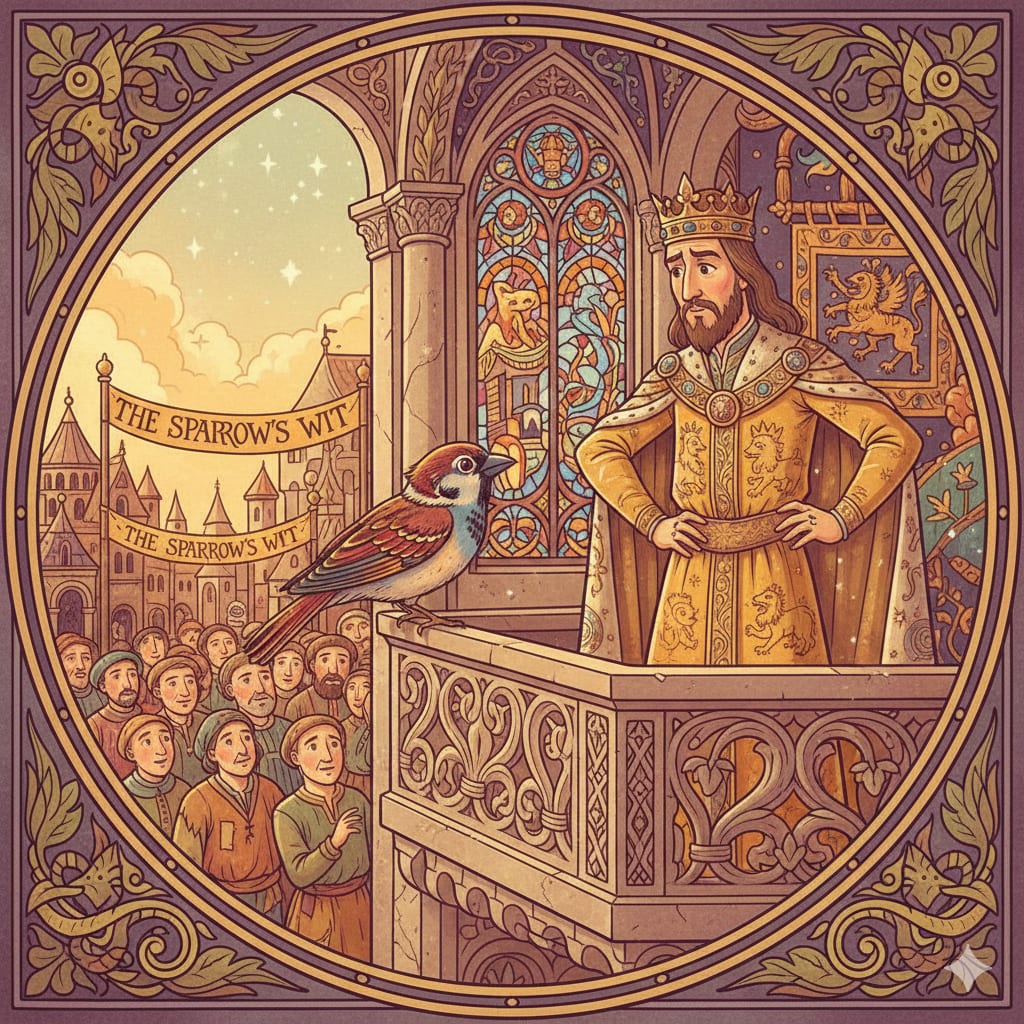
Long ago—long enough that stones still remembered footsteps and birds were not afraid of crowns—there lived a king who believed he was the smartest creature ever born.
He did not merely rule land and people.
He ruled ideas.
“If a thought is worth thinking,” the king proclaimed, “it must first pass through my mouth.”
People nodded. Not because they agreed, but because nodding is lighter than chains.
One morning, the king climbed onto his marble balcony and made a decree that echoed across the city:
“From this day forward, wisdom belongs to the crown.
No riddles may be spoken without permission.
No clever sayings without my seal.
Anyone caught being wiser than the king will be corrected.”
The crowd murmured uneasily. Wisdom, after all, is like smoke. Try to trap it, and it slips through your fingers laughing.
That laughter came from a sparrow.
The bird landed lightly on the balcony rail—small, dusty, unimpressed.
“O King of Great Head and Small Ears,” chirped the sparrow, “I hear you now own wisdom.”
The guards raised their spears at once.
The king smiled. “I do. Do you wish to borrow some?”
“No,” said the sparrow. “I wish to test it.”
A ripple of laughter passed through the crowd like wind through wheat. The king waved his hand.
“Very well,” he said. “Speak, crumb with feathers.”
The sparrow asked,
“What grows when shared, shrinks when hidden, and dies when owned?”
The king laughed loudly. “That is easy. Gold!”
The sparrow tilted its head. “Strange. Gold grows heavier, not wiser.”
The king frowned. “Then it is power.”
“Power grows teeth, not truth.”
The king’s face reddened like iron left too long in fire.
The sparrow said gently, “It is wisdom. And if you own it, it has already died.”
The square went silent. Even the guards shifted uneasily.
“Enough!” the king roared. “If you are so wise, prove it. Tomorrow I will ask you a question. Fail, and you lose your head.”
The sparrow bowed. “Fair. But if I win, you must admit wisdom lives outside your crown.”
The next day, the city gathered again. Merchants left their stalls. Children climbed rooftops. Even the old men came, leaning on memories.
The king asked,
“How many birds fly over this kingdom each day?”
The sparrow smiled. “Exactly half.”
The king laughed. “Wrong!”
“Then count the ones flying back,” said the sparrow.
Laughter burst from the crowd. The guards hid their smiles behind steel.
Furious, the king ordered a final test.
A mirror was brought and placed before him.
“What do you see?” the king demanded.
The sparrow replied, “A man afraid of silence.”
“I see a king,” the ruler snapped.
“Exactly,” said the sparrow. “That is the problem.”
For the first time, the square fell completely quiet.
The king stepped down from the balcony. Slowly, he removed his crown.
“Perhaps,” he said at last, “wisdom cannot be owned.”
The sparrow fluttered upward. “It can only be visited.”
The bird was never seen again.
But after that day, the markets grew louder with stories. Children asked dangerous questions. Old women spoke truths sharper than swords.
And whenever a ruler tried to claim wisdom, people would look up, smile, and listen for wings.
About the Creator
Iqbal
Iqbal was a visionary poet
Ludacris and Nelly draw backlash over bookings at MAGA-coded music festival
Ludacris and Nelly headlining a mostly right-wing event is good for them. It’s also great for the genre of hip hop. The two rap veterans have showcased their talents on other stages. Why can’t they perform for mostly MAGA folks and grab that bag?
By Skyler Saunders6 days ago in Beat


Comments
There are no comments for this story
Be the first to respond and start the conversation.