
The Sound of Dust.
Sometimes the quietest moments echo the loudest truths.

The Sound of Dust.
BY [ WAQAR ALI ]
Sometimes the quietest moments echo the loudest truths.
The sun had just begun its descent, casting long shadows across the cracked earth of the village. Dust lingered in the air, kicked up by footsteps that came and went without purpose—shuffling, searching, surviving.
Adil stood outside his grandfather’s abandoned shop, the wind tugging softly at his kurta. The wooden sign above the door still read "Iqbal & Sons – Textiles & Threads" though most of the lettering had faded into a ghostly gray. The shop hadn’t opened in years, not since his grandfather died and his father moved to the city, leaving behind nothing but empty rooms and memories trapped between the walls.
But Adil had come back.
Not for business. Not even for family. He came because the city had grown too loud for him—too many voices, too many opinions, too many false starts. At twenty-nine, he had tried being everything: a student, a seller, an artist, a partner. None of it had fit.
So he returned to the place where time moved slower. Where mornings began with prayer, not traffic. Where people knew your name—and more importantly, your father's name.
He reached into his pocket and pulled out a small notebook, the one he had carried since college. Its pages were filled with half-poems, dream fragments, drawings of strange birds, lists of "things to do before 30" that no longer made sense. He flipped to a blank page and scribbled:
"Sometimes the dust speaks louder than the wind."
A line. Just a line. But it felt honest.
Inside the shop, light filtered through the broken shutters, striping the empty shelves in gold. He stepped in slowly, as if entering a shrine. The air smelled of old cloth and sunbaked wood. A broken fan hung from the ceiling, rusted into stillness.
He remembered standing at the counter as a child, watching his grandfather cut fabric with a heavy pair of iron scissors. The shop had been full of color back then—rolled silks, cotton in pastel shades, glass jars filled with buttons and beads.
Now it was just shadows and silence.
Adil dragged an old stool to the center of the room and sat down, notebook in hand. He didn’t write. Not yet. He listened—to the creak of the beams, the hum of the ceiling, the occasional bark of a distant dog. He wanted the place to tell him what to say.
The village didn’t care much for poetry. His cousins laughed at the idea. "You're writing feelings now?" they'd tease. "Why don’t you write a resume instead?"
But here—where he could hear the soil breathe, where the air carried the scent of ripe mangoes and damp earth—poetry felt like survival. Like translation.
He spent the next few hours dusting shelves, pulling open drawers, unwrapping forgotten bundles of cloth. In one, he found an old photo: his grandfather standing beside a younger version of his father, both smiling, eyes squinting into the sun. They were surrounded by stacks of fabric taller than the youngest child.
Behind the counter, tucked into a rusted cash box, Adil discovered a folded letter. The ink had faded, but he could still make out the words—written in his grandfather’s slow, looping Urdu:
"This shop is not made of bricks, but of time. It is not a place to sell, but a place to see. Every person who walks in brings a thread. Some leave it behind. Some carry it with them. But every thread has meaning, if you look closely enough."
Adil read it three times, letting the words stitch themselves into his chest.
Maybe he didn’t need to restart the shop as it was. Maybe he could remake it in a new way. A place for stories, not sales. A space where people could write what they couldn't say aloud. A quiet corner of the world for the loudest thoughts.
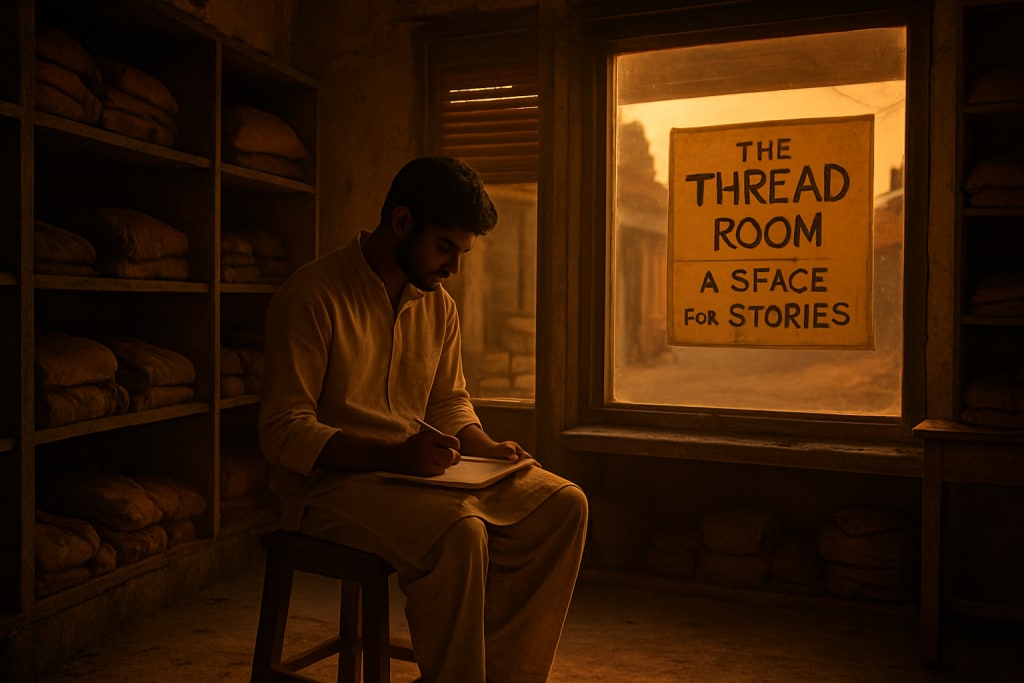
That night, he cleared the counter, lit a single lantern, and pinned a handwritten sign to the front window:
"The Thread Room — A Space for Stories."
Below it, a second note in smaller print:
"Come. Sit. Write something true."
And they did.
First, the shy girl from the bakery. Then the elderly man who always walked barefoot near the canal. Then a group of teenagers who didn't know where else to go when school felt too tight. One by one, they came. Some wrote letters. Some wrote confessions. Some wrote names they hadn’t dared to speak.
Adil didn’t try to fix anything.
He just kept the lantern lit.
About the Creator
WAQAR ALI
tech and digital skill
Resurrection Sunday
The bell of St. Catherina’s Chapel rang out over the town of Black Hollow, its mournful toll cutting through the crisp Easter morning. The sound sent shivers down the spines of the townsfolk, who hurried to the chapel with lowered heads and heavy hearts. Easter was no time for joy in Black Hollow. It was a time of reckoning.
By V-Ink Stories2 days ago in Fiction
Wild Card Weekend Recap: What Happens Now?
I think I figured out why I love Wild Card Weekend so much. It's because it's the first playoff anything of the calendar year. The NFL season starts in the fall, and once upon a time, the champion was crowned either on or slightly before New Year's. The evolution of the NFL schedule has resulted in the playoffs starting just into the New Year, and currently, the final week of the season falls on the first weekend of the New Year, with Wild Card Weekend coming a week after that. So yes, chronologically, the NFL's Wild Card Weekend serves as the first playoff anything of the calendar year.
By Clyde E. Dawkins5 days ago in Unbalanced




Comments
There are no comments for this story
Be the first to respond and start the conversation.