
The Song of the Fireflies
A Dance of Light and Memory

The Song of the Fireflies
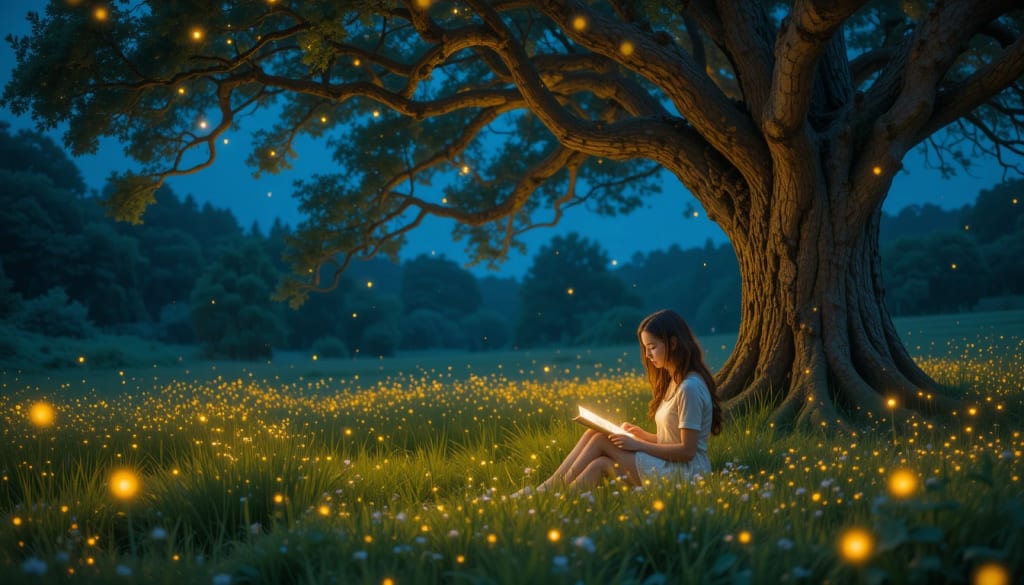
The meadow at the edge of our village was a secret kept by summer nights, where fireflies danced like tiny lanterns under a velvet sky. I was Tara, fifteen, with a heart full of questions and a notebook full of half-written poems. My grandfather, Nana, called the meadow his “thinking place.” He’d take me there when the world felt too heavy, his old harmonica in his pocket, ready to play a tune that made the stars seem closer.
“Tara,” he’d say, his voice rough like the bark of the oak we sat under, “the fireflies aren’t just bugs. They’re memories, flickering to remind us who we are.” I’d giggle, thinking he was teasing, but I loved his stories. They turned the ordinary meadow into a place of magic, where every light held a tale.
One humid evening, with the air thick and the fireflies brighter than ever, Nana told me a story that changed everything. We sat on our usual blanket, the grass cool beneath us, his harmonica glinting in the moonlight. “Long ago,” he began, “there was a girl named Elara, barely older than you. She loved the meadow, but she wasn’t just chasing fireflies—she was listening to them. They sang to her, not with sound, but with light. Each flicker was a note, each pattern a song of the village’s heart.”
I leaned in, the fireflies’ glow reflecting in my eyes. “What kind of songs?”
Nana’s smile was soft, his gaze far away. “Songs of love, loss, hope. Elara learned to read their light, and she wove their songs into melodies that healed broken spirits. One summer, when a drought stole the village’s crops, she played a song that brought rain. Another time, when grief silenced the people, her melody brought laughter back. They called her the Firefly Singer, and her songs are still out there, in the meadow.”
“Where is she now?” I asked, my voice small against the night’s hum.
“No one knows,” he said. “Some say she became a firefly herself, her light forever dancing. Others say her songs are waiting for someone new to hear them.”
I laughed, sure it was one of his fanciful tales. But that night, as the fireflies swirled, I swore their lights pulsed in rhythm, like a heartbeat. I closed my eyes, trying to hear what Nana heard, but all I got was the rustle of leaves and the distant croak of frogs. Still, I fell asleep on the blanket, dreaming of a girl playing a melody that made the stars sway.
Years passed, and the meadow stayed my refuge. But the village was changing—new houses crept closer, and the city’s glow dimmed the stars. Nana grew quieter, his harmonica played less often. I saw the sadness in his eyes, the way he lingered in the meadow as if saying goodbye. I wanted to stay, to keep his stories alive, but I also dreamed of the city—poetry slams, bright stages, a life beyond the valley.
At eighteen, I left for the city, my notebook stuffed with poems and a small harmonica Nana had given me. The city was alive—cafes buzzing, streets pulsing with music. I read my poems at open mics, my words finding a rhythm I hadn’t known I had. But at night, when the neon faded, I’d clutch the harmonica, hearing Nana’s tunes in my mind. I missed the meadow, the fireflies, the way his stories made the world feel infinite.
Two summers later, a call came. Nana was fading, his heart weak. I returned to the village, the meadow unchanged, its fireflies still dancing. Nana was in bed, his harmonica on the table beside him. “Tara,” he whispered, “go to the meadow. Listen.”
That night, I walked to our oak, the blanket under my arm. The fireflies were out, their lights brighter than I remembered. I sat, my notebook open, and played a shaky note on the harmonica. The sound felt wrong, too loud for the quiet night. But then, something shifted. The fireflies’ lights pulsed in time with my notes, their glow weaving patterns—faces, moments, memories. I saw Nana teaching me to whistle, the village dancing at a festival, my mother’s smile before she left us. My breath caught, my hands trembling. Was this Elara’s song?
I played on, the harmonica’s notes blending with the fireflies’ light. The patterns grew clearer—a drought ending with rain, children laughing, Nana’s face lit with pride. I saw a future, too—the meadow preserved, the village alive with music, young poets learning under the oak. Tears streamed down my face. This wasn’t just light. It was us—our joys, our sorrows, our songs.
By dawn, I’d filled pages with new poems, each one humming with the meadow’s magic. Nana saw them and smiled, his hand weak but warm in mine. “You heard it,” he said. “Elara’s gift. It’s in you.”
Nana passed soon after, but I stayed. I started a poetry circle in the meadow, teaching kids to listen to the fireflies, to write what they saw in their light. The village rallied, protecting the meadow from developers. People came from the city to hear our poems, to see the fireflies’ dance. The songs never stopped, and neither did we.
Sometimes, when I play the harmonica at dusk, I feel Elara’s presence—her quiet joy, her love for the light. The fireflies still sing, carrying memories, dreams, and secrets. And I, Tara, am their keeper, weaving their songs into words that light up the night.
About the Creator
Shohel Rana
As a professional article writer for Vocal Media, I craft engaging, high-quality content tailored to diverse audiences. My expertise ensures well-researched, compelling articles that inform, inspire, and captivate readers effectively.
Keep reading
More stories from Shohel Rana and writers in Fiction and other communities.
The Mirror’s Debt
The town of Greystone was a place where history clung like damp rot, its streets lined with sagging storefronts and memories no one cared to recall. Tucked at the end of Mill Lane was Hollow’s Antiques, a shop so old it seemed to grow from the earth itself. Most folks avoided it, muttering about strange lights or whispers from within. But for Tessa Wren, the shop was her inheritance—and her curse.
By Shohel Rana8 months ago in Fiction
Miss Persephone's Manual to a Seemingly Ordinary Life
Miss Persephone was found at the dining table, her blue eyes swollen, her tears arriving and retreating like the tides of the ocean. Earlier that day, her family had visited her in the retirement home where she had lived for eight years. It was her eightieth birthday.
By Imola Tóth6 days ago in Fiction
Smart phones, Humans and Aliens.
WARNING. I will be tapping into one of your favorite creative tensions: The absurdity of humans worshipping their glowing rectangles as if they were tiny oracles. There’s something deliciously poetic about that contradiction, and it lends itself beautifully to an instructive proviso.
By Novel Allen5 days ago in Poets


Comments
There are no comments for this story
Be the first to respond and start the conversation.