

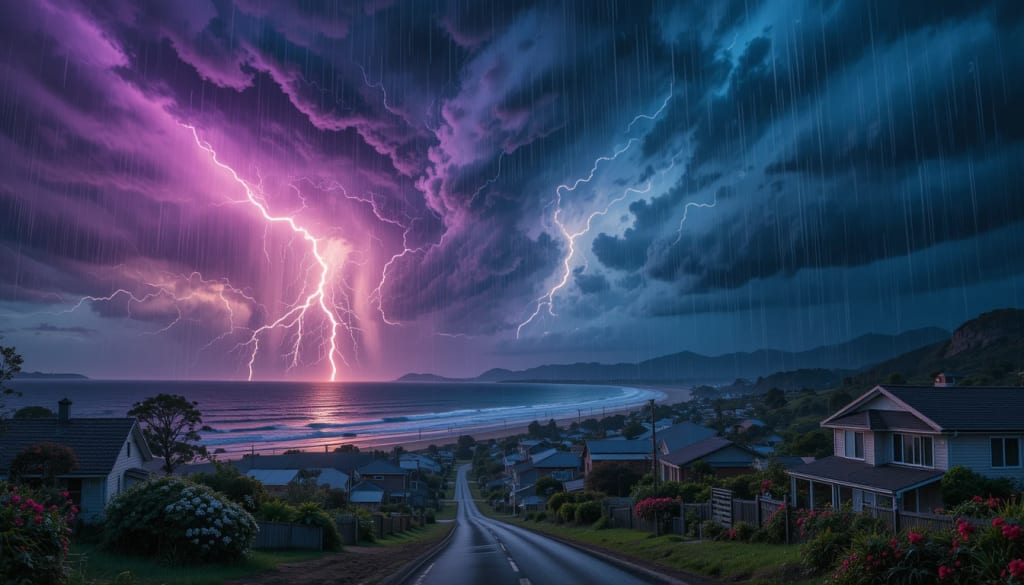
On a humid June night in 2025, the sleepy coastal town of Haven’s End, nestled along Australia’s southern shores, braces for an unnatural storm. The sky churns with colors no meteorologist can explain—violet streaks and golden fissures—before unleashing rain that feels alive, stirring forgotten memories of the townspeople’s past sins. From a fisherman’s betrayal to a teacher’s buried scandal, these secrets rise like specters, demanding amends. As the storm intensifies, threatening to swallow the town, its residents must confront their guilt or face annihilation. This tale weaves the beauty of nature’s fury, the psychology of memory, and the hope of redemption into a gripping narrative.
The Storm’s Arrival
Haven’s End, with its weathered cottages and salty air, has always lived by the sea’s rhythm. On June 2, 2025, at 1:27 AM AEST, the horizon glows unnaturally as locals gather on the cliffs. Old Tom, a fisherman, squints at the sky, muttering, “This ain’t right.” The storm hits with a roar, raindrops heavy as stones, carrying whispers—memories long suppressed. Tom recalls abandoning a crewmate decades ago, leaving him to drown in a squall. Across town, Sarah, a retired schoolteacher, hears a child’s cry in the deluge, triggering guilt over a student she failed to protect from bullies, a secret she buried with tenure.
The storm isn’t just weather; it’s a catalyst. Meteorologists on the news call it an anomaly, with winds reaching 150 km/h and electrical discharges defying patterns. Yet, the townsfolk feel it personally—each drop seems to know their shame. This supernatural twist echoes folklore, like the biblical flood or Indigenous Dreamtime stories of nature punishing imbalance, blending cultural resonance with eerie suspense.
The Psychology of Memory
The storm’s power to unearth memories taps into a fascinating psychological phenomenon. The human brain stores trauma in the amygdala, often locking it away until triggered. Dr. Bessel van der Kolk, in The Body Keeps the Score, explains how sensory cues—like rain or wind—can unlock these hidden vaults. For Haven’s End, the storm acts as a collective trigger, forcing residents to relive guilt they’ve avoided. A 2021 study in Nature Neuroscience suggests environmental stress can enhance memory recall, particularly of emotional events, aligning with the storm’s effect.Tom’s memory of his crewmate, Jack, surfaces with vivid detail—the cold water, Jack’s pleas. Sarah remembers the boy’s tear-streaked face, her silence a betrayal. These flashbacks aren’t random; they’re tied to unresolved guilt, a psychological debt the storm demands be paid. The narrative explores how memory, when suppressed, festers, waiting for a reckoning like this unnatural tempest.
A Town Divided by Secrets
As dawn breaks, Haven’s End fractures. Tom confesses to his son, Mark, who storms off, furious at the legacy of cowardice. Sarah faces the boy’s mother, now elderly, offering a tearful apology that’s met with silence. Other sins emerge: a shopkeeper’s price-gouging after a past disaster, a mayor’s cover-up of a toxic spill. The rain amplifies these revelations, its rhythm matching the townsfolk’s confessions, as if the sky judges their sincerity.
The community’s response splits between denial and action. Some, like the mayor, blame the storm on climate change, refusing to acknowledge their role. Others, led by a young pastor, Emily, see it as a call to repent. Emily organizes a town meeting, her voice steady amid the howling winds: “We can’t outrun this. We face it together.” Her leadership mirrors real-world resilience, like post-disaster communities in Queensland after Cyclone Yasi, where unity fostered recovery.
The Storm’s Escalation
By midday, the storm worsens. Lightning strikes the old lighthouse, a symbol of Haven’s End’s endurance, sending it crumbling into the sea. The rain turns acidic, eroding rooftops, while visions of past sins haunt the streets—shadows of the drowned crewmate, the bullied child. A scientific angle emerges: the Australian Bureau of Meteorology reports anomalous atmospheric pressure drops, hinting at a rare convergence of natural and unexplained forces. Yet, the townsfolk feel it’s more—punishment tied to their unconfessed pasts.
Tom ventures into the storm, seeking the spot where Jack died, laying a wreath as amends. Sarah visits the boy’s grave, planting flowers, her tears mixing with the rain. These acts of contrition seem to calm the tempest briefly, the violet streaks fading. The narrative suggests a symbiotic link: the storm’s fury mirrors the town’s collective guilt, its abatement a reward for reconciliation.
The Cultural Echoes
The story draws on cultural motifs of nature as a moral arbiter. In Greek mythology, Zeus sent storms to punish hubris; in Aboriginal lore, the Rainbow Serpent brings floods to cleanse or warn. Haven’s End’s storm feels like a modern echo, blending these traditions with a coastal Australian identity. The town’s name, Haven’s End, hints at a sanctuary turned to reckoning, a poetic nod to its fate.
Literature offers parallels too. Hawthorne’s The Scarlet Letter explores public shame, while Shelley’s Frankenstein warns of nature’s revenge on human folly. Echoes of Truth aligns with this, using the storm to expose and redeem, its beauty—violet skies, crashing waves—contrasting its destructive force. This duality captivates, inviting readers to see nature as both mirror and judge.
The Turning Point
As night falls, the storm peaks. A tidal surge threatens to submerge Haven’s End, and Emily leads a vigil on the beach, urging confessions. Tom admits his abandonment to the crowd, Sarah her negligence, and others follow—petty thefts, lies, a hidden affair. The air crackles with emotion, the rain softening to a gentle patter. Suddenly, the sky clears, the unnatural colors replaced by stars. The surge recedes, leaving the town intact but transformed.
The resolution hinges on collective atonement. Psychologists like Dr. Everett Worthington, who studies forgiveness, note that communal reconciliation can heal trauma. The storm’s retreat suggests a metaphysical balance restored, though the townsfolk know their scars remain. This moment blends hope with realism, a beautiful yet grounded conclusion.
The Aftermath and Legacy
In the days that follow, Haven’s End rebuilds. Tom and Mark reconcile, fishing together as a tribute to Jack. Sarah starts a mentorship program, honoring the boy she failed. The mayor resigns, and a community council forms, vowing transparency. The storm becomes legend, a story told to children with a mix of awe and caution. Emily’s leadership earns her a permanent role as town mediator, her faith a beacon.
The narrative reflects real-world climate psychology. A 2022 study in The Lancet Planetary Health found that extreme weather can spur community action, as seen in Haven’s End. The town’s redemption arc offers a model for facing environmental and personal crises, blending informative insight with captivating storytelling.
A Broader Reflection
The Sky Came Crashing Down is more than a tale of survival; it’s a meditation on guilt, memory, and renewal. The storm’s beauty—its violet hues, its raw power—mirrors the complexity of human nature, urging us to confront our shadows. In a world grappling with climate change and personal reckonings, Haven’s End’s journey resonates, reminding us that amends can transform even the darkest storms. It’s a story of hope, wrapped in the wild embrace of nature.
Writing this felt like stepping into Haven’s End myself—the salt air, the tension, the quiet after the storm. I’ve always been drawn to stories where nature and human flaws collide, and this one let me explore that fully. I hope it stirs something in you too—maybe a memory or a thought about making things right. Thanks for reading; I’d love to hear your take on it!
About the Creator
Shohel Rana
As a professional article writer for Vocal Media, I craft engaging, high-quality content tailored to diverse audiences. My expertise ensures well-researched, compelling articles that inform, inspire, and captivate readers effectively.
Keep reading
More stories from Shohel Rana and writers in Fiction and other communities.
Echoes of Truth
In the quiet hum of a rainy Tuesday morning on June 3, 2025, book reviewer Elise Harper sits in her Melbourne apartment, flipping through an unsolicited manuscript titled Echoes of Truth by a mysterious Mara Lane. What begins as routine work spirals into a chilling discovery: the novel mirrors Elise’s life with uncanny precision, from her childhood in a coastal town to her darkest secrets—affairs, regrets, even the miscarriage she never told a soul about. As Elise digs into the author’s identity, she uncovers a conspiracy that blurs the lines between fiction and reality, forcing her to confront her past and question her sanity. This tale weaves together the allure of literature, the psychology of identity, and the unsettling power of hidden truths.
By Shohel Rana8 months ago in Fiction
Miss Persephone's Manual to a Seemingly Ordinary Life
Miss Persephone was found at the dining table, her blue eyes swollen, her tears arriving and retreating like the tides of the ocean. Earlier that day, her family had visited her in the retirement home where she had lived for eight years. It was her eightieth birthday.
By Imola Tóth6 days ago in Fiction
Smart phones, Humans and Aliens.
WARNING. I will be tapping into one of your favorite creative tensions: The absurdity of humans worshipping their glowing rectangles as if they were tiny oracles. There’s something deliciously poetic about that contradiction, and it lends itself beautifully to an instructive proviso.
By Novel Allen5 days ago in Poets



Comments
There are no comments for this story
Be the first to respond and start the conversation.