
The Silent Village
I stumbled upon a village that wasn’t on any map. No one spoke, but everyone seemed to know my name

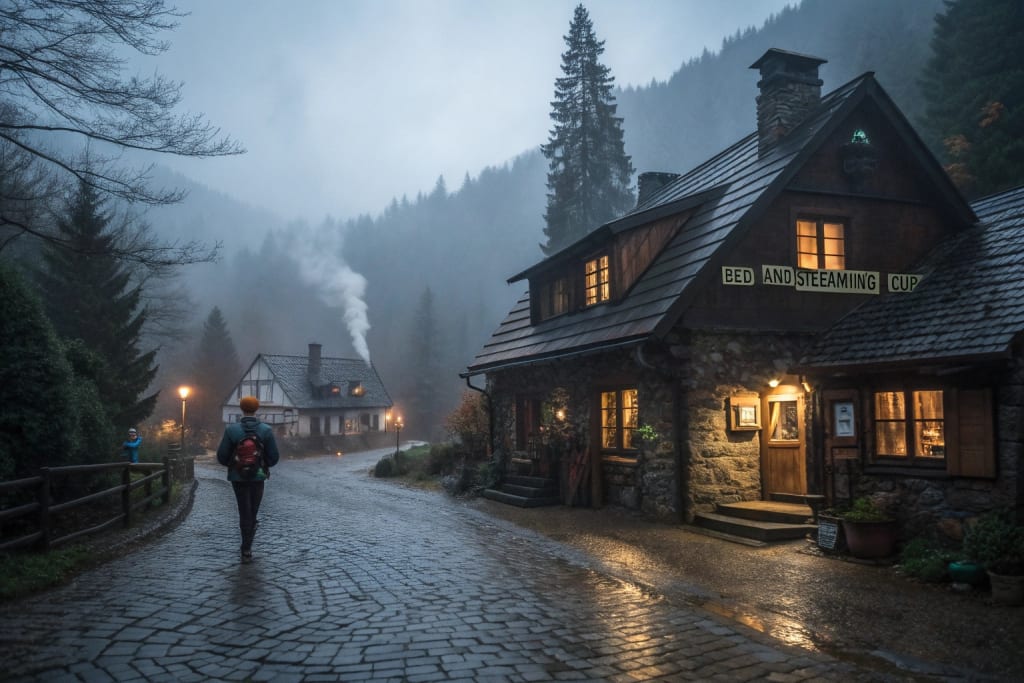
The rain had been falling for hours, a steady deluge that transformed the dirt road into a soupy mess. My hiking boots sank ankle-deep with each step as I trudged forward, squinting through droplets that clung to my eyelashes. According to my GPS, I should've reached the main highway twenty minutes ago, but the dense forest showed no signs of thinning.
I checked my phone again—no signal. The screen flickered and died, the battery finally surrendering to the inevitable. Perfect. Lost in unfamiliar woods with no way to call for help and no idea which direction led back to civilization.
As darkness began to settle between the trees, panic crept along my spine. Spending the night out here wasn't an option; the temperature was dropping rapidly. I picked up my pace, ignoring the burning in my calves as I climbed yet another hill.
When I reached the crest, I stopped, momentarily forgetting my discomfort. Below me, nestled in a shallow valley, lay a village. Warm light spilled from windows, creating golden rectangles on the wet cobblestone streets. Smoke curled from chimneys, promising warmth and shelter.
I fumbled for my hiking map, unfolding the soggy paper under the meager protection of a pine tree. There was no village marked anywhere near my location—nothing but wilderness for miles. Strange, but at this point, I wasn't about to question my good fortune.
The rain eased to a drizzle as I made my way down the hillside toward the cluster of buildings. The architecture seemed oddly timeless—sturdy stone structures with steep slate roofs, neither modern nor particularly ancient. No power lines ran between the buildings, I realized. Perhaps they buried their utilities underground.
As I entered the main street, the first thing that struck me was the silence. Despite the smoke rising from chimneys and lights in windows, I saw no one outside. No voices carried on the evening air, no music played, no televisions hummed from within the homes.
I approached what appeared to be an inn, a wooden sign swinging gently in the breeze. The carved image showed a bed and a steaming cup, universal symbols that transcended language. Relief washed over me as I pushed open the heavy wooden door.
Inside, a dozen faces turned toward me. Men and women of various ages sat at wooden tables, some with drinks before them, others with bowls of stew. A fire crackled in a stone hearth at the far end of the room, casting everything in a warm, amber glow.
Yet despite all the people, the silence remained unbroken.
I cleared my throat. "Hello," I said, my voice sounding unnaturally loud. "I'm sorry to intrude. I got lost in the woods, and my phone died. Could I possibly stay the night and get directions in the morning?"
No one spoke. Instead, the innkeeper—at least, I assumed he was the innkeeper, given his position behind the bar—smiled and nodded. He was an older man with thick gray hair and kind eyes that crinkled at the corners. Without a word, he reached beneath the counter and produced a key with a wooden tag attached.
When he held it out to me, I saw my name carved into the wood: Daniel.
My breath caught. "How did you—" I began, but the words died in my throat as the innkeeper pressed a finger to his lips, his expression gentle but firm.
No talking. That was clearly the rule here.
I took the key, confusion mingling with unease. A young woman stood from her table and gestured for me to follow. Like the innkeeper, her manner was warm and welcoming despite her silence. She led me to a small room at the top of a narrow staircase, where a bed with fresh linens awaited, along with a basin of steaming water and a towel.
After she left, I sat on the edge of the bed, trying to make sense of what was happening. How did they know my name? Why didn't anyone speak? And why wasn't this village on any map?
Sleep came fitfully that night, filled with dreams of silent faces watching me from doorways and windows.
Morning brought sunlight streaming through lace curtains and the smell of baking bread. I found clean clothes folded at the foot of my bed—not my own, but they fit perfectly. A woolen sweater in deep green, sturdy trousers, and soft leather boots.
Downstairs, breakfast awaited. The innkeeper's wife—I guessed from her familiar way of moving around the space—served porridge drizzled with honey and fresh bread still warm from the oven. Other villagers came and went, acknowledging me with nods and smiles. Some pointed at my bowl when it was empty, offering more. I declined with a shake of my head and a grateful smile of my own.
I was adapting quickly to their wordless communication.
After breakfast, I ventured outside. The village was beautiful in the morning light. Flower boxes brightened windowsills, and vegetable gardens flourished behind picket fences. Children played in the village square, their games conducted in perfect silence—no shouts of joy or playful arguments, just exuberant movement and expressive faces.
An elderly woman tending her garden waved me over. She pointed to a wooden sign beside her gate, where my name was carved alongside a simple drawing of hands planting seeds. An invitation to help.
Throughout the day, similar signs appeared. My name on the blacksmith's door, next to an image of bellows. My name on a basket of wool at the weaver's cottage. My name carved into a chair at the communal dining table.
Everyone knew me, expected me, welcomed me—all without a single spoken word.
Days passed in this strange, silent rhythm. I learned to listen differently—to footsteps and breathing, to the rustle of clothing and the cadence of movements. I learned to watch faces more carefully, to read the minute shifts in expression that conveyed complex thoughts and emotions.
And slowly, I began to understand.
Sound traveled oddly in this hidden valley. Whispers became shouts, normal conversation unbearably loud. The villagers had adapted over generations, developing a rich language of gestures and expressions. They could communicate everything they needed without words.
But that didn't explain how they knew my name, or why they seemed to have been expecting me.
The answer came on the seventh night, when the innkeeper led me to a small building on the edge of the village. Inside, the walls were covered with intricate paintings—a visual history of the community.
And there I was, depicted in scene after scene. Planting gardens. Mending roofs. Growing old among these people.
In the final image, I stood beneath a tree, teaching a group of children to shape their hands in strange gestures—sign language, I realized. I was going to teach them a more sophisticated silent language.
The innkeeper pressed something into my palm. My phone—repaired, recharged, and showing full signal. A choice.
I could call for help, return to my old life with its constant noise and chatter, its mindless distractions and superficial connections.
Or I could stay in this silent village that had been waiting for me, where communication went beyond words to something deeper and more meaningful.
I looked at the innkeeper. His eyes asked the question his voice did not.
I slipped the phone into my pocket and smiled.
Some stories don't need to be told aloud to be understood.
About the Creator
A S M Rajib Hassan Choudhury
I’m a passionate writer, weaving gripping fiction, personal essays, and eerie horror tales. My stories aim to entertain, inspire, and spark curiosity, connecting with readers through suspenseful, thought-provoking narratives.
Keep reading
More stories from A S M Rajib Hassan Choudhury and writers in Fiction and other communities.
The Doll Maker's Curse
Any collector or treasure hunter will find something about estate sales to pique their interest. They had always captivated me; the antique trinkets, faded books, and dusty furniture loaded with lost stories drew me. Nothing, though, could have prepared me for the day I came and found an apparently harmless vintage doll that would transform my house.
By A S M Rajib Hassan Choudhury10 months ago in Fiction
After the Storm
After the storm of winter snow there sat a small bear by the name Ted, of course. He loves the snow and likes to roll around in it making all sorts of trails and whatever he has a mind to do. He wondered where all the people are, but in a way, he is hoping that they are all snug in the homes maybe drinking hot chocolate-one of his favorite drinks with mini-marshmallows and eating something homemade for he likes this winter wonderland all to himself to romp and play and maybe even catch some fish down by the river.
By Mark Graham3 days ago in Fiction
The Strong Word
Studio lights permitted the viewer enough visual stimulation as a NASA engineer’s workspace. The producer, Latrell “Real Weight” Voight, looked black as root beer. He queued up a video of a documentary depicting the construction of a skyscraper in Wilmington, Delaware a few blocks away. The engineer, Argent “Clean Bill” Boggs, possessed the skin color of an oak tree.
By Skyler Saundersa day ago in Fiction




Comments
There are no comments for this story
Be the first to respond and start the conversation.