
The Silent Mountain
In 1947, five strangers climbed the Carpathians in search of forgotten legends. Only one returned.

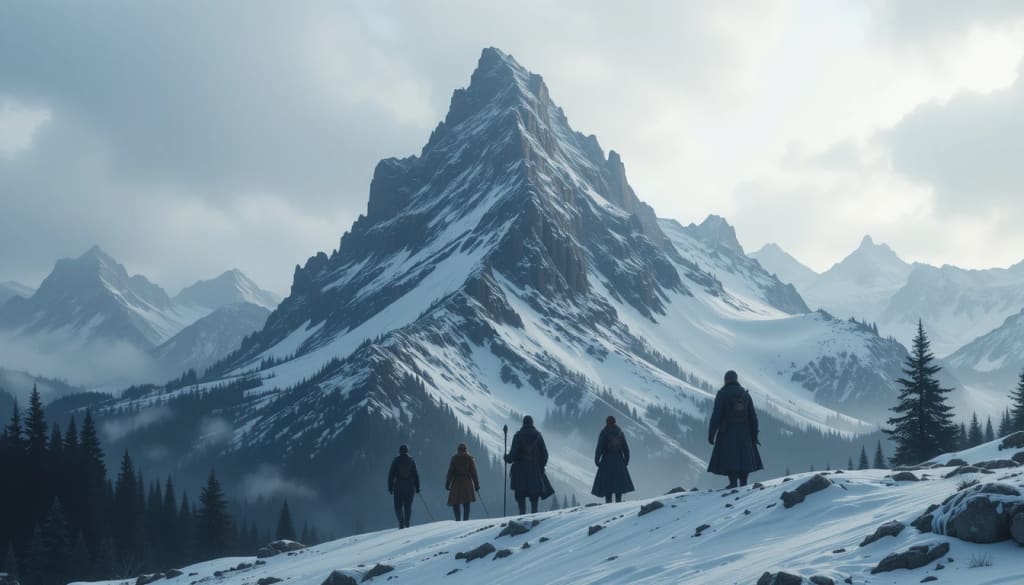
The Silent Mountain
Written by Noor Khan
Part I: The Whisper of the Carpathians
In the autumn of 1947, just two years after the end of World War II, Europe was still licking its wounds. Towns were rebuilding, families were reuniting, and the continent's scars ran deeper than any map could show. But in a quiet café on the outskirts of Brașov, Romania, a different story was about to unfold.
The café was filled with cigarette smoke and murmurs when a man named Elias Kovács stepped inside. A Hungarian linguist and former codebreaker during the war, Elias wasn’t there for coffee. He carried a leather satchel filled with maps, letters, and a single photograph: a grainy black-and-white image of a snow-covered mountain with strange markings near its peak.
“I need a team,” Elias said quietly to the woman sitting at the corner table.
Her name was Ana Petrova, a Bulgarian geologist who had studied fault lines all through the Balkans. She took a sip of tea, then nodded slowly. “I’ve heard of this mountain. Locals call it Tăcerea, the Silent One. No birds fly near it. No one who climbs it ever speaks of what they saw.”
By the end of that week, five had joined the expedition:
Elias, the linguist and seeker of hidden codes.
Ana, the scientist chasing seismic anomalies.
Luca, an Italian war photographer haunted by the past.
Elena, a Polish nurse turned herbalist, fascinated by ancient cures.
And Henrik, a stoic Austrian mountaineer with lungs like bellows and eyes that missed nothing.
They set off from Brașov with mules, canvas tents, and little fanfare. Their destination: a forgotten path through the southern Carpathians, rumored to lead to a site that predated Roman rule—a mountain lost in silence and time.
---
Part II: The Mountain That Watched
The climb began gently. Green meadows gave way to dense fir forests. Villagers in nearby hamlets whispered warnings in half-lost dialects: “Don’t stay on the mountain after sundown.” Others simply crossed themselves and closed their doors.
On the third night, as the group camped near a frozen stream, Henrik said he’d seen figures among the trees—silent, unmoving, and gone when he looked back.
“Elk, maybe?” Luca offered.
Henrik shook his head. “Elk don’t watch. These did.”
On the fifth day, they reached the base of Tăcerea. The snow was thin but icy. Strange spirals were carved into the rocks—patterns that Elias matched with symbols found in a pre-Christian manuscript from Transylvania. “These weren’t just markings,” he said. “They’re warnings. Directions, maybe. Or barriers.”
Elena found herbs growing where no light reached. “This plant shouldn’t exist here. It’s used in rituals... old ones.”
And Ana, placing a seismograph into the ground, discovered constant vibration—not from the earth below, but from within the mountain itself.
That night, the wind howled in bursts like whispers. The fire wouldn't stay lit. Luca’s camera snapped twice—no one had touched it.
---
Part III: The Descent into Silence
On the seventh morning, Henrik didn’t wake up. He was alive, but stiff as stone, eyes wide open, lips murmuring nonsense in an unknown tongue. When Elias leaned closer, he gasped.
“He’s repeating the same five words… over and over. But it’s not a language I know.”
They tried to carry Henrik down the mountain, but as they descended, the mountain began to change. The trail they had marked was gone. The rock underfoot seemed to breathe. Luca tried to photograph the spirals again, but every picture came out black—except one, which showed six shadows instead of five.
Panic set in.
Elena, normally calm, broke down crying. “We were warned. We shouldn’t have come here. This isn’t science or history—it’s something older. Something angry.”
On the ninth day, with food low and sanity fading, the group split. Elias and Ana tried to trace their steps back. Luca insisted on finding the spiral chamber again. Elena stayed to care for Henrik, who now spoke clearly—but in a dead language no one understood.
Only Ana returned.
---
Part IV: What She Told the World
Ana was found two weeks later by a shepherd. She was pale, bruised, and holding a cloth bag containing only Henrik’s compass and Luca’s broken camera. She never spoke publicly about what happened.
In a letter to her sister, smuggled out of a hospital in Vienna, Ana wrote:
> “The mountain doesn’t want to be known. It was never meant to be touched. Whatever was buried there… watches still. We weren’t the first. We won’t be the last. But I pray the next ones don’t come so soon.”
The film from Luca’s last shot was eventually developed. It showed a cavern lined with glowing moss and a dark figure standing just beyond the group—tall, faceless, arms stretched wide.
That photograph, now locked in an archive in Warsaw, has never been released.
About the Creator
Keep reading
More stories from Moonlit Letters and writers in Fiction and other communities.
The Ring in Her Coffee
The Ring in Her Coffee Written by Noor Khan Sofia never liked early mornings. But working the 6:30 AM shift at Café Vento in the heart of Florence meant she had no choice. The job wasn’t glamorous—wiping tables, smiling at tourists, and making espressos—but it paid enough to help her cover rent for the tiny attic apartment she shared with her cat, Leo.
By Moonlit Letters8 months ago in Fiction
Just a Slice of Life
I. The Morning Light Sunlight flooded the loft, catching the salt-and-pepper of my close-cropped hair as I lay in bed, weighing the question of identity. I am a large man—6'2" and 220 pounds—with a face usually framed by a goatee and mustache. I move through the world quietly, a private observer who finds peace in the simple sight of people enjoying their lives. I’m easygoing until I see the vulnerable—children or seniors—disrespected. That’s the Southern stock in me. My parents moved from the South to Southern California with nothing but a relentless work ethic, and their legacy is the lens through which I see myself.
By Jeffrey Lewis Shamburger7 days ago in Fiction




Comments
There are no comments for this story
Be the first to respond and start the conversation.