
Stephanie’s eyes snapped open in a pitiful attempt to escape the memories which haunted her nightmares. Like every morning, Stephanie found some solace in knowing her mother’s semblance was watching over her, even though she couldn’t see her mother’s magnified eye hovering just a few millimetres above her head through the cocooned darkness of the locket in which she lay. Or her miniaturised eye, in Before terms, Stephanie supposed.
The survivor hesitated for only a moment to listen for any murmurings of danger from outside her metallic sanctuary before reaching up for the lever she’d fashioned out of a toothpick, prying open her last worldly possession with a sharp jerk. The heart-shaped locket sprung open with enough force to catapult Stephanie into the rancid air which rushed into the treasure, and though her woven grass blanket cushioned the brunt of her fall, she winced as the impact inflamed her back injury from the early days, before she had thought to pad her sleeping quarters.
The physical pain mutated into much deeper sorrow as dappled sunlight illuminated her mum’s radiant smile in the faded photo that was preciously tucked into the locket. Whether she would see her mother again was Stephanie’s every waking and final thought, the guilt gnawing away at her sanity like a parasite. How could Stephanie have foreseen that an alien race would conquer the planet by instantaneously shrinking all fauna to a fraction of their normal size? She couldn’t have known!
But it was Stephanie who had demanded her mum drive the ten minutes to the supermarket to buy popcorn for movie night rather than pop two doors down to Mr Singh’s Convenience for a bag of choc like they usually did – after all, she had just passed her driving test, so didn’t she deserve a treat? And that’s why she hadn’t seen her mother in two years.
“I couldn’t have known,” Stephanie whispered into the ether. The world didn’t respond.
Sagging under the weight of yet another day of survival ahead, Stephanie dragged herself up to sitting and surveyed the mishmash of carboard houses on the floor of Mr Singh’s. Though the irony of living in the corner shop was a continual reminder of her selfishness and loss, Stephanie conceded that she and the other rice-sized survivors of Parkfield Avenue had been rather fortunate, comparatively.
She had been choosing a film on the sofa when, in one second, The Shrink changed reality for an entire civilisation millions of years of evolution in the making. One moment mindlessly flicking, the next screaming into a maze of herringbone twill. Stephanie had no idea how long she had cried for her mother, but eventually she stumbled to the dizzying precipice of the sofa edge. There was so much Stephanie could not remember from the early days, but she vividly recalled being immensely grateful that mum had chosen the Harris Tweed over the smooth velvet or leather fabrics, even though Stephanie had bemoaned the coarse texture when it arrived just a few weeks before. Without the rough fibres she gripped during the agonising descent to the laminate floor, Stephanie knew she wouldn’t have survived the half-meter sheer cliff face.
It’s funny what you’re grateful for in hindsight. This locket, for example. Stephanie had been pissed when her mother’s cheap boyfriend bought her the flimsy, gold-painted trinket for her 16th. She’d only worn the oversized costume jewellery to appease her mum, but if it had been real gold, it probably wouldn’t have rolled to the floor when Stephanie was shrunk, and neither would she have been able to drag it behind her, through the cat flap and into the chaos beyond. Without the locket, she didn’t know if she’d be able to remember her mother’s face.
That’s another thing she’s grateful for – the cat. Oh, how she’d hated that hissing ball of furry evil, but Stephanie knew the furious feline had saved her life; she could have never escaped her home without the cat flap.
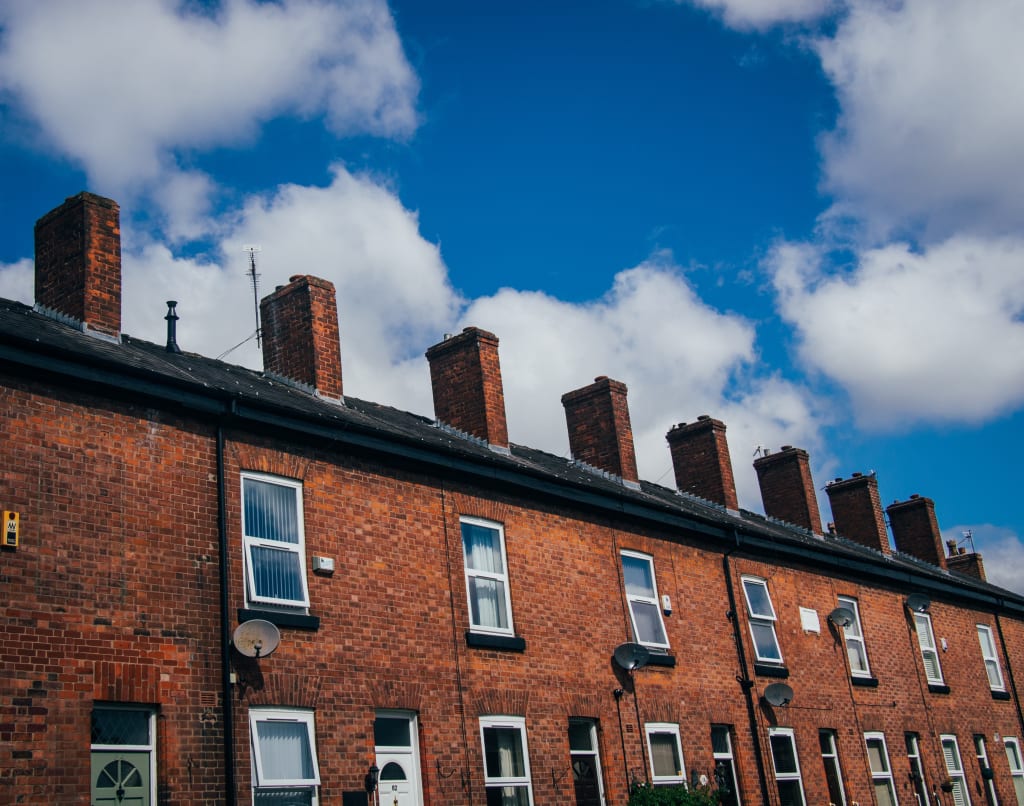
Many others had not been as lucky. Those first few weeks, Stephanie had walked up and down the terraced houses, trying to make some sense out of the impossible situation. Down past the petulant pensioner at No. 16, up next to the students at No. 31. A few had made it to a window in search of hope. Day after day, they banged on the glass in vain, but in their shrunken state, no-one could open a window or even force through the resistant draught excluder of a front door, and gradually they wasted away. Across Earth, every home – once places of absolute refuge – had become a sarcophagus.
Stephanie could think of nothing else to do but walk back and forth, witnessing the devastation of those brick tombs. Through the floor-to-ceiling windows of the kitchen extension next-door, Stephanie had watched the previously-smug Flatters family comically chase their golden retriever in circles. It was certainly odd returning home to feast on her pre-movie snacks of giant, increasingly soggy crisps and slurp up the water she’d toppled on to the floor, all while knowing that Ben, Jemma and little Fred were on the other side of their connecting wall gnawing on the bones of Tessy. Still, it could be worse. She’d seen ten-year-old Josh from No. 5 banging on his windows in week three, long after most had stopped moving. Josh had had dried blood crusting around his mouth. Josh didn’t have a pet.
She had spied Mr Singh’s frantic beckoning on the twelfth day, and only returned home to fetch her locket before joining the corner shop community. She couldn’t bear to leave her mother’s smile behind. Indeed, most who had managed to escape their homes brought a memento of their previous life, so Mr Singh’s was full of unusual, tiny objects, from the useful (No. 12’s sowing kit sprung to mind) to the purely sentimental. Doddery Mrs Wellingborough could probably trade her diamond earring for a battery, if only she were willing to part with it.
Stephanie sighed. She was still sat in her locket. It was pretty common for Stephanie to spend the morning reflecting on the new world, probably prompted by her nightmares. That, and she wasn’t enthralled by the monotony of the day ahead. Wake up to the face of someone she’d probably never see again, go on patrol, work with the community to pulley non-perishables down from the shelves or use the can opener, guard the front door barricade of can lids and toothpick defence spikes, then go back to bed, pulling the locket closed, her mum’s face the last thing she saw. Sometimes Stephanie slept straight in the middle of the locket, primed to reach upwards and release herself at any indication of danger, but other times she needed to curl up against the comforting curved contours of the heart.
It was, in many ways, an easy life. One can of food would feed the community for weeks, so they’d hardly made a dent in Mr Singh’s well-stocked convenience store within two years. This success gave her hope. A tiny amount of hope, but any hope these days was hard to come by. Stephanie had no idea if her mother had made it to the supermarket by The Shrink, but she chose to believe her mum had been inside. What a place to be trapped for eternity! Stephanie shuddered at the thought of the smell of all those rotting perishables, but it was a small price to pay for survival. There was enough in all those aisles of tins, crisps, nuts, cakes, and drinks to sustain the rise and fall of an entire civilisation of tiny humans.
Stephanie stood, stretched, and reached for the scraps of fabric she draped across her to fashion a garment. Humans had shrunk but clothes had not, so embarrassment was a concept left in Before. In the absence of being able to operate a sowing machine or open Velcro, another good consequence of The Shrink was that everyone had become very good at tying knots.
As she tethered together the remains of what she thought used to be a tea towel, Stephanie ran through her trio of well-rehearsed reasons why she shouldn’t just pack up and walk to find her only relative:
- One. She’d done the calculations. Travelling 150 meters a day (without interruptions or obstacles), it would take 54 days to walk the ten-minute drive to the supermarket. She wouldn’t survive. She might drown in the rain. She could be killed by one of the gangs who marauder the streets in remote-controlled cars, Mad Max style. What if she encountered an escaped animal from the zoo?
- Two. What would she do when she got there? Even if the electricity were still working, she’d be too light (or small) to trigger the automatic entrance doors.
- Three. Her mother might not be alive.
Funnily enough, the aliens didn’t factor into her reasoning. As she vaulted the barricade into the wilderness of Parkfield Avenue, Stephanie somewhat hoped she would see an alien. She had only witnessed one up close and personal once before, and had marvelled at the godlike quadruped’s ungainly manner as it dragged its scaled talons across the concrete. Of course, she had no idea what they looked like past the ankle, and could only see that far by craning her neck. Beyond that, the aliens simply blocked out the sun.
Unlike all the other survivors, Stephanie thought her conquerors quite benevolent. After all, if an alien race had the almighty power to warp the bonds between molecules and shrink organic matter, Stephanie was pretty sure they could annihilate a civilisation if they wished. Instead, the giants had left humanity with their lives and continued to let them live, seeming to completely ignore us as we used to ignore ants, for the most part. If it were a prerequisite to leave the previously dominant species alive when colonising a planet, Stephanie thought that shrinking was quite a merciful way of doing it.
As for why they were here, that was anyone’s guess – and everyone did have an opinion. Some believed the aliens came to strip the Earth of its resources and will one day abandon a ruined planet, but equally what if they were escaping an extinction event of their own, and this was the best way they could think of to coexist? Speculation was futile, Stephanie had concluded, along with the realisation that she was quite possibly the perfect prisoner: apathetic, guilty and grateful.
Expertly traversing the troughs and mounds of Parkfield Avenue, Stephanie barely glanced at the skeletons which waved from the terraces’ windows. She couldn’t go far before needing to turn back, but venturing outside was more about pretending to live rather than exploration. She didn’t often see anything new, and was so entrenched in her routine that she almost missed it.
Pink.
Stephanie’s head whipped back round to ogle the anomaly.
Bright pink wasn’t a colour you saw by the side of the road these days, and what Stephanie found dipping into the curve was equally unexpected. Comprising simply of one pink four-by-two brick, two axels and four wheels, the Lego car wasn’t much, but it was an escape.
Stealing a furtive look to check for any traps, Stephanie laboriously pushed the monster truck back to Mr Singh’s with all the strength she could muster, hid it behind a particularly dense tuft of grass, and proceeded to ignore the questioning of her neighbours as she pulled her lucky locket out to the car. This was the sign she had needed, and there was no point looking back. Stephanie tore off her drape and used the scraps to fasten her medallion to the back axel, and finally pulled out its toothpick lever with all her might.
The naked woman climbed to the top of her car. Toothpick quant pole in hand, Stephanie steeled herself for what was to come.
“I’m coming, Mum.”
About the Creator
Keep reading
More stories from writers in Fiction and other communities.
So You Decided To Become a Nurse Practitioner:
So you decided to become an "Advanced Practice" nurse. Congratulations!... is what I would say if this was a good idea. Grad school? In this economy? What were you thinking? Likely it was something along the lines of either 1) “I've seen these other chucklefucks do it— Why can't I?” or even 2) “I've got a nice career, I should shake it up. I miss feeling like I have no clue what I'm doing.”
By Sandor Szabo7 days ago in Fiction
Deception
“Oh, what unbearable heat! It feels as if the sun is standing right over my head,” Nawab Sahib muttered to himself as he walked along carrying a bag of vegetables. Suddenly, he collided with a young man—or perhaps the young man collided with him. The potatoes fell and scattered on the road.
By Sudais Zakwanabout 11 hours ago in Fiction



Comments
There are no comments for this story
Be the first to respond and start the conversation.