
The Scent of Glass and Memory
In a sunlit workshop, shards of the past are pieced together, petal by fragile petal.

Soft light filtered through the large workshop windows, casting colorful patterns on the hardwood floor. The mesmerizing dance of purples, blues, and yellows seemed to perform a silent symphony beneath the quiet hum of activity. Standing in the center of the room, Eleanor held a piece of milky-white stained glass up to the morning sun. The glass had a subtle opalescent quality—when the light hit it just right, she swore she could see the gentle swirl of an ocean wave hidden within.
The workshop itself had been her grandfather’s domain for nearly five decades before it was passed on to her. She remembered being a child, tiptoeing through the labyrinth of crates and glass shards, wide-eyed at all the colors. She recalled the faint odor of molten lead and the sweet yet tangy aroma of flux. The place had always felt like a magical realm where broken pieces could be united into something breathtaking.
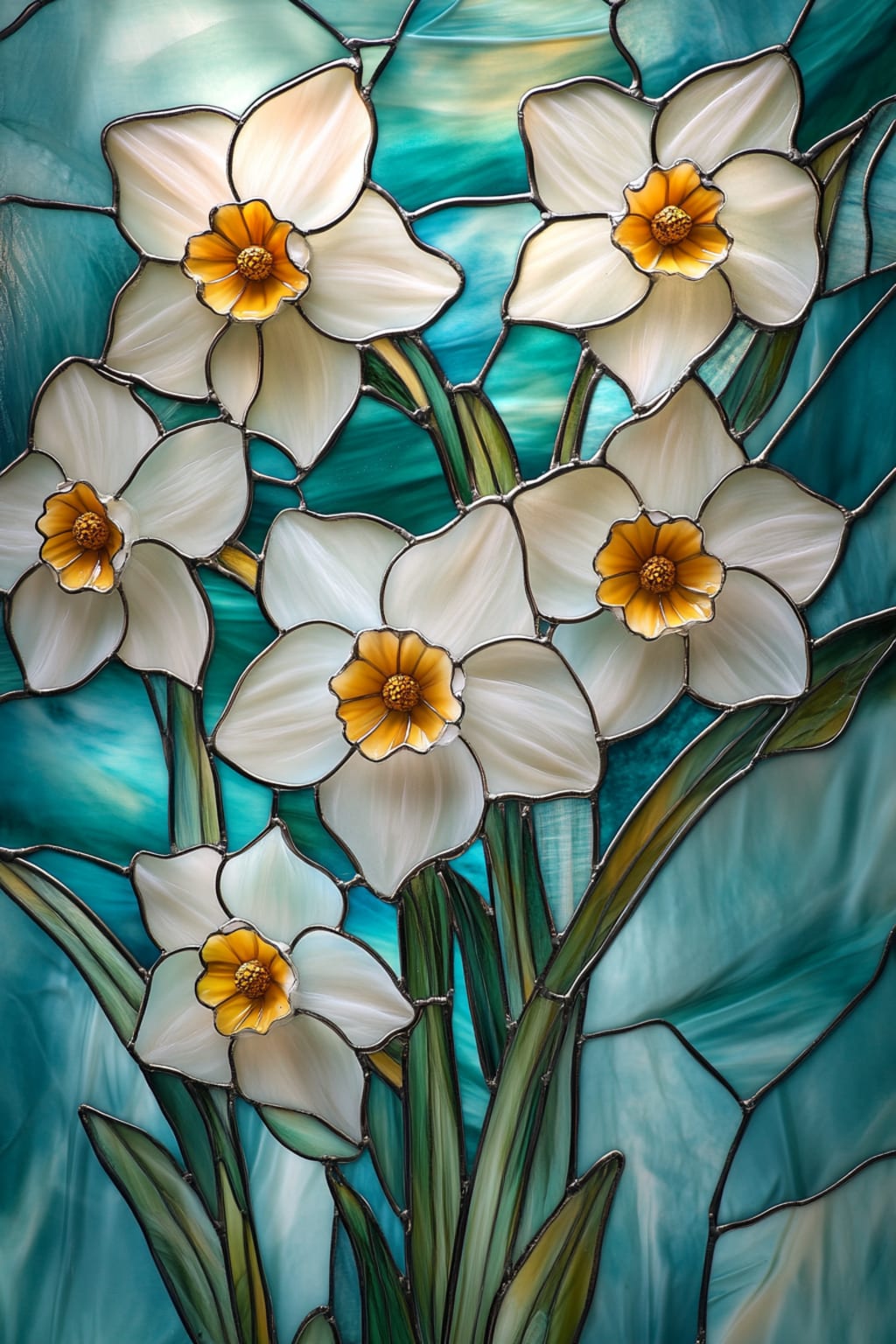
Now, all these years later, she was here for a different reason: to resurrect a piece of her family’s legacy. Spreading out across a weathered oak workbench lay the blueprint for a large stained-glass panel: a cluster of delicate daffodils set against a swirl of teal and turquoise. The design was a mesmerizing tribute to the changing seasons, featuring luscious white petals and golden throats that seemed to promise rebirth. In the upper corner, there would be arcs of swirling azure, like shifting skies on a spring morning.
This project was both a commission and a personal obsession. A local museum had requested a floral-themed stained-glass exhibit, one that reflected the region’s horticultural heritage. Yet for Eleanor, this wasn’t merely about an exhibit. It was also a chance to revisit her grandfather’s final, unfinished masterpiece.
Chapter I: An Inherited Passion
Eleanor’s grandfather, Edward Hawthorne, had passed away before completing the daffodil panel. She’d found the sketches carefully folded inside a leather-bound portfolio, along with hand-scribbled notes detailing glass colors, shapes, and special cutting instructions. A scrawled dedication read: For Margot—who saw beauty in every reflection. Margot was Eleanor’s grandmother, a gentle soul who’d nurtured Edward’s artistry through lean times, sickness, and the weariness of old age.
Though long gone, Edward’s presence seemed to dwell in every nook of the workshop. Tools lined the walls, each with a small label indicating its origin: a glass cutter from France, specialized lead came strips from a workshop in Italy, and an antique Tiffany-style lamp stand. Rows of glass sheets in multiple hues leaned against the far wall, reminiscent of upright rainbows in the dim light. From time to time, Eleanor felt almost as if she heard her grandfather’s voice, instructing her on the correct angle to hold the soldering iron, or reminding her never to skip the protective gloves when handling chemicals.
He had taught her everything she knew, from the geometry of glass cutting to the subtle artistry of layering colors for the greatest visual impact. Often, he would begin each lesson by describing the soul of a stained-glass piece: “It’s all about light, Ellie,” he would say. “No matter how beautiful your design, without light passing through, the art remains hidden.”
There was both poetry and practicality in that statement. To Edward, a piece of stained glass wasn’t merely a window—it was a canvas that came alive only under the right illumination. Eleanor had taken that lesson to heart, refining her craft so her panels glowed like living paintings in the presence of sunlight.
Chapter II: Shards of a Story
On a day that smelled faintly of spring, with early blooms and a promise of warm breezes, Eleanor spread out the individual glass pieces she’d already cut. Each petal for the daffodils had a slightly curved edge, painstakingly shaped using a grinder until it fit snugly against the next. The central cups were a bold golden hue—a translucent saffron that glittered brightly when a beam of light caught it at an angle.
Beside the main shape of the daffodils, she had sorted out slender pieces of green for the leaves and stems, along with large turquoise panels. These turquoise sheets had subtle gradations, giving the impression of water or sky shifting in color as it moved. The method required a steady hand and careful measurement, but that was only half the challenge.
Eleanor’s heart tightened each time she picked up a new shard. The design wasn’t exactly her grandfather’s original plan—she’d made modifications to ensure the structure would hold and to integrate a technique called plating, which layered multiple pieces of colored glass to achieve richer tones. But each addition or tweak carried a tinge of guilt, as though she were painting over his intentions. Yet she also believed he would have encouraged her to adapt, to iterate.
With her mind in a quiet place, she started the process of laying out the glass segments over the blueprint. Small nails pinned each piece into place on a waxed board, forming a mosaic that gradually came to life. A sense of rising warmth filled her chest. Soon she’d be wrapping the edges of each shard in copper foil, soldering the joints, and forming the final lattice of lead came that would hold everything together. But that was the mechanical side of the craft.
The spiritual side, the intangible essence, was her recollection of the cottage garden where Margot’s daffodils once thrived. Every spring, the garden would burst into a sea of white and yellow blossoms, their sweet perfume drifting through the open windows. Even as a girl, she’d marvel at how delicate the petals were, how fiercely they stood against drizzly days and still bloomed despite unexpected frosts. Eleanor could nearly smell them as she shaped each piece of glass. That recollection made her smile.
Chapter III: Visitors in the Workshop
While painstakingly cutting a new piece of glass, the workshop bell chimed. A visitor? The museum curator wasn’t due for another week. Perhaps a neighbor wanting a quick repair on a chipped window. She set the glass down carefully and headed to the front.
The visitor turned out to be Martha Reid, a local historian known for her thorough knowledge of the town’s heritage. Slightly hunched, with alert gray eyes, Martha clutched a thick folder. She greeted Eleanor with a warm grin.
“Working on the daffodil panel, aren’t you?” she asked, surveying the workshop’s colorful chaos. “I heard the museum folks are counting on you for their new exhibit.”
Eleanor smiled, nodding. “That’s right, Ms. Reid. I’m still in the layout phase. Cutting and shaping the glass can be tedious, but it’s also the most meditative part.”
Martha rested her folder on a tall stool, patting it gently. “Well, I found some old documentation about stained glass in this region—especially about your grandfather’s commissions. Thought it might help. The historical society had it locked away in a dusty cabinet.”
Curiosity piqued, Eleanor flipped through the folder. Old photographs, letters from Edward Hawthorne’s clients, and newspaper clippings featuring images of past creations. One page outlined a special mention of “Hawthorne’s Daffodil Series,” a rumored collection of three distinct panels that he planned to donate to the local chapel.
“Three panels?” Eleanor murmured, frowning. “I only knew about one. The one he was working on when he… well, before he passed.”
Martha nodded. “Yes, apparently he wanted to do a triptych. Something about capturing the early bud, the full bloom, and the final fade. But he never got to finish them. Some folks say only one panel was partially done.”
Eleanor felt a surge of excitement. This new discovery cast a fresh light on her own project. Maybe she was unknowingly completing the first in a series. Or perhaps it was the second, or third. She wondered how many half-forgotten ideas might be hidden in the corners of the workshop or scrawled in old notebooks. Gently closing the folder, she thanked Martha, who left with a promise to return soon to see the progress.
Once alone, Eleanor felt inspired, as if a door had opened to her grandfather’s world. She rummaged through the workshop’s back shelves, searching for more sketches or notes. Tucked behind dusty bottles of patina chemicals and boxes of mosaic tiles, she found a small wooden crate labeled in Edward’s meticulous handwriting: “Daffodil Dreams.” Inside, she discovered additional glass squares in varying shades of white and yellow, carefully sorted and wrapped in old cloth. And near the bottom, a sealed envelope.
She pried it open with trembling fingers. Inside lay a single sheet of paper, a note scrawled in Edward’s refined script:
“Margot’s love for daffodils saw me through our hardest winters. If only I could complete this final piece in time, she’d see that hope endures, even when the blossoms fade. One flower for every promise I made her.”
Eleanor’s throat tightened. Hope endures, even when the blossoms fade. She recalled how Margot had passed just months before Edward fell ill. The heartbreak of losing her likely drained him of his creative spark. Now here she was, decades later, standing where he once stood, ready to finish what he began. No, she corrected herself. Ready to build on it and create something new.
Chapter IV: Beyond the Glass
Over the next week, the workshop echoed with the soft crunch of glass cutters and the hiss of a soldering iron. Eleanor worked tirelessly, her mind abuzz with the newly discovered sketches and Edward’s heartfelt note. She rethought certain portions of the design, acknowledging the possibility that her grandfather envisioned more than a single panel. The blueprint she’d started with might be a single chapter in a trilogy, each one capturing a stage of life—or a stage of love.
At times, fatigue threatened to overwhelm her, but she pushed on, the prospect of unveiling a completed piece spurring her forward. She thought about the Museum’s opening night, how the stained glass would stand tall in a specially lit alcove, visitors pausing to admire the glow. The idea that she might continue her grandfather’s legacy, that she might even craft the entire triptych if time allowed, filled her with a sense of responsibility and wonder.
By the fourth day, the structure of the panel was almost complete. Each shard had been foiled or secured with came. Lines of molten solder traced graceful arcs around the daffodils, setting their delicate petals in place. Turquoise glass shimmered like a sea of morning light. A quick polish with a soft cloth revealed a mesmerizing mosaic that felt alive when she tilted it towards the sun’s rays.
Chapter V: Test of Strength
Just when she believed the hardest work was done, an unexpected challenge arrived. The museum curator, Mr. Langley, stopped by unannounced with a frantic look in his eye.
“Ms. Hawthorne,” he said, wringing his hands, “I’m sorry to impose, but we’ve had a scheduling shift. The exhibit is opening one week earlier than planned.”
Eleanor’s jaw dropped. One week less? “But the piece still needs reinforcing rods, plus the final patina and polishing,” she explained. “I also have to build a proper wooden frame so it can stand upright in the exhibit.”
He bowed his head apologetically. “I know it’s a lot to ask, but we’re unveiling the exhibit in conjunction with the Spring Fair. If we don’t have a centerpiece, the museum board will be quite… disappointed.” He paused, clearly torn. “I can ask for an extension, but it’s unlikely they’ll grant it. The press releases have already gone out.”
His desperation reminded her of how fiercely her grandfather had cared about his craft’s reputation—how he often accepted near-impossible deadlines to support the local community. With a deep breath, Eleanor found herself agreeing to try. After all, she was so close to finishing.
That same night, she worked until the stars disappeared behind the neon glow of city lights. By lamplight, she reinforced the panel with slender rebar to ensure it wouldn’t bow under its own weight. She buffed the soldered lines, wincing as the chemical patina stung her fingertips. Yet the piece took on a new richness, each seam gaining a subtle dark sheen that accentuated the white-and-yellow petals.
Exhaustion weighed on her, but the art soared, breathing life into the quiet workshop. When she finally stepped back at dawn, the daffodils looked as though they might flutter in a passing breeze.
Chapter VI: A Full Bloom of Light
Opening day arrived with crisp morning air and an energetic buzz around the museum. Eleanor transported the panel carefully in a wooden crate filled with foam. Once at the exhibit hall, she guided a pair of assistants as they lifted the piece out, mounting it in a specially lit alcove near the entrance. Natural light from a tall window overhead cascaded onto the glass, unveiling turquoise ripples, golden hearts, and creamy petals. The effect took her breath away.
Mr. Langley stood beside her, looking equally stunned. “Ms. Hawthorne… this is remarkable. It’s as though the flowers themselves are aglow.”
Visitors trickled in, some exclaiming at the luminous panel, others pausing in silent admiration. An older woman dabbed at her eyes, remarking how the daffodils reminded her of her childhood garden. A younger couple took snapshots, drawn by the serene aura. The museum buzzed with life, every head turning toward this newly completed masterpiece.
Eleanor felt her pulse quicken at the compliments. But it was more than just pride in her work. It was a sense of communion—her own life story intersecting with her grandfather’s, layered like the very glass. The pain of old loss and the hope of new creation melded in those shimmering daffodils. She was completing something that Edward had left unfinished, and in doing so, forging her own legacy as well.
Martha Reid appeared at her elbow. “I see you worked wonders,” the historian said with a grin. “It’s quite an homage to your family history.”
Eleanor nodded, eyes misty. “I hope so. I like to think my grandfather would be proud.”
Martha laid a gentle hand on Eleanor’s shoulder. “Proud? He’d be over the moon. And you know, if ever you decide to find or craft the other two panels, I’d be more than happy to help you research them.”
A thought sparked in Eleanor’s mind. She pictured a triptych standing tall in a chapel or perhaps a dedicated wing of the museum. Daffodil Dreams, in three acts: bud, bloom, and fade. Could she track down or recreate Edward’s vision? The notion was at once daunting and exhilarating.
Chapter VII: The Legacy Continues
As the day’s festivities wound down, soft rays of late-afternoon light angled through the museum’s skylights. Eleanor stepped up to the panel for a final, personal moment. Her reflection hovered on the glass surface, intermingling with the daffodils. She recalled her grandfather’s mantra: It’s all about light, Ellie. Without it, the art remains hidden.
She reached out and gently touched the cool surface of the stained glass. In that instant, she felt the presence of both Edward and Margot—a warmth that transcended words. It was as though the panel completed a circle, bridging past and future, sorrow and joy.
Back in the workshop that evening, she carefully placed the newly discovered sketches and leftover glass pieces into a protective box. The museum exhibit would run for several weeks, drawing crowds who admired the floral masterpiece. But her journey was only just beginning. She intended to unearth every detail of that rumored triptych. If the second or third panel existed in incomplete form, she would restore it. If not, she’d build it anew, guided by the spirit of her grandfather’s craft and the memory of Margot’s garden.
Moonlight streamed through the high windows, illuminating the outlines of tools and glass sheets. A hush fell over the workshop. Exhausted but inspired, Eleanor took a seat at her grandfather’s old drafting table and opened a fresh notebook. She began sketching a second panel, tentatively titled “Fading Petals,” envisioning deeper golds and amber tones to capture the wistfulness of late spring. Her pencil glided across the page, accompanied by the faint scratch of lead on paper.
She could almost hear Edward’s voice once more, encouraging her to push boundaries, to allow the light of every season—both joyful and melancholy—to shine through. For the first time, she felt a calm assurance that her additions to his designs wouldn’t tarnish his legacy, but rather carry it forward. That was how art, and life, progressed: each generation building on the last, weaving new narratives through the old frameworks.
The next morning, she’d return to the museum to oversee final details, accept congratulatory remarks, and perhaps hint at her plan to continue the Daffodil Dreams series. For now, she permitted herself a quiet moment of gratitude. Beside the window, the reflection of her carefully arranged glass shards shimmered like a promise of more beauty to come.
About the Creator
Alpha Cortex
As Alpha Cortex, I live for the rhythm of language and the magic of story. I chase tales that linger long after the last line, from raw emotion to boundless imagination. Let's get lost in stories worth remembering.
Keep reading
More stories from Alpha Cortex and writers in Fiction and other communities.
Blood and Sand: The Rise of a Gladiator
The sun was merciless above the Colosseum, casting sharp golden light onto the sand that had drunk more blood than wine. The roar of the crowd was a living thing, echoing off the marble columns like a thousand beasts baying for violence. I stood among the ranks, armor clinging to my skin, sweat running rivulets beneath the burnished bronze of my helmet. The gate behind me creaked open. It was time.
By Alpha Cortex12 months ago in Fiction


Comments
There are no comments for this story
Be the first to respond and start the conversation.