
The Rivalry of Titans: Elon Musk and the New World’s Richest
When wealth, innovation, and vision collide, history is written not just in fortunes but in ideas.

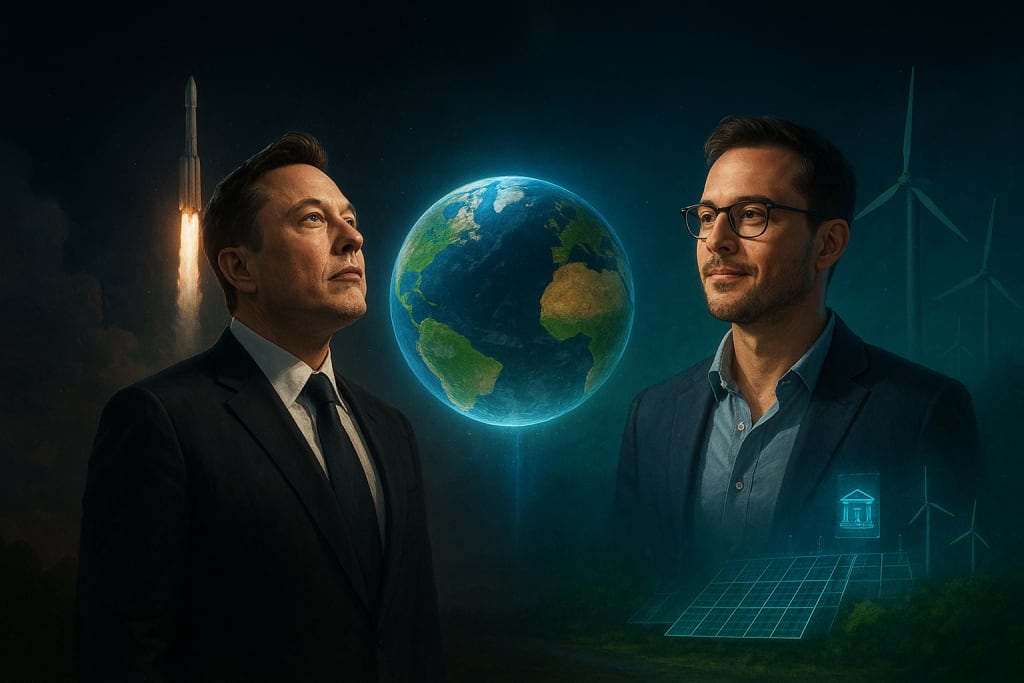
The Rivalry of Titans: Elon Musk and the New World’s Richest
When wealth, innovation, and vision collide, history is written not just in fortunes but in ideas.
The world has always been fascinated by its wealthiest individuals. From John D. Rockefeller in the 19th century to Bill Gates in the 20th, the title of “the richest person on Earth” carries with it an aura of power, influence, and mystery. In recent years, that story has centered largely on one man: Elon Musk. Known for Tesla, SpaceX, Neuralink, and countless ventures that blur the line between science fiction and reality, Musk has long held the throne of wealth.
But fortunes change quickly. One day, news broke that another figure had surpassed Musk, pushing him into second place. The name on top was not just a number on Forbes’ billionaire list; it was a signal of a shifting tide. The “second richest person in the world” was suddenly Elon Musk himself. And with that change came a story not only of rivalry but of vision, identity, and the meaning of wealth itself.
The Conversation That Never Was—but Should Have Been
Imagine the two men in a quiet private lounge of an airport, each waiting for their respective private jets. One is Elon Musk, charismatic, blunt, and endlessly ambitious. The other, the new holder of the richest crown, is a man whose empire grew through e-commerce, green energy, and digital finance—let’s call him Arjun Patel, a composite of the rising global elite emerging from Asia’s booming markets.
The air is tense but charged with curiosity.
Musk leans forward:
“So, congratulations. You’ve taken the spot. How does it feel being the richest person on Earth?”
Arjun smiles calmly:
“Honestly, Elon, the title means little. It’s a mirror of where capital flows. Sometimes toward cars that drive themselves, sometimes toward rockets, and sometimes toward platforms that connect billions of people. My concern isn’t the rank—it’s the legacy.”
Musk smirks:
“Legacy? Legacy is going to Mars. Legacy is making sure humanity survives AI. Legacy is building things that last longer than nations.”
Arjun counters:
“Or maybe legacy is solving Earth first. Feeding the hungry. Fixing climate change. Making sure technology doesn’t only serve the wealthy but uplifts the billions at the bottom. You aim for Mars—I aim for Earth. Two visions, same ambition.”
A Clash of Philosophies
The dialogue between them reflects more than two men—it reflects two philosophies shaping the 21st century.
Musk’s Philosophy: Humanity must expand beyond Earth. In his mind, the planet is fragile, and survival demands spreading life across the cosmos. His companies—Tesla, SpaceX, Neuralink—are not just businesses but pieces of a survival puzzle.
Arjun’s Philosophy: Wealth should be leveraged for social balance. The future lies in fixing inequalities, investing in renewable resources, and ensuring that developing nations leapfrog into prosperity rather than being left behind. His empire thrives on digital banking for the poor, solar grids for remote villages, and AI-driven education platforms.
The richest title is symbolic, but what it symbolizes is a fork in humanity’s road: Do we look to the stars, or do we heal the soil beneath our feet?
The Human Side of Riches
Their imagined conversation drifts beyond business. Musk, candid as ever, admits the pressures of being in the public eye: “People think wealth makes life easier, but it magnifies everything. Every tweet, every misstep—people are watching.”
Arjun nods, adding: “The higher you climb, the more you realize that wealth is not ownership. It’s stewardship. These resources—billions of dollars—aren’t truly ours. They are tools. The question is, will they become weapons or medicine?”
There is a moment of silence. For two men surrounded by empires, it is a rare glimpse of humility.
The Competition That Shapes the Future
History shows that rivalry often drives progress. Tesla wouldn’t have grown without the competition of traditional automakers. SpaceX wouldn’t have innovated without government contractors doubting them. And now, Musk himself faces competition—not in rockets or cars, but in the very idea of wealth.
Being the “second richest” might sting, but for Musk, it could also be fuel. Perhaps it will push him harder toward colonizing Mars, or accelerating Tesla’s mission to transition the world to sustainable energy. Perhaps Arjun’s rise will inspire a new wave of social entrepreneurship, where billionaires aren’t just measured by net worth but by impact.
Beyond Numbers
At the end of their conversation, as each prepares to board his jet, Musk makes a parting remark:
“You may have the crown now, but remember, crowns are heavy. I’ll take rockets over gold any day.”
Arjun replies with a gentle laugh:
“And I’ll take feeding a billion mouths over flying a rocket. Different crowns, Elon. Different thrones.”
As their jets disappear into the night sky, the world watches, not with envy, but with hope. For in their rivalry lies the possibility that the future will not be dictated by wealth alone, but by the visions carried by those who wield it.
Final Thought
The story of Elon Musk and the man who surpassed him is not just about two billionaires. It’s about two roads humanity can take. One that reaches for the stars, and one that heals the Earth. Perhaps the true destiny of our world is not choosing between them, but learning to walk both paths at once.
About the Creator
WAQAR ALI
tech and digital skill
Pandora’s Burden
“My brother warned me to not accept gifts from the one who commissioned you,” said Epimetheus to the woman clad in silvery raiments standing at the entrance to the temple. Her silver tiara and the silver rings on her fingers and toes glinted in the firelight cast by torches set on either side of the doorway. Lingering in the shadows, beyond the reach of the flames as she was, he could not tell what she held in her hands. At first what appeared to be a box was perhaps a funerary urn, or maybe merely an apple.
By J. Otis Haas3 days ago in Fiction
The Boy Who Cried Blood
For a hideous, elongated moment, she thought one of the estate kids had broken in and cut off his face. He wore a dry mask of blood and his white pillows were drenched in sticky red. It was only when he moaned and his sealed eyelids began to undulate like boiling pasta parcels, that she screamed with relief and ran to his bedside.
By Matthew Batham3 days ago in Fiction


Comments
There are no comments for this story
Be the first to respond and start the conversation.