
The Piano Lesson of Henri Matisse, Age 7
An immortal painter's first and last lesson...


1890

Books: Well damn me if they don’t look like books.
Candle: So well lit for an unlit candle! What is this gluttonous window? Eat, eat, eat, eat, these Paris windows.
Newspaper, tablecloth: Thought I would pull a Van Gogh, the folds were so maddening. Egad! Why would anyone want to do this for a living?
1877
He is a little boy with a shaved head and rings on his cheeks, and fear. The fear is rectilinear, clear, opaque. He tests its weight in his hands.
An open window five stories above the avenue permits a vivid green and a vivid grey light, which the boy also tests in his hands, his unlined palms, his soft knuckles.
The music stand rising above the piano keys is a lattice-pattern of dark wood. It mimics the curvatures of the iron in the balcony railing, and issues an ebony glare, which with the green and the grey assumes a meek corner of the boy’s field of vision.
There is also a grey voice. “He can’t keep his hands together. Nothing much you can do for a boy who can’t keep his hands together.” The grey woman’s voice floats over the boy’s shoulder and through the window. “I can get him to play the right notes, of course, which is an intellectual triumph, but the act of playing them at the right time is totally different. It is an athletic feat. This boy, the poor devil, is no athlete.”
Henri takes the news with humility, which to some may seem like defeat. The piano teacher is right, of course, he is no athlete. His rejection of the physical is not a reasoned position. It is a kind of blind-spot. It is something he never thinks about until other boys invite him to kick a football around an alley or his father goes to the handball courts and comes home dripping with sweat and life. It makes sense that the boy cannot keep his hands together. He can hardly keep his eyes together.
Learning the notes is something else altogether. Herni enjoys reading the music on the page, the beautiful black dots like distant crows in snowy fields; the ovals empty in the middle, rimmed in black, pupil-less eyes, shadowed cabaret-eyes; the sequence of parallel line-segments bisecting the staff, like skeleton fingers laid across a latitude-map. The progression, left to right, is a long frieze like the Bayeux Tapestry or the procession of white figures atop Bernini’s colonnades in Rome. Henri admires lines. Lines make sense. They sit in time, like fat kings in velvet chairs. Henri admires the sacred rationality of beginnings and ends, the rejection of circles.
Of course Henri doesn’t think using these terms. Not yet. He is aware only of the comfort that can be found in knowing this code, this system of lines and dots.
Is it not enough to read the music? To look at it? Must he pound it out on the keyboards, like some mad opiate writhing in an absinthe-hued basement?
Maman is beside herself. “Why can’t you keep your hands together? Henri, you smell with both nostrils simultaneously, you look with both eyes, you chew with those pairs of teeth in your head, why can’t you play with both hands?”
1910
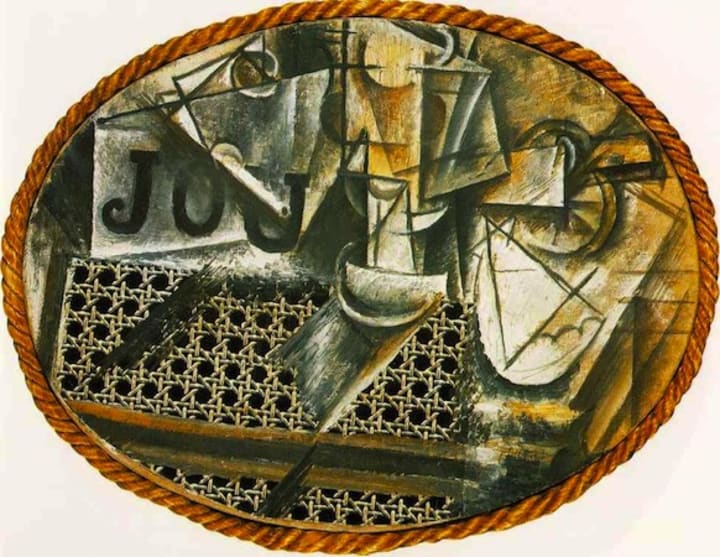
Pipe: Bowl moon, bull moon, occluded albino-cherry throat-lodged bowl-balloon! Cyclops of a picture! The drain of the canvas, clogged with tube-paint. An anus, dilated. A extra touch of barbarity to an already barbarous work. Invitation to sodomy.
Newspaper: The bastard is little more than than a picky thief; he steals only from Braques. Adds a pun, and voila le celebrite. Language ought not to be a subversion of three-dimensional space because it negates the whole concept of space. It’s abstract. Its topography is purely time. Letters are not the business of painters, any more than a novelist should execute his own illustrations. Picasso ought to be a poet, the scoundrel.
Caning: An Eiffel-honeycomb, wrought in pale iron. A negative of a photograph of staff-paper. A hundred little eighth-notes in relentless pentatonic chords. Comical, really. Illiterate. Despite the pun. A vain grasping for the chairs in Van Gogh’s bedroom at Arles. Grasp a little more, Pablo, grasp with both hands.
Polygons: Shapes within shapes within shapes! Plagiarizer of Euclid, abhorrer of nature, fixator on angle. Why don’t you pay more attention to the curvatures in your life, Pablo, you son of a bitch.
Other Thing: What is that at the right, a cannon? Just like the Francophile, to think himself Napoleon.
Palette: I must say, I do not like the color. But then, I don’t drink coffee.
1877
At first the boy’s father is pleased with the drawings. His child has talent, as much talent as any young man can display with propriety. If he makes the drawings with a little over-enthusiasm, a bit too much concentration, the lip in the teeth, well, he’s just a boy after all.
But ah, the piano! In the full heavy light of the window, where not even at midnight is it necessary to light a candle to read the music. Where everything seems outlined in thick ink, and a macaron on a white dish is as vivid as a black cat’s eyes.
The boy’s father is a grain merchant. He has money. He has spent most of his life in the countryside, negotiating the buying and selling of wheat, barley and rye. He has saved enough for the apartment in Paris, for the piano, for coaches to and from parties, for the boy’s paper and pencil-crayons which he goes through like a horse goes through oats.
The boy! The strange boy! His gaze is more deliberate than is strictly polite. In short, he ought to blink more, if only to put people at ease. One shouldn’t look so directly at people, should one? Even if one is a child.
The boy’s father does not care so much that his son can’t keep his hands together this afternoon. At least he’s sitting still for a moment.
He says to Amélie, “Think of it as an hour without the stench of ink.” He’ll endure a mismatch of bass and treble for sixty minutes in the afternoon if it means a bit of clean air.
A candle on the broad back of the piano burns lower, toward evening; time points down, the dipping beak of a thirsty bird.
The boy is sulking now! Or maybe squinting. Should we get his eyes checked?
It will be another decade before Henri’s mother gets him a set of art supplies for safe passage through a bout of appendicitis. In between he will train in law and be a clerk for the municipal court of a small village close to where he spent his childhood. He will not quite know what instigated the fixation on color, on shape. He will not examine his impetus to paint. He will not question the pursuit. He will not wonder why. He will not extemporize memoir. He will not grant interviews to journalists. He will allow photographs of himself to be taken, but will insist on goofing off. He will write about the intersection of Jazz and painting, but in a childlike way. He will talk with you about Matisse, but only informally. He will have a black beard, then a grey beard, then a white beard.
For now, he is clean-shaven. For now he sits at the piano each evening around sundown, and looks at the pages of the music, and tries not to look at the Venus figurine on the table by the sedan. The sudden revelation of the kerosene lamp will shrink him into an even smaller image of a boy. This small child will squint regularly each night, with his hands not together, at the dots on the page.
1892
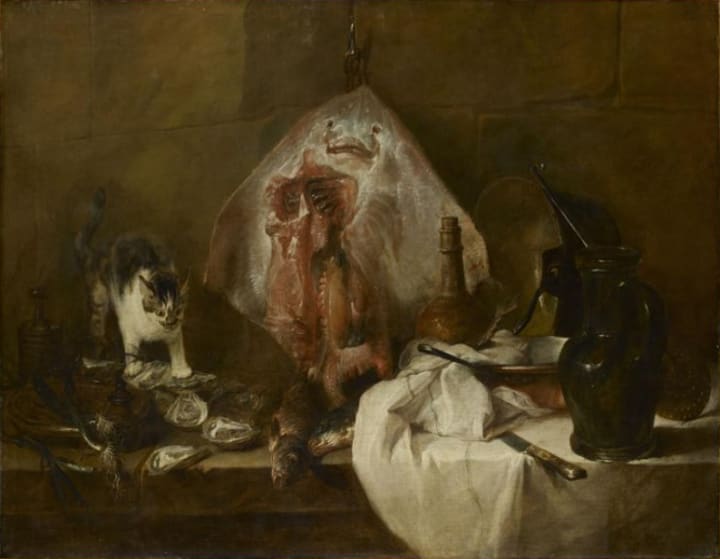
Cat: Seems odd to be preoccupied with clams, even with that hulking bloody monster an inch from its shoulder. Hey look, foreshortening.
Ceramic: Say, I recognize that jug! Soft green swell, dark green, envious like the night, side-dwelling, something Hamlet might whisper to Horatio. I gave it better color. But Chardin gives it better light.
Ray: What a grimace. As if to say, “There’s nothing you can do, is there? Send a letter or two to a judge? If you can’t… but all the same, thought I’d ask.”
Big white triangle somehow lighter for its size, wrestling with copper, battling the phantom of Red. What are those ghastly shapes? Its insides? They’re odd beasts these rays. I have a wound in my own gut, a winding curve, like an iron tulip in a window-railing.
Best of all is the milk spread on its cheeks. Best of all second to the milk is its weight, its downward-orientation, like a Christ taken down from the cross, or a child slouching on a piano bench, or a candle whose light is its means of destruction. Same as the burning sun, or a log in the hearth, or a heart in love.
Everything else: Graceless clutter. Why did every still-life painter in the damn world paint messy rooms? I will change that. If their pictures are flailing children, mine will be calm women. If they worked exclusively after earthquakes, I will give the world a tense morning. I will paint the five minutes before the earthquake, when the perfection of a woman’s living room breathes its final exquisite breath.
Background: Canvas? Wallpaper? Fog of London? Fog of Paris? There are lines there, but there are lines everywhere, even in the thick of London fog, even in the thick of Paris fog. I suppose it must be only wallpaper. Or the lungs of wallpaper, after lives of tobacco. Or guts of coffee, after lives of early rising. Or only wallpaper.
Palette: The colors native to things that sit, and do nothing, claim no agency, exhibit no will but the flitting of eyes. Coffee colors. I adore coffee!
A dark room, with one bright window.
1877
A bright room, with one darkening window. The grey woman stands in defeat by a silly narrow table the boy’s parents clutter up with trinkets.
“Once more, please, Henri. Then you will be liberated for another twenty-four hours.”
Keeping a safe distance, as if his notes were arrows.
Everything sits heavily in this room: even the people seem pulled downward by hidden weights, marionettes of lead. The Venus figurine is sprawled licentiously on the arm of a chair a vivid ocher in the glow of the lamp.
Henri puts his fingers to the keys, guided by the crow-eyes. The notes come delicately, quietly, which takes not inconsiderable control on a piano of this size. A melody twists through the room, twists like a unclothed torso, like Manet’s Olympia. Father in the next room pokes his head out. Mother sits on the tense edge of the sedan, her hands wrestling each other.
The melody becomes a dozen bathing women, molded out of chalk-pastels as Adam was from clay, not-women, parallel-women always doing something with their arms. Then it becomes literate, books piled on other books, the dull colors of imaginationless publishers. The motion of the melody seems to validate the stillness of everything in the room, the stillness of everything outside the window; it engenders this stillness, provides these objects an ether in which to exist. Newton-like, the objects in the room cannot move because there is no one to move them—Henri is at the piano. But Henri cannot leave the piano because if he does the music will stop and the medium by which all of these things gained bodies would extinguish, and there would only be Henri, alone. So he sits where he is, offering the melody so that these objects might live, but unable to move them so that they might live well.
This is the meaning of the words ‘Still Life.’
In French we call still life nature morte. Dead nature.
Henri finishes. Father applauds from the next room. Rather good! he says, or asks. Mother looks eagerly from her son to the piano teacher.
Answering the unasked question, the teacher says, “Yes. It was beautifully played.” She smiles. Henri looks at her. He begins to laugh.
Mother kisses Henri. “I knew he could do it!”
Father: “Not for nothing do we shell out for these lessons!”
“He was together this time, wasn’t he?” asks Mother. “Was he together?”
The teacher replies, “He was playing only with his right hand.”
1909

Breasts: Michelangelo-tits. No escaping that. I could tell people that the circular shape of the breasts is meant to reflect the dance itself, to show that within these women is the innate capacity to revolve, which represents the life inside women. The double-heart of woman. The double revolution of the woman-spirit. But they’re Michelangelo tits.
Pink: The madness of this color! There is no skin that is pink except that of hairless swine. On a human shape it bespeaks youth, serious youth, youth older than its years. These are very young women, but not virgins. They misrepresent themselves, but do not collude. They share the same innate capacity for deceit. It is the only tool they possess with which to protect themselves against the world.
But then, is it pink? Might it not be the corpse of orange? Or the devolution of white? Or some sort of optical trick, and its really red?
Blue: Air? Water? These women are drowning. They can’t breathe. They dance against their will. They have been set in motion and they can’t stop. I can’t leave my brush and easel long enough to grab them and halt them because to do so would extinguish them; they are my creation. I created them spinning.
God forgive me, I didn’t know what I was doing. I have created, for the first time in my life, Life in Motion.
I have made a painting in time, but unlike notes on a page I find that there is no beginning or end.
Green: Unless it is the breaking of the circle where the two foremost women do not quite clasp hands. Perching above the highest outcrop of green, a few feet up at most.
I do not mean for the colors to be beautiful. I am not involved with beauty. I am painting time, time outside memory. And madness: the madness of reaching and not grasping. That woman, with her black hair trailing like a comet as she stretches toward her companion, the companion who does not look at her, who pulls her hand away imperceptibly. The moment of fear, of great heavy fear in the gut the moment before the circle collapses, the five minutes before the earthquake, the moment before a great unbearable light extinguishes them. The madness of an inert object just before it is struck, the madness of a spinning thing just before it is still.
The horror of reaching and not grasping!
It is a fear that one holds in one’s hands.
I must not stop painting this circle.
1877
The boy has a great fear, the fear of stillness. The fear that if anything is perfectly motionless for even the smallest moment, it will disappear. That if he stops moving, poof! he will vanish. When he is a man he will paint books stacked on books and fruit in baskets and heavy jugs and reclining women, knowing that he cannot create anything unless he creates it unmoving. Except for the women in the circle, the circle that has a beginning and an end. These women whom he cannot stop painting for the rest of his life.
He will have hatreds and rivalries and jokes and coffee and joy and robust youth and robust old age and children and grandchildren, but for now he has only a fear.
He fears that unless he makes something, then and there, with the whole apartment watching him, with his children in the same room decades from now watching him, with a small Spanish boy yet to be born smirking expectantly across the miles and years, he will drift off his seat, lift off the piano cushion first slowly, and then quicker, lift off and begin to spin…
About the Creator
Eric Dovigi
I am a writer and musician living in Arizona. I write about weird specific emotions I feel. I didn't like high school. I eat out too much. I stand 5'11" in basketball shoes.
Twitter: @DovigiEric
Keep reading
More stories from Eric Dovigi and writers in Fiction and other communities.
Lulu Will Be Late for the Funeral
Saturday afternoon finally arrives. Lulu, who had insisted on taking over every detail, stalks through the house like a disappointed bird of prey. There’s nothing left to do. She searches for any activity or point of focus with which to keep away thoughts of her son.
By Eric Dovigi4 years ago in Fiction



Comments
There are no comments for this story
Be the first to respond and start the conversation.