
The Passport of Torenza
At Torrento Airport a single stamp opens a door no map should show.
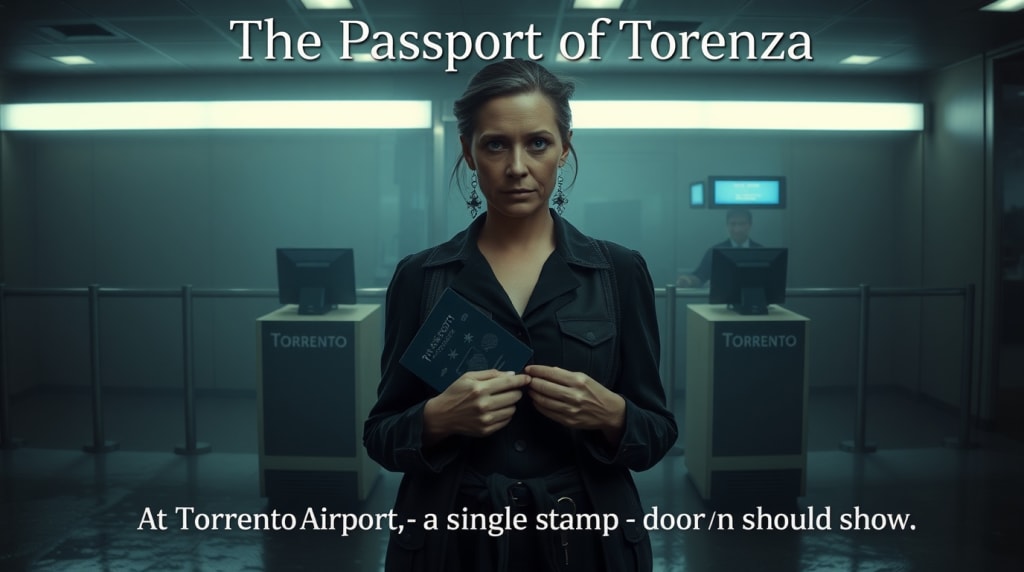
They found her in the pre-clearance queue at Torrento International just after midnight, a single passport on the stainless steel tray and a story nobody at the airport could fit into their forms.
The woman claimed to be from Torenza. She spoke with a calm voice, an accent nobody could place — part Mediterranean cadence, part something older and flat. Her passport name matched the boarding pass. The immigration officer, Marco, thumbed his tablet and frowned. Torenza did not exist on any state list, no diplomatic code, no travel advisory. The passport, though, was rubbed and honest in the hand: leather rounded by use, pages full of stamps for places Marco recognized and places that had vanished from his atlas. There were visas from cities whose names had been redacted in old encyclopedias, a transit stamp dated two days ahead, and a seal imprinted with a symbol Marco had seen once long ago in a museum: a circle bisected by a line, like a horizon with a cut.
By three a.m. the video from Marco’s desk had already spread on the phones of the duty-free cleaners. A shaky fifteen-second clip showed the woman calmly removing a photograph-sized card from the passport: a map. Not a map of countries Marco knew — but a grid of islands and rivers that drifted where no ocean lay, islands laid over familiar coastlines as if sewn from a different cloth. The woman laughed softly when Marco reached for it. "You don't see it because you are not looking with the right map," she said, and for a moment Marco thought she meant a metaphor. Then her smile looked like a lock closing.
Word moved faster than permission. By dawn the clip was on the local feed, the airport’s security inbox, and a rookie reporter's TikTok that added a caption — “Torrento Passport Mystery — Is Time Broken?” — and three million views by breakfast.
Nobody official came with a simple answer. The woman—Kira Toren, the passport said—had no visa in any European Union database. Her fingerprints were unfamiliar. Her passport microprint, under the officer’s magnifier, used a weave of inks that did not match modern security pigments. A trace analyst noted under her breath that the fibers in the paper were not the same as any national registry she had tested: cellulose blended with a reddish filigree like dried reeds, something more like a herb than cotton. The forensics lab wrote more cautiously in its report: unknown organic compounds; submitted for international review.
The station had its own politics. Border control wanted to deport; the civil office wanted answers; the airline wanted the gate cleared. In the interim Kira slept on a leather bench, her hands folded over the passport, murmuring words that sounded like names of mountains rather than a prayer. She refused interviews until the third morning, when she agreed to coffee with Lucia Petrov, a cultural anthropologist the station had placed on retainer for “public communications.” Lucia had a doctorate, a patient way of listening, and the habit of writing things down in pen.
"Where is Torenza?" Lucia asked.
Kira’s eyes were the color of rain-hardened slate. "Torenza is a line on an old chart," she said. "It was a port once. Maps forgot it. But forgetting does not mean vanished. The sea remembers shorelines that men erase."
Lucia asked how she moved, how she carried a passport so used if her country did not exist. Kira smiled as if telling an old joke. "Borders are for those who do not pay attention. We move where currents welcome us. We keep our papers because leaving a mark is how we keep our names from being eaten."
Lucia later described the meeting with a scholar's unease: Kira's story was full of small, plausible facts—names of harbors hidden in nineteenth-century shipping logs, the emblem of an obscure maritime guild from libraries closed for sixty years. Yet the facts stacked into impossibilities: stamps dated after the issue, visas from an embassy that had dissolved with no notice—and a boarding record showing Kira had cleared passport control in Torrento before, twice, on days the airport's log insisted its cameras had been offline.
The journalist who buzzed around the case discovered that the station’s CCTV had a one-minute gap each time Kira presented her passport, a gap always beginning at one-minute past the hour and ending with a flicker in the feed—an analog hiccup where static resolved into a frame of streetlight. That same minute had, in the log, once recorded a flight manifest for an airplane that did not show at the gate.
By the fifth day, conspiracy accounts had stitched the story into mythology: "The Woman From a Country That Was," "The Torenza Passport — Proof of Parallel Borders." On late-night radio shows, callers described relatives who’d seen shadow-ports with lights below the coast. A retired cartographer in a seaside town produced a photocopy of a navy chart with a smudge where a coastline had once been, annotated by hand: Torenza Bay, 1892. The authenticity of the photocopy was never resolved. Neither was the cartographer.
Kira, meanwhile, stopped speaking in days. Her passport, once warm in her lap, sat under a glass dome on the interrogation table. Government reps fingerprinted it. Police technicians recorded its microtext and compared it to international registries. They burned through budgets and patience and still returned, again and again, to a single perplexing match: an eighteenth-century traveler's entry about a ship that had moored "off a shore invisible on our charts, yet teeming with lantern-lit people who signed their names with a thin, obedient script." The traveler's account was dismissed by his contemporaries as drunken fancy—until the faded manuscript was carbon-tested and the time matched the traveler's noted year.
As the town's fascination turned toward hysteria, small papers noticed something stranger. In the weeks after the initial clip, travelers reported faint, unaccounted-for stamps appearing in their passports—tiny impressions like the mark of a thumb, no ink, just a minuscule bisected circle. They assumed it a printing error until one of them, a schoolteacher returning from a conference, found on his kitchen table a photograph he had not taken: his own passport open to a page blotted with the very symbol. He had not been near the airport.
On a rainy Sunday, Lucia returned to the terminal with a sealed envelope she had found in the municipal archive: a letter dated 1910, written by a customs inspector at the old Torrento harbor. "Some places," the letter read, "do not exist for those who do not belong. We fed them neither coin nor name and were repaid with forgetting." The letter had a pressed scrap of paper folded within it—an island sketched in pencil and scored with the same bisected-circle seal.
Three days later, Lucia woke to find a tiny, dry reed on her kitchen table and a thumbprint-shaped shadow in the soap on her sink. She told no one at first. When she did, her voice was small. "The marks spread the way mold does," she said. "They do not simply affix to paper. They affix to memory."
The government's final act was pragmatic: classify the case, order the passport returned, and quietly move Kira by night to a facility for "medical observation." Video feeds in the escort van show a woman in a heavy coat, face turned to the window. In the reflection she raises a hand and traces the air with slow fingers, and for one second the van's tinted glass shows another landscape: a shoreline folded over a different map, lanterns moving along an impossible quay.
Kira boarded a flight on a scraped manifest under a name that meant nothing to the booking clerk. The passport was removed from the record as an anomaly. The file was sealed.
Weeks afterward, when the airport resumed the old flow of tides and arrivals, Marco found a single stamp on the corner of his personal passport — so tiny he almost missed it. It looked like nothing at first: a faint bisected circle, inkless, like a pinprick. He scrubbed the spot with a rag until his knuckle burned.
That night, he dreamed of a quay he could not name. Lanterns moved across waters that edged the wrong way. He woke to the taste of salt on his tongue and the faint weight of a passport on his chest — though he had left it on his dresser.
When Marco opened his passport, on a blank page, someone had written, in tight, precise handwriting: *See the map. Remember where the shore used to be.* The ink was fresh.
About the Creator
Wellova
I am [Wellova], a horror writer who finds fear in silence and shadows. My stories reveal unseen presences, whispers in the dark, and secrets buried deep—reminding readers that fear is never far, sometimes just behind a door left unopened.
Miss Persephone's Manual to a Seemingly Ordinary Life
Miss Persephone was found at the dining table, her blue eyes swollen, her tears arriving and retreating like the tides of the ocean. Earlier that day, her family had visited her in the retirement home where she had lived for eight years. It was her eightieth birthday.
By Imola Tóth4 days ago in Fiction



Comments
There are no comments for this story
Be the first to respond and start the conversation.