
THE PARALLEL TRANSMISSION
When the message arrived , reality began to unravel .
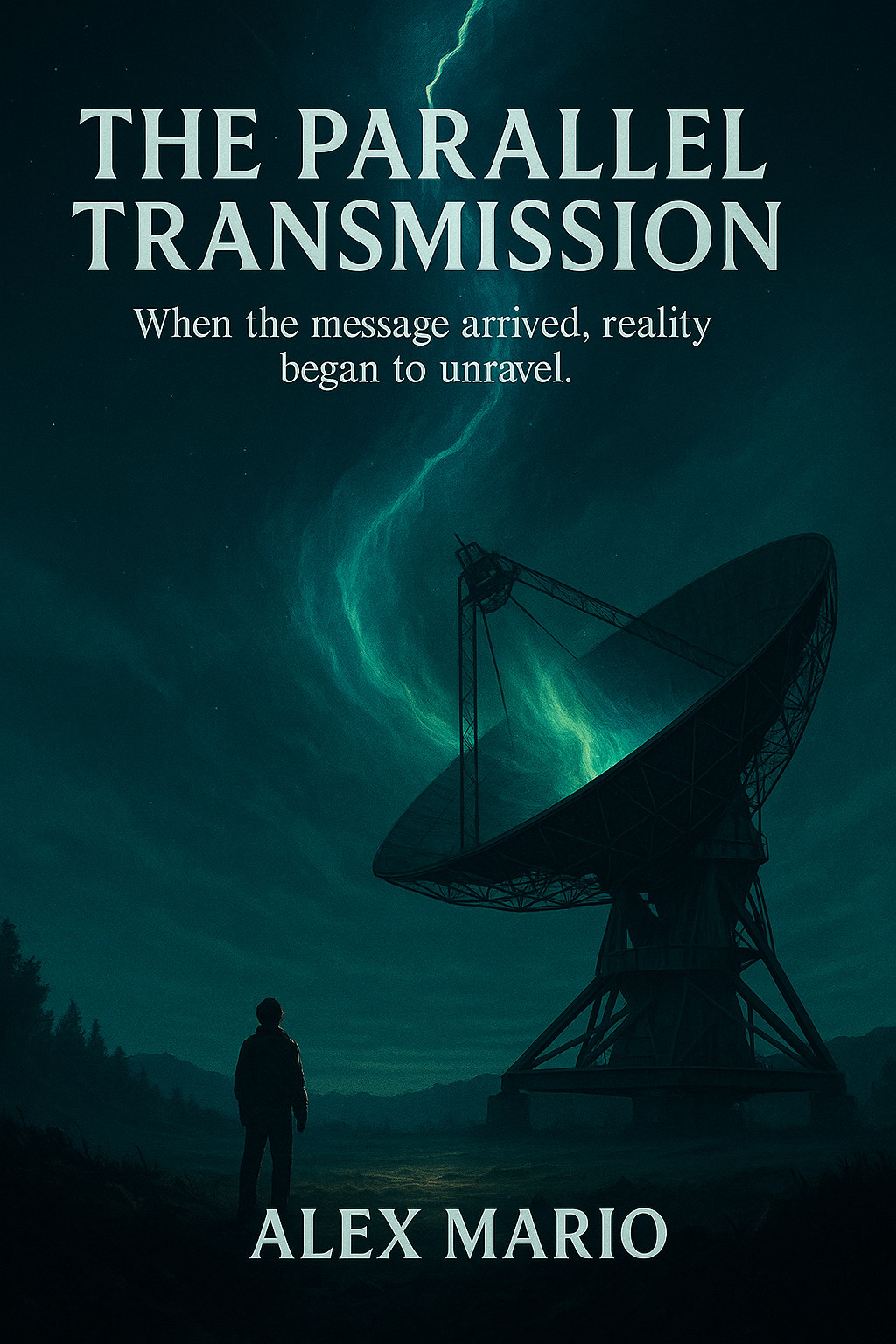
The Parallel Transmission
When the message arrived, reality began to unravel.
by Alex Mario
The night was silent—too silent for a world stitched together by signals, motors, and the soft hiss of the cosmos. Wind swept over the Carpathian ridge and died against concrete, and inside the hilltop observatory the only sound was the hum of old equipment refusing to retire.
Dr. Adrian Vale should have been asleep. The station had been mostly automated for months, reduced to a caretaker role, the kind of place where you watched computers watch the sky. But insomnia had dragged him up the mountain anyway. He made tea, checked logs, scrolled through noise. And then he noticed it: the universe had gone strangely quiet. Background radiation—normally a soft blanket of static—dipped like someone had pressed mute on creation.
At 2:47 a.m., the quiet broke.
Three long pulses. Two short. Pause. Three long again.
Adrian blinked, and the old knowledge surfaced from a childhood spent fiddling with radios. Morse. SOS.
He told himself it had to be a glitch—some artifact of the automation, a satellite misbehaving. Except the coordinates on his monitor didn’t fit any orbital path. The origin point drifted with each measurement, like a lighthouse seen through heat shimmer.
He switched to the hydrogen line, the frequency astronomers used as a universal constant when they were arrogant enough to call the universe. The signal was there, loud and implausible, but not coming from a star or a nebula. It was coming from behind the noise—threaded through the fabric of the spectrum as if the spectrum were a curtain.
Adrian’s hands shook. He activated recording. Waveforms crawled across glass. A voice rose out of the interference—faint at first, then clear enough to make the hairs on his arms stand.
“—if anyone hears this, we hear you too. This is A-0 Earth. Repeat: A-0 Earth. We are… displaced.”
The room tilted, and for a second he felt seasick. “A-0 Earth” meant nothing, except it did, immediately, in the unlit hallway of his mind where you kept the words you weren’t ready to say. Parallel. Another track on the same record.
He hit “respond” and heard his own voice go thin. “This is Carpathian Ridge Observatory, Romania, Earth. We copy your… transmission. Identify.”
The reply came with a stutter, as if it had to cross a field of broken clocks.
“This is Dr. Eliza Vale, A-0 Earth, Central Eastern Array.” A pause. A ragged breath. “If this is a joke, it’s cruel. If it isn’t—Adrian? If you exist there, listen to me.”
He forgot to breathe. Eliza. His Eliza had died two years ago in a flash flood that turned a city street into a river. The grief had been clean and brutal and final. He had gotten very good at living around an empty chair.
“This is Adrian,” he said, and his voice betrayed him; the syllables came out soft around the edges. “Eliza… you can’t be—”
“I know,” she said. “On our side, you drowned. I buried you with a notebook in your pocket and a frequency map you never finished. I learned the map. That’s how I found this channel. We don’t have time for the long version.”
He sat down because the room was full of knees and if he didn’t, he would fall. The tea went cold on the console.
“Explain,” he whispered.
“Three months ago,” Eliza said, “the sky on A-0 went wrong. Not with storms or ash. With time. Shadows lagged a heartbeat behind their owners. Birds refroze mid-flight and then caught up. The oceans forgot how to breathe. Our spectral background dipped—just like you’re seeing now. We built a model and it said we’d been untuned from the rest of reality. Like we were a guitar string plucked off key.”
“Cause?”
“A collider experiment we thought was harmless. Or maybe it was always going to happen. The model can’t tell blame. It only tells when. We’re slipping.”
A different voice broke in—hoarse, urgent, someone off-mic: “Thirty seconds to drop.”
Eliza again, fast now: “We phase out and back in waves. During the lows, we can transmit through the hydrogen line. During the highs, we’re… not here. We need help calibrating a counter-wave. You always loved that kind of math, Adrian. I hated it. But I learned.”
He stared at the screen until the pixels grew into a swarm. His body wanted to say no, because saying yes meant believing in a world where your dead wife asked you to save her across a slit in the universe.
“Send the data,” he said.
It arrived like snow. He parsed the file, old instincts snapping into place, fingers remembering a rhythm they hadn’t played since grief quieted the music. The model was elegant and terrifying: a picture of two branes—two adjacent realities—touching and repelling like magnets turned the wrong way. If he could mirror their wave by driving selection antennas on this side, he might dampen their oscillation, pinning A-0 in phase. It would need dangerous power and perfect timing. It would also need a human guessing at the part of the math the math couldn’t reach.
“Adrian,” Eliza said softly, as if they were in their old kitchen and dawn had just begun to try the window. “If you do this, your grid will brown out. Hospitals, transit—”
“I’ll warn them,” he said. “Our grid has redundancies. Does yours?”
A silence thick with unsaid things. “Not anymore.”
The second voice returned. “Five seconds.”
Eliza’s breath hitched. “We’ll fall out again. The next window is in ninety-one minutes. Build the wave. If you can’t reach us then, try at plus one-eighty-two.” The quiet ate half a sentence. “…and if you can’t at all, that’s okay. I love you anyway. In both universes.”
The channel died.
Adrian looked at the empty room and laughed once, the sound a little cracked. He moved.
He called grid control and invented a plausible lie about an emergency test. He diverted power from the valley and felt, for the first time since the flood, like he was steering something instead of bobbing on it. He cursed at old screws. He opened panels that had been sealed with the kind of optimism that thinks hands won’t be needed anymore.
At the seventy-minute mark, Elena from the valley clinic burst in, soaked with fog, someone who had sprinted uphill through a century. “Whatever you’re doing is dimming my monitors,” she said. “If this is a passion project, pick another night.”
“It’s not passion,” he said. “It’s grief that learned to do math.”
She stared—and because she had held too many hands for the polite lies to work on her anymore, she said, “Explain while I wrap cables.”
He did. She didn’t call him insane. She tightened a bolt with a nurse’s decisive kindness and said, “Tell me where to push.”
At the ninety-first minute, the air felt thinner, as if the room had been emptied of half its oxygen. The hydrogen line bloomed. Eliza’s voice rode in on a carrier wave like a message in a bottle.
“Window. Are you ready?”
“We built the counter-wave,” he said. “The phase curve wants a 0.13 lead, not a lag. Your model underestimates drift in the third harmonic.”
“That sounds like you,” she said, and he could hear the smile he had fallen in love with because it always sounded earned. “Ready on our side.”
He looked at Elena. She nodded once, as if to say go, before we remember all the ways this could break. He threw the switch.
Power leapt into the array. Antennas sang a pitch too low to hear. The mountain trembled and the lights of the valley flickered as if someone had taught them to pray. On the screen, two impossible curves tried to match steps. For one exquisite second they did.
And then the wave bucked.
“Eliza,” he said, “you’re a quarter-beat heavy.”
“We lost a substation,” she replied, voice shredding at the edges. “We can reroute in eight seconds.”
“Seven and you fall out,” he said.
“Then six,” she answered.
He altered his curve blindly, trusting the muscle memory in his hands more than the numbers. Elena called out voltage like a mantra. Somewhere far below, a siren rose and fell. He thought of funerals on two Earths and decided not to attend either.
“Now,” Eliza said.
He shoved the lead. The curves kissed.
The screen steadied, then brightened as if someone had turned up reality. Outside, the wind remembered how to be wind. In the valley, the siren cut off mid-wail. In the control room, three humans remembered they had bodies and sat down before their knees made a decision for them.
“Hold,” Eliza whispered. “Hold.”
They held for nineteen seconds. Twenty. Twenty-one.
At twenty-two, the grid howled. A breaker tripped and the array’s song dropped an octave. Eliza swore—language that proved the world was still human.
“Adrian,” she said. “I can take the last adjustment. You need to bleed power or you’ll crash your side.”
He wanted to argue. He wanted to keep both plates spinning. He wanted to live forever in the exact length of a heartbeat where he could hear his wife and save a planet and be the version of himself who deserved either.
“Take it,” he said, and let go.
The array eased back. The mountain exhaled. The curves on the screen slid into each other and—miracle or math—stayed. The hydrogen line settled into a steady thrum like a cat deciding you were furniture and therefore safe.
Eliza laughed, and it was the laugh he knew best, the one she made when a recipe finally turned out. “We’re stable,” she said, breathless. “Adrian, we’re stable.”
Elena leaned against a rack and wiped her face with both hands. “Do I put that on the paperwork?” she asked the ceiling. “Interdimensional resuscitation successful. Recommend tea.”
Adrian found his mouth and made it smile. “Tea,” he agreed.
The channel stayed open longer than physics had any right to allow. Eliza told him about her city—same streets, different graffiti. He told her about the clinic and the way Elena could talk a frightened child into letting a needle do its job. They traded small details like seeds: the corner bookstore where the owner miscounted on purpose in your favor, the way the ridgeline looked after rain, how grief had tried to make them smaller and failed.
When the window finally narrowed, the voice on Eliza’s end—the hoarse one—cut in. “Thirty seconds,” it warned.
Eliza’s words turned urgent again. “We’ll ride the model now. It should hold, as long as your grid doesn’t mind humming in sympathy. If you ever need us—if your side ever slips—call the hydrogen line. We’ll listen.”
He swallowed, because of course someday his world would break too. All worlds do. “I’ll be here,” he said.
“And Adrian?”
“Yes.”
“I have you,” she said simply, as if that were a fixed star and he was allowed to navigate by it in both skies.
The line thinned to static, then to the ordinary whisper the universe carries when it has nothing in particular to say.
Elena poured tea from a pot she had conjured out of nowhere. Outside, the valley lights steadied. Somewhere, a fox barked at nothing and then reconsidered. The observatory smelled like dust and victory.
Adrian sat with the cup steaming between his palms and stared at the empty channel, which did not feel empty at all.
“Is she… yours?” Elena asked, gently, not looking at him as she asked it, which was a kindness.
“In a way that matters,” he said. “And in a way that doesn’t belong to this world.”
Elena nodded. “Most important things are like that.”
He powered down one console at a time, petting the switches as if they were tired animals. The logs would read strange in the morning. The Board would ask questions. The valley would tell stories that became legend by Sunday.
He walked to the door and opened it. The night air was cold and new, and the sky—his sky—felt a fraction closer, like it had leaned in to hear what two small humans had decided together.
He thought of the message that crossed the seam and the two curves that learned how to share a line. He thought of how grief had been a wall, and how, tonight, it had turned into a bridge.
When the wind moved, it sounded like someone turning the dial of a radio, trying to find a voice. He smiled at the old equipment, at the fox, at the dark that wasn’t empty.
“We hear you,” he said softly, to his world and the other. “We’ll listen.”
About the Author — Alex Mario
Alex Mario writes human-first science fiction that blends technology, mystery, and emotion. His stories chase the thin line where ordinary people meet impossible choices—and discover that courage is the most reliable signal in any universe.
About the Creator
Keep reading
More stories from Alex Mario and writers in Fiction and other communities.


Comments (1)
it is very good to read