
The Other
Mindy meets her doppelgänger. Is it a real person? Should she face it or run?

The first time I saw her was on an autumn day in Barley, my Minnesota town. It was down on the old train tracks that ran past the back of Sid’s tavern − a lively place with noise and music in summer, but quiet in late September, with a chill in the air and the outdoor patio closed up.
That day I remember thinking how the buzz of June bugs was gone. All around were brown and brittle thickets, and cottonwoods turned to gold. We had played along these tracks as children in the summertime, where we could hear swearing and laughter at the tavern and imagine the lives of grownups. As an adult, I came for the comforting quiet − the empty, forlorn tracks stretching ahead to a curve that embraced the cliff face and away out of sight.
The last thing I would expect to see was someone walking along the tracks toward me.
I must have walked a mile or more that fall afternoon, past the tiny bungalows of my neighborhood, and through town and woods, coming finally to that old stretch of tracks behind Sid’s like a homing pigeon. I picked my way over the ties, awkwardly, because railroads were not designed for the human stride.
Going there to that contemplative place was how I could get away from my thoughts and yet be in them. I don’t know if that makes any sense. I may have been whistling something. A show tune, or who knows what. I had passed Sid’s and it was quiet.
That’s when she appeared. My twin. Or someone so uncannily like me that for a moment I put my hand up, as if to touch a mirror. She was a ways off, but unmistakable. Same mouse brown hair pulled into a mess of a ponytail. Same blue jeans with ripped knees and a blue and white striped boat-neck shirt. I stopped, staring. She walked toward me, and kept walking, even when the train hove in from around the bend just beyond, and I realized I had been feeling its vibration under my feet for some time.
My alarm at seeing this semblance of myself was overtaken by fear. She was in the direct path of the train, and the tracks were surrounded by a sheer rock wall and thickets on one side, and a steep drop-off on the other. I waved my arms to tell her to get off the tracks − even if it meant jumping into the thicket that was surely full of stickers and sharp twigs. The whistle blew, and the train came on. She just kept walking, no care in the world. I turned around and ran back toward Sid’s, where I jumped off the track at the crossing and then stood and stared as the train chugged by. A noisy monster. Had it just taken a life? Wouldn’t it be braking, stopping, assessing damage?
My heart beating like a desperate incantation, I got back onto the track and returned to that spot. I knew right where I had been, and right where she had been walking along, so mindlessly. And now she was gone, just like that. A slight breeze ruffled my hair. A goldfinch sped past and I watched as it rose and fell the way they do, as if riding waves on the wind.
I determined that I had imagined all this − experiencing a bizarre episodic moment of some kind. I was possibly spending too much time alone.
Back home, I went about some chores, which involved mostly picking away at the dying garden. I had always tidied and cut things back before the snow came, pulling out old cucumber vines and cutting back potato tops so they could winter. The birch had dropped all of its leaves and I raked them up into damp piles, for it had rained earlier in the day − a solemn, season-shifting rain that left nothing to the imagination.
Then I straightened up the house, putting magazines back that I had paged through that morning over coffee. As if impressing upon me that time is meaningless, some of them still lingered here in the old sturdy frame house from when it belonged to my parents. These were the ways I would pass the time. Even though everything was different now with Jamie dead, I tried to keep routine. It seemed the right thing to do.
Dusk was falling. In the months since June, when my life changed forever because of Jamie’s tractor accident over at Marvin’s where he’d done farm hand work in between roofing jobs, I’d been living day to day in a quiet void. Passing the time until my destiny's next phase revealed itself. Now, suddenly fidgety and restless, I rang up my sister Amy, the only person I spoke to these days.
“Hey Mindy. How’s the loner life?”
I laughed. “That’s quite the indictment.“ I knew she meant well, didn’t want to coddle me or be some kind of enabler of self-pity. Being widowed at the age of 28 brings out interesting behaviors in one’s family and social circles. “It’s going okay. I’m just putting one foot in front of the other.”
“That is grief, my sweet. It has its own timeline.” She paused for a moment and I wondered if she had some wisdom for me, if there were words that would help put it all straight. Some sisterly advice that would soften the ache within me. But she said, “We could grab a beer, if you like.”
We agreed to meet a short while later at Sid’s and so I retraced the steps I had taken earlier in the day through my little town, bringing a light with me for the trip back. I looked down the tracks as I crossed them, now shrouded in an autumn dimness that seemed to hail from some other era, as if the tracks were a time machine and you could walk on down and find an earlier version of your life waiting there.
Amy was at the bar with a Surly, which they served on tap. Some locals were playing pool and the yeasty brewery aroma was thick in the air. I pulled up a stool.
“Look who’s making an appearance,” Sid said.
I blushed, not knowing what to say. I fought a small urge to run. This is why I had holed up these months. What was there to talk about, except how much life had changed and how awful it all was? One minute you had a husband, and the next minute you didn’t. I had no desire to complain. And there wasn’t a damn thing anyone could do to bring my husband back. It all just was.
I tried to smile. “I’ll have what she’s having.”
“There were never such devoted sisters,” Amy said.
After Sid dropped off my Surly Furious, I stared at it. “I think this was a bad idea.”
“They have other things on tap. How about a Bauhaus?”
“I mean coming here, you goose.”
She laughed and twirled her glass around slowly in the condensation that had collected under it. It was too warm in the bar and she was using the coaster to fan herself. I supposed they had turned off the AC, now that it was fall. But there always seemed to be a lingering heat inside buildings that left them sultry and stuffy until sometime in November.
Amy turned to me. “So Amy, how are the kids?”
I shook my head. I didn’t understand. And then I did. “Sorry,” I said. “How are the kids, Amy?”
“So glad you asked. Constance likes 5th grade. She thinks she’s all grown up now and has started wearing a bra, though she’s still shaped exactly like a boy. And Ronny is quite the precocious third grader. He plays chess. And he’s good. He beats Martin at it every night.”
I thought of them a little wistfully. I wasn’t ready to go back to all the life things I had before. In fact, I could barely remember that life, except that whispers of it came back to me sometimes, as they did now. I had been close to Amy’s kids. I had called them Connie and Ronny, though Constance only went by her formal name. I remembered tousling their hair, taking them to the store for bubblegum, and going to their church pageants at Christmas and Easter.
Jamie and I had been planning for children. We were trying. I thought of the kids I would have had, growing up with their cousins. Boat rides we might have taken on the Mississippi, watching fireworks together on the 4th of July. I shook my head to stop this line of thought from parading through my mind like a freak circus. I discovered I was chewing my thumbnail.
“What about Martin?” I asked finally, though I didn’t exactly know what question I was posing. I noticed a couple of guys playing pool were glancing occasionally in our direction, probably looking for wedding rings. Plotting a move.
“Martin,” she said, as if that was an answer. And for the first time I wondered about them − Martin and Amy. Did they have a good marriage? There would have been a time when I would have asked more, would have been more curious in a helpful sort of way that could have made a difference. Now her mention of Martin’s name felt final, as if there was nothing more to be said about it. It also occurred to me that whole, undamaged people can tell the difference between concern and intrusion.
I looked at her. “Did you say something?”
When she sighed it seemed to come from deep within her like a spirit cry from a cold dark well. “I said ‘at least you’re out and about.’”
Then Patsy Cline came on the sound system, singing “I Fall to Pieces,” and I realized I was done. “I’m sorry,” I said, putting some money on the bar next to my untouched beer. I touched her shoulder, then squeezed her arm. We looked at each other and my eyes began filling with tears.
She held my hand for a moment. “It’s okay. Baby steps, Mindy.”
The walk home was dusky and damp and the air smelled of mulch, like rotting apples and hay. Livestock in the nearby farms would be bedding down for the night. I looked toward the Sampsons' fields, where giant bales of rolled hay sat like big sleeping trolls, and watched as a barn owl swooped through the dusk after some unfortunate rodent. The half moon to the south glowed through a mist that seemed mysterious and somehow meaningful, though I didn’t know what to make of it.
***
Halloween came. Once a week I would go to Wal-Mart to stock up, and for weeks I had been witness to the local kids haggling with their parents over light sabers, fake guns and hideous masks, gashed with blood, scars and popped out eyeballs. I bought some candy in preparation for the big night, though I wasn’t sure I could do the whole trick-or-treat thing. I reasoned that if I turned the lights out and just hunkered down in my bedroom at the back of the house, no one would come. I wouldn’t have to hear that cheerful ding of the doorbell or open the door to see the bloodied masks.
And yet, toward dusk on Halloween night, I lit some candles and taped a picture of a jack-o-lantern in the front window, poured the candy in a bowl, and swapped a black light in for the usual yellow incandescent porch light. I put the Counting Crows collection on repeat on my Bluetooth. Then I sat in a wicker chair in the screened entryway to watch and wait. First the very small children toddled up, some being pulled along in red wagons by proud young parents. I met each little group at the door to the screened porch, and extended the candy bowl before they even had a chance to say “trick-or-treat.” It seemed to give me a modicum of control over the experience.
I watched the parents as they came to the door. I wanted to ask them, “What is it like, having kids? Do you feel like you have been given the most amazing gift?” But I saw a startling mix of expressions on their faces − fatigue, boredom or perhaps a yearning for their life before − and simply looked at them and tried to smile.
Later the grade school kids came along, also accompanied by adults, though they were allowed to walk at a distance, clearly having started the long separation process that is an essential part of growing up. And some of the older ones − Connie’s age, I thought − traveled in packs and seemed dedicated to garnering as much candy as was possible in the available time. The masks and the outfits all lent a strange quality to the evening, in the way that a particular place and moment can sometimes feel like the setting of a movie, as if we were all just actors.
What I didn’t expect was to see her again. The other me. But there she was, walking along the road as if looking for someone. She wore the same outfit I had on at that very moment − Levis, a pair of brown leather cowboy boots that were showing their wear, and a thick maroon sweater. The logical part of my brain had shape-shifted amidst the other-worldly surroundings of Halloween night and couldn’t make sense of what I was seeing. Was someone playing a prank of some kind?
She turned off the street and a moment later I saw with alarm that she was walking up the steps to my house. I gasped, and air caught in my lungs. She rang the doorbell. And as I backed away from the screen door to the door of the house, nearly falling over the threshold, she said “trick or treat!”
Who was this zombie, this doppelgänger? What did she want? I managed to squeak out, “Who are you?”
But she only stared through the screen.
I fled into the house, locked all the doors and windows and turned on the lights. I knew I had imagined it all, and yet it seemed so real. I curled up on the couch with an afghan, staring out at the dark windows, fearing I would see her face there. In the morning, I woke with autumn light streaming in the windows and my Halloween candles still burning low, and it was as if it had never happened.
***
A few days later Mr. Olson, the Barley Grade School principal, called. We hadn’t spoken since the accident, when I called him up to say I wouldn’t be going back to teach in the fall. Just days after Jamie died, I had already known it couldn’t work. There would be no going on with public life, social things and normalcy. Not then, not in the fall, not ever. I was taking a leave of absence, with an indeterminate end time, I told him. And I explained why, though everyone in town already knew. “I’m so sorry,” he’d said back then. “That’s a difficult cross to bear. A very difficult cross.”
Here it was, four months later.
“I was calling,” Mr. Olson said in a gingerly fashion that was unlike him, “to see how you’re getting on, how the recovery is going from your loss. I know it is certainly not something one just gets over.”
When I didn’t answer in the moment it took for him to take a breath, he continued. “Of course, everyone grieves differently. I do understand that. Your loss is monumental. Just terrible. Honestly, I’ve tried to imagine." He paused again. "At any rate. I hope you’re as well as can be expected?”
“I’m getting on. Thank you.”
Principal Olson revealed his agenda. “You remember Mrs. Helgason, I’m sure?”
I confirmed that I did. The former Ms. Barbara Berkshire was now married and pregnant, though no one knew which had come first. She and Jamie had been an item for some time before things fell apart between them and he abruptly chose me. Now Barbie was leading the right sort of life that so many small town Midwest women hope for. She was married, having a baby, and living in a cute house on 4th street with an eye-catching weeping willow in the yard − symbols of shifting fate.
Principal Olson continued. “You probably know she’s preparing to go on her maternity leave? So then. I’d like to see if you would consider coming back. If you could fill in while she’s gone, it would give you a chance to try things out again, and see if it feels right to be back on the job.”
“Oh. I see.”
“Will you consider it?”
An old left-over summer fly buzzed maniacally at my kitchen window and I wondered for a moment how long they live. I supposed I would have looked that up for my students and shared it in my Ms. Mindy’s Matter of Facts session. But the person who made lesson plans, showed children how to catch butterflies without harming them and laughed at their antics was officially missing in action. “No,” I said. “I don’t think so.”
I could almost hear a solemn nod on the other end, and I remembered this about him. That he would give long speeches followed by a gallows silence. It was possibly a device to force others to talk, as the quiet following one of his speeches was deafening, and one couldn’t help feeling a deep desire to break the spell. It worked often enough.
“I mean,” I said, “I’m sorry. I’m just not ready. My husband’s death still feels like yesterday. I thought I heard his boots in the hall the other day giving two stomps, which is just exactly what he used to do each night when he stepped onto the boot tray. Do you know what I’m saying?”
Somehow I heard him nod again, silently. “I’m just asking you to think about it,” he said. “Barbie… I mean Mrs. Helgason, is working right up to Thanksgiving, so you wouldn’t have to start until after the break. I’ll just give you some time to think about it. Alright? Well it has been wonderful chatting. Bye for now.”
I stood holding my cell phone, as if expecting him to come back on and let me give a proper goodbye. Then I went out into the garden to turn the last of the tomatoes into the compost bin, as they had grown full and green, but would develop no further now that the days had turned cool.
***
I called Amy one day in the middle of the afternoon, when I knew the kids would be at school. I realized I had forgotten to ask what costumes they wore for Halloween and felt like a shit. When she picked up, I asked, “How does a person know if they are going crazy? Asking for a friend.”
She laughed a little, but her voice sounded strange the way a person does after awakening from a disturbed sleep. “What is your friend experiencing, exactly?”
“She sees herself, like around town. Just literally a carbon copy of herself. An exact replica.”
Amy had been a psychologist before kids, and would be again one day, I supposed. Perhaps she would have to study and take all the exams again. Maybe it would be like starting over. Or maybe she would end up waitressing, like our mother, who had worked at the Perkins in Whimden after we started high school. She had stopped being a doctor to have us, and then it was evidently too much trouble and expense to start up again.
Amy had not said anything, and in the silence I could only hear her breathing. Perhaps we were both thinking about our mother’s sad existence − her life chances tossed away. Our parents lived now in a retirement community near Reno and had become chain smokers. We rarely saw them.
“I don’t know,” she said finally, and I realized she was crying.
“Amy? Are you okay?”
I could hear her blowing her nose. “I guess. I think maybe I’m going crazy myself. I actually have a fantastic job prospect. But Marty wants me to be here when the kids come home. He wants a traditional wife. Mindy, I’m losing myself. I don’t think I can do this.”
I waited. As a teacher I had learned that a lot of wrongs right themselves if you give people time. Once I had listened to two girls, faces streaked with mud and tears crying to me about their fight on the playground over the rules of hopscotch. I looked from one to another, just nodding at what they were saying, and offering no advice or treatises or punishment. In a few minutes the tears stopped and they said they were very sorry and hugged each other and went back outside to play. Now I waited. After a moment, I merely said, “I’m listening.”
I could hear her crying again. Then she said, “Thanks Min. I needed that.” She sniffed. “I just need to tell him I have to go back to work or go completely insane. I will feel so much happier. And with my psychologist’s pay, we can afford the most qualified nanny in town. You know, I actually think it will be better for the kids. A nanny will have more patience. Certainly she will be better at all the crafts and kid activities than I am.”
I closed my eyes. Breathed in. Breathed out. Then I said, “I could probably help out. At least until you find someone good.”
“Oh my God, are you sure? I mean, are you up to it?”
“There’s one way to find out.”
I could hear her kids coming through the door, dropping backpacks and asking for snacks. “Gotta run,” she said.
I wanted to tell her to wait. Maybe I had only offered to baby-sit for her in a moment of weakness. I could no more handle children right now than I could take a job as an astronaut. Fighting a wave of dismay bordering on paralysis, I only said, “Sounds good.”
“Oh,” she said. “About your twin. It’s likely just some part of you. A kind of apparition that is trying to force you to reckon with something.” She hung up the phone and was gone.
***
The next day I drove to the best place in the region to walk and think. In Whimden, there were bluffs overlooking the Mississippi river where you could see hawks and eagles. In the summers, paddlewheel boats ran up and down the river giving rides to the tourists and you could watch them moving along the water down below the coulees, looking every bit like bathtub toys.
But in autumn, the patchwork quilt of oaks and maples lining the bluffs on the opposite side sported the fading colors of the season. Jamie had loved the bluffs, and we would picnic there sometimes on a Saturday, or just drive up with binoculars and look for eagles. I wanted to reach out for his hand, feel the solidness of him, feel his breath on my cheek and hear his voice, but he was not there.
Perhaps there is a guidebook on how to be a proper widow. How to grieve, how to find a way to live. Looking out at the brown of late Autumn, the coulees, and the reflections of sky, clouds and trees in the river, it felt as elusive as ever − as if the required lessons were being withheld until I showed some sign of readiness to learn.
I walked along the bluffs watching a small flock of seagulls perched on a rock outcropping. There was only the sound of the wind and the occasional cries of the gulls. The Whimden University students came here often for everything from science projects to making out, but it was the middle of a Thursday afternoon and there was no one.
Except there was.
When I saw her, I stopped still, frozen. She was walking toward me from far down the bluff, as if she too had come here to consider life’s mysteries. And yet her purposeful stride indicated something more. A plan. An agenda.
I couldn’t decide whether to stay or to run. I wanted to shout, “What are you doing here? What do you want?”
Instead I stood rooted, immovable. She was about 25 yards away, close enough now for me to see the expression on her face − my face − which was one of almost pained intensity.
I could also see what she wore. It was, I realized with a horrid jolt, the outfit I had been wearing the day Jamie died. How dare she? How could anyone just show up like this and take me back to that day? Anger took hold of me. I felt a fury burning in my gut. I shouted, “Stop!”
She kept on. I began shaking in sorrow and anger. She wore my familiar white jeans, red plaid flannel shirt and leather sandals. It had been summer when he died. My toenails were painted. I was happy then, and my life was good. Jamie had been strong and alive. We’d had plans.
When she stood before me, I felt I couldn't breathe. The likeness was startling. But why was this happening? “Why are you here?” I said, choking out a sob.
Her eyes narrowed. “Because you won’t let go.” Then she reached toward me, grabbing at me. I backed away. She lunged and grabbed again. I fought her off, but she gripped my arms and I discovered she was fiercely strong. I resisted with everything I had as she pulled and dragged, and I realized we were moving toward the edge of the bluff.
In the struggle, I lost my footing and tumbled to the ground, and she fell upon me, and rolled, forcing me to roll with her to the bluff’s edge. I shouted, “No!” I tried to scramble away and she quickly grabbed me again. I suddenly understood that this was a fight to the death. One of us had to go − the shell of a person I was in the present, or the one who was frozen in the past.
And I made a choice. I decided that it was not my time to die. I clambered up, ready to run or to fight, and she grabbed me again. But I ripped her hands off of me, and then I shoved her with all of my might. She lost her grip on my arms, and tumbled off the edge of the bluff, past the coulees to the river below.
I stood, panting, looking up at the blue autumn sky. I did not go to the edge of the bluff to look over. Instead, I listened to the sounds of the river, flowing through time and space. Then I began walking − away from the open maw of the bluff, away from the shadow land of a life interrupted, and into an existence in which I could be healed.
About the Creator
Keep reading
More stories from writers in Fiction and other communities.
The Legend Of El Dorado
For centuries, humanity has remained captive to the mesmerizing glow of gold. Throughout history, this precious metal has driven nations to war, kings to madness, and explorers to the ends of the earth. Yet, within the annals of history, there exists a name that sparked more obsession than any other — El Dorado. This was the legendary city said to have streets paved with gold, palaces covered in pure sheets of the precious metal, and a king who dusted his entire body with gold powder before diving into a sacred lake. It was the ultimate dream of wealth, a mirage that lured thousands to their doom.
By Literary fusion2 days ago in Fiction
Early March 2026: 4 Goals Accomplished
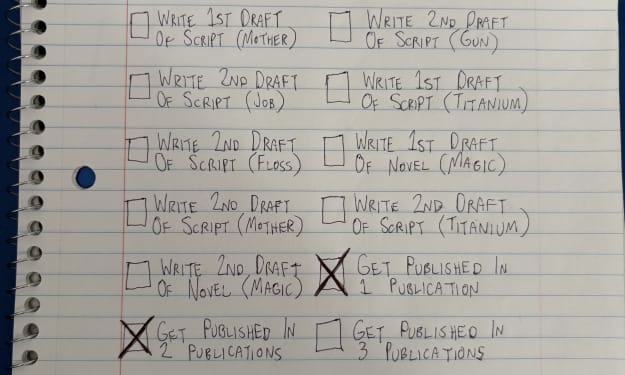
It's early March and I've now accomplished my 4th writing goal for the year of 2026. Before diving into the behind-the-scenes of it... why not tell you up front what that accomplishment was? I was published in a 2nd publication for this year. Published in Helix Literary Magazine out of Central Connecticut State University. You can read it for free right now!
By Stephen Kramer Avitabile3 days ago in Writers



Comments
There are no comments for this story
Be the first to respond and start the conversation.