
The origins of written language.
The written language stands as one of the most significant milestones in human history.

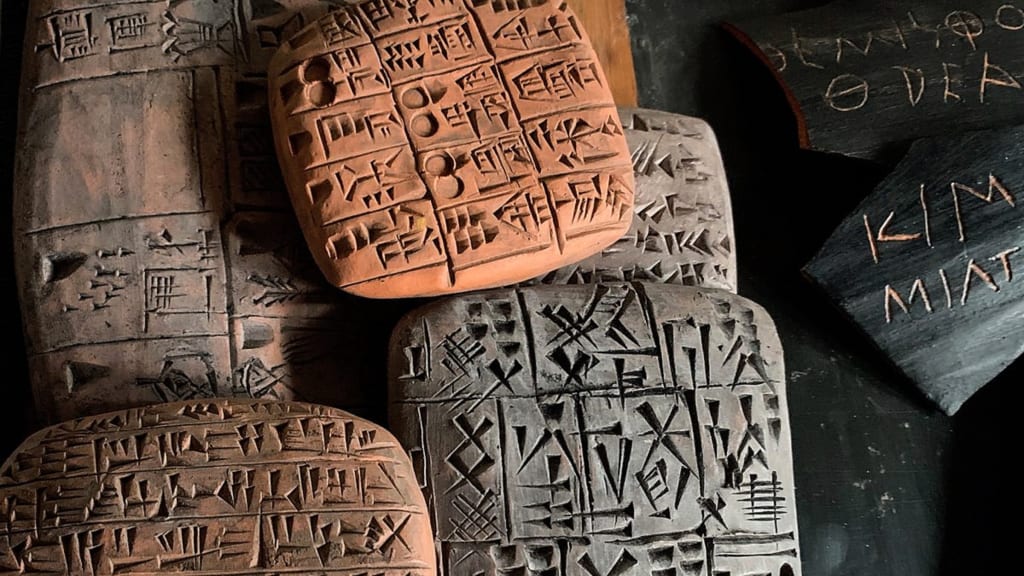
Writing transformed communication, administration, and culture, enabling civilizations to record knowledge, pass down traditions, and govern societies more efficiently. The origins of written language can be traced back to the early need for recording economic transactions and organizing increasingly complex societies. This article explores the evolution of writing from its earliest forms to fully developed writing systems.
Pre-Writing Communication
Before the invention of writing, early humans relied on oral traditions and symbolic representation to convey meaning. Cave paintings, petroglyphs, and symbolic carvings dating back tens of thousands of years suggest early forms of visual communication. These symbols often depicted animals, hunting scenes, or abstract shapes that carried cultural or spiritual significance. While not writing in the strict sense, these representations provided the foundation for later written symbols.
The Emergence of Writing
The first true writing systems emerged in Mesopotamia and Egypt around 3100 BCE. These early systems primarily served economic and administrative purposes, as rulers and merchants needed ways to track trade, resources, and transactions. The two most well-known early writing systems are cuneiform and hieroglyphics.
Cuneiform (Sumerian Writing)
The earliest known writing system, cuneiform, originated in Sumer (modern-day Iraq). It began as pictographs inscribed on clay tablets and gradually evolved into wedge-shaped symbols made by pressing a stylus into wet clay. Initially used for record-keeping, cuneiform later adapted to represent spoken language and express ideas, allowing literature, law, and historical records to flourish.
Egyptian Hieroglyphics
Around the same period, the Egyptians developed hieroglyphics, a pictorial script used primarily for religious and monumental inscriptions. Hieroglyphs combined logographic and phonetic elements, making them more complex than earlier pictographs. The Rosetta Stone, discovered in 1799, played a crucial role in deciphering Egyptian writing, as it contained the same text written in Greek, Demotic, and hieroglyphic script.
Development of Phonetic Systems
As societies grew more complex, logographic and pictographic systems became cumbersome. The need for more efficient writing led to the development of phonetic scripts, where symbols represented sounds rather than whole words or concepts.
Proto-Sinaitic and the Alphabet
Around 1800 BCE, Semitic-speaking workers in the Sinai Peninsula adapted Egyptian symbols into a more simplified script known as Proto-Sinaitic. This system marked the transition from pictographic to alphabetic writing, where individual symbols represented consonantal sounds. This script evolved into the Phoenician alphabet, which later influenced Greek, Latin, and many modern writing systems.
Chinese Logographic Writing
In a separate development, Chinese writing emerged around 1200 BCE during the Shang Dynasty. Chinese characters began as pictographs and evolved into a complex logographic system, where each character represented a word or concept. Unlike phonetic alphabets, Chinese script has remained largely logographic, though it has undergone simplification over time.
The Spread of Writing Systems
As civilizations interacted through trade, conquest, and cultural exchange, writing systems spread and evolved. The Phoenician alphabet, for example, influenced Greek writing, which in turn shaped the Latin alphabet used in much of the modern world. Similarly, Aramaic script influenced Arabic and Hebrew writing systems.
In India, the Brahmi script, developed around 500 BCE, became the foundation for many South Asian writing systems, including Devanagari (used for Sanskrit and Hindi). Writing systems adapted to suit different linguistic needs, leading to the diversity of scripts seen today.
The Impact of Writing
The invention of writing revolutionized human civilization in numerous ways:
Record-Keeping and Administration: Writing enabled governments to maintain records, collect taxes, and enforce laws. Hammurabi’s Code (circa 1754 BCE) is one of the earliest known legal codes, inscribed in cuneiform on stone tablets.
Literature and Storytelling: Writing allowed myths, religious texts, and literary works to be preserved. The Epic of Gilgamesh, written in cuneiform, is the oldest known literary works.
Science and Philosophy: Writing facilitated the transmission of scientific knowledge and philosophical ideas across generations. Ancient texts on mathematics, astronomy, and medicine have significantly influenced modern disciplines.
Cultural Identity and Preservation: Writing helped societies document their histories, traditions, and languages, shaping cultural identities that persist to this day.
Conclusion
The origins of written language demonstrate humanity’s ingenuity in developing systems to record, communicate, and preserve knowledge. From simple pictographs to complex phonetic alphabets, writing has continuously evolved to meet the needs of societies. Today, digital technology has further transformed writing, making communication more accessible and widespread than ever before. However, the fundamental role of writing—as a tool for expression, memory, and progress—remains as vital as it was thousands of years ago.
About the Creator
Badhan Sen
Myself Badhan, I am a professional writer.I like to share some stories with my friends.
Keep reading
More stories from Badhan Sen and writers in Fiction and other communities.
The science of Volcanoes.
Volcanoes have shaped landscapes, influenced climate, and even affected human civilizations. Studying volcanoes is crucial for understanding the Earth's geology, mitigating natural disasters, and harnessing geothermal energy. This article delves into the science of volcanoes, covering their formation, types, eruptions, and impact on the environment and society.
By Badhan Sen12 months ago in Fiction
Put Emotion on Hold
I am taking a break, for I have been thinking too much, about everything and things are coming unglued. So this is my attempt to glue them back together again. In the grand scheme of things, no one cares who I leave my little treasures too, and perhaps I think too much, after all they are just things in the long run,
By Susan Payton4 days ago in Fiction


Comments
There are no comments for this story
Be the first to respond and start the conversation.