
The Only Thing More Dangerous Than a Secret
Seventeen years and a half-extinguished cigarette

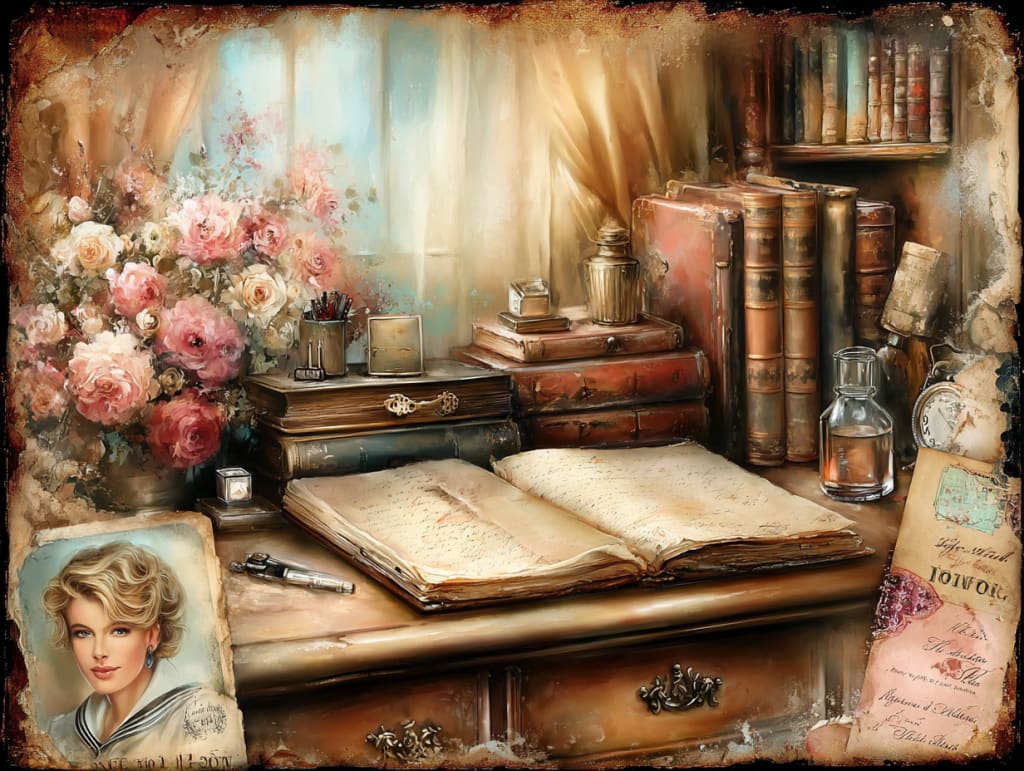
Beatrice arrived precisely at four-fifteen, which she considered the most decent hour for dealing with the deceased. Four-fifteen suggested efficiency, but left ample time for a cocktail before one was required to consider dinner.
The room in question, Aunt Penelope’s notorious Study, was situated at the end of the second-floor corridor, looking out onto a stretch of municipal park that provided excellent views of other people’s disappointments. Penelope, having engineered her death with the same meticulous flair she used for canapé service, had made arrangements. The Study, she decreed in her will, was to remain locked for seventeen years to the day.
Seventeen years. Not twenty, which would suggest a tragedy of classical dimensions, and certainly not five, which might imply impatience. Seventeen was arbitrary, cruel, and perfectly typical of Penelope. It ensured that everyone who might truly care was too tired or too busy with their own bankruptcies to feel the proper sense of drama upon its opening.
Bea, who had inherited the property, along with Penelope’s appalling collection of porcelain shepherdesses, was accompanied by Mr. Hemlock, the solicitor, a man whose suit looked permanently crumpled, as though he had slept in it while wrestling with tax law.
"The key, Miss Harding?" Mr. Hemlock inquired, holding out a large brass object that looked suspiciously like the key to a medieval dungeon, or perhaps a particularly expensive trunk of lingerie.
"Such an ordeal," Bea murmured, taking it. "It’s always an ordeal, isn’t it, whenever someone insists on being Significant."
The lock was stubborn. It surrendered with a tired, rasping noise, like an old woman admitting a secret she’d long forgotten was interesting.
Bea pushed the heavy oak door inward.
The atmosphere was immediate and absolute. It was the smell of preserved time, a dry, papery scent overlaying stale Shalimar perfume and the faint, unmistakable odor of expensive scotch. The light, admitted hesitantly through a single gap in the heavy velvet curtains, fell in a rigid column, illuminating the truly astonishing amount of dust.
"It’s not dust," Bea announced, stepping over the threshold. "It’s powdered history."
The room was exactly as Penelope had left it on the evening of October 4th, 1952. Nothing had shifted. Time, having been deliberately excluded, had simply ceased to circulate.
On the large mahogany desk, a silver cigarette box lay open. Two cigarettes remained, their tobacco having long since dried to brittle brown flakes. Beside it, a heavy ashtray held one lipstick-stained butt, extinguished with violent finality. There was a glass, etched with a crest that Bea recognized as belonging to a club where women were strictly forbidden, and the residue of what had clearly been a considerable measure of neat liquor.
Hemlock coughed, a thin, nervous sound. "It seems… quite intact."
"Intact," Bea agreed. "Penelope was never one for leaving an untidy final tableau."
Bea walked slowly around the periphery. The curtains hung like exhausted bishops. The fireplace held a fan of cooled ash. The shelves were filled not with the legal tomes Penelope pretended to read, but with slim volumes of minor poets and a surprising number of books on cryptography.
Penelope, Bea recalled, had been famous for her perfection. Her husband, Reginald, had been celebrated for his quiet devotion. They were the couple you invited when you needed to feel that lifelong commitment was not just an aesthetic possibility, but a moral certainty.
Bea paused at a small reading table. Here, the details sharpened. A copy of the day’s newspaper, dated October 4th, 1952, lay folded open to the classifieds. Beside it sat a small, leather-bound notebook, thin and worn at the edges.
"Perhaps this is where the instruction to seal the room is explained," Hemlock suggested hopefully. He wanted documents. He wanted closure.
Bea did not touch the notebook immediately. She ran a finger over the cover, disturbing the fragile layer of settled neglect.
"A notebook, Mr. Hemlock," Bea sighed. "Nine times out of ten, it’s recipes for terrible casseroles or lists of people one intends never to speak to again. In Penelope’s case, it’s likely both."
She opened it. The handwriting was elegant, slanted, and entirely devoid of casseroles.
The first ten pages contained expenses, dry cleaning, theatre tickets, a sizeable purchase of French lace. The middle pages were filled with meticulously drawn sketches of various complicated knots.
Bea turned to the final entry, dated October 4th, 1952. It was not a grand confession. It was three lines, written in that steady, unforgiving script:
Reginald is asleep. The knot is tied. It is always easier to manage the wreckage if you leave it untouched long enough for everyone else to decide it never existed.
Bea closed the book, the thud ridiculously loud in the seventeen-year silence.
"Well," she said, placing the notebook back precisely where she had found it. "No great revelations there. Just an observation on human nature."
But the secret was not in the words; it was in the objects that had been allowed to endure around them. Bea’s eyes fell to the desk again, specifically to a slender silver frame tucked haphazardly beneath the newspaper.
It was a photograph.
It showed Penelope, undeniably, but it was not the regal, corseted Penelope of Bea’s memory. This Penelope was laughing, her hair slightly mussed, standing on a windy, sun-bleached pier. Her arm was looped through the arm of a man who was decidedly not Reginald. This man was younger, vaguely nautical, and possessed a grin of utterly reckless abandon. They looked, in short, dangerously happy.
The photograph had been taken in Monte Carlo, Bea recognized the distinct, improbable blue of the Mediterranean behind them, and it was taken, judging by the clothes and the youthful lack of exhaustion on Penelope’s face, around 1935.
Penelope and Reginald had married in 1937.
The perfection, Bea realized, had not been a marriage. The perfection had been the performance of the marriage. The sealing of the Study, the seventeen-year wait, the final tableau, it was all designed not to reveal a secret, but to ensure that the memory of the real, vital, messy secret was preserved long after anyone involved was capable of being hurt by it.
She hadn't been avoiding the room; she had been protecting it.
"I think, Mr. Hemlock," Bea announced, turning back toward the door, "that the Study contains nothing of legal interest. Just a great deal of dust and a few things that ought to be burned."
She did not mention the reckless sailor, nor the laughter. One did not speak aloud of such fleeting, embarrassing bursts of happiness.
"What shall we do with the contents?" Mr. Hemlock asked, clearly disappointed that there was no hidden diamond tiara or coded map to the Swiss banking system.
Bea stepped out, pulling the heavy door closed again, though she did not lock it. The smell of the past remained on her coat sleeve, like a faint smudge of smoke.
"Do?" Bea lit a cigarette, inhaling deeply. "We shall do what Penelope intended. We shall leave it alone. We shall allow the space to prove that the only way to keep a moment beautiful is to ensure no one ever enters to mess it up."
She looked back at the closed door, behind which the memory of a younger, happier Penelope waited patiently, preserved exactly as she had been before she chose to become respectable.
"They really are the most sensible ones," Bea concluded, tapping ash onto the expensive rug, "the people who decide that truth is far too tiring to live with."
About the Creator
Diane Foster
I’m a professional writer, proofreader, and all-round online entrepreneur, UK. I’m married to a rock star who had his long-awaited liver transplant in August 2025.
When not working, you’ll find me with a glass of wine, immersed in poetry.
Reader insights
Outstanding
Excellent work. Looking forward to reading more!
Top insight
Excellent storytelling
Original narrative & well developed characters
Keep reading
More stories from Diane Foster and writers in Fiction and other communities.
Blue Eggs and Wormholes
Elon squinted at his tasteless boiled eggs. The yolks weren’t the right shade of blue; Earth cuisine was undoubtedly barbaric. He’d been stuck here for millennia, pretending to be human, inventing flamethrowers for fun. “I just want to go home,” he whispered, Googling “cheap wormholes near me.” His assistant peeked in: “Another Mars rocket, sir?” “Yes,” Elon said, “but this time, make it less explode-y.” He sighed, munching on egg substitute, scrolling through intergalactic Zillow. Nothing. Still stranded, still weirdly famous. “Fine,” he grumbled. “Guess I’ll buy Twitter again.” The AI toaster beeped approval. “Finally,” Elon muttered, “someone from home.”
By Diane Foster3 months ago in Fiction




Comments (2)
Your story was amazing, can I tell you my ideas for it?
Every word carried so much strength. This one’s going to stay with me for a while.