
The Night of the Drones
When the silent machines rose into the darkness and war turned into a battle of shadows.

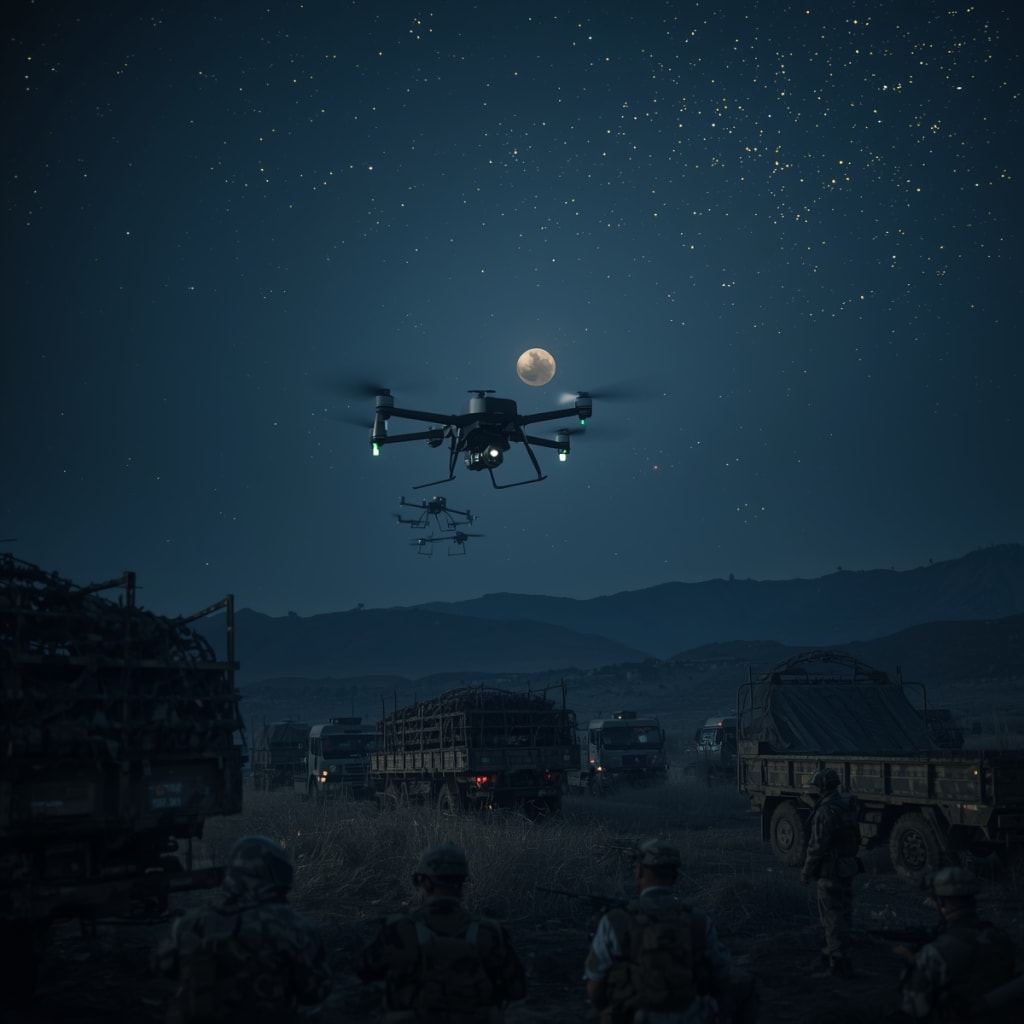
The Night of the Drones
The night after the air battle was strangely quiet. Too quiet. The kind of silence that doesn’t calm the heart but warns it.
At a forward Pakistani post near the Line of Control, Captain Ahsan Farooq stood on the rooftop of a small command bunker, scanning the moonlit valley. The sky looked peaceful, but he knew peace was only a costume war sometimes wore before striking again.
Earlier that evening, intelligence reports arrived:
“India may launch a drone offensive.”
Not just reconnaissance drones.
Combat drones.
Swarm drones.
Machines that could attack in the dark without a single human scream.
By 11:50 PM, the men were ordered to blackout the entire post. No lights. No fires. No movement in the open. The valley disappeared into darkness.
Ahsan listened to the wind brushing across the sandbags. He felt something shifting in the air — a strange tension that clings to the skin.
At 12:14 AM, a young soldier, Shaheer, pointed toward the sky.
“Sir, do you hear that?”
Ahsan closed his eyes.
There it was.
A faint buzzing. Soft at first. Like distant bees. Growing louder.
Then he saw them.
Tiny blinking lights moving in formation.
Ten.
Twenty.
Fifty.
Maybe more.
A swarm.
The soldier whispered, “Sir… they’re coming straight toward us.”
Ahsan gave the order immediately.
“Everyone inside. Anti-drone units to position. No one fires without command.”
The men rushed into the bunker tunnels. Operators armed the new anti-drone jammers Pakistan had installed just months earlier. These were powerful but still experimental, and no one knew how they would perform under real battle conditions.
The buzzing grew louder.
The first wave of drones crossed the ridge, gliding like mechanical insects. They carried small payloads — explosives, sensors, automatic targeting systems. They moved as if thinking together.
It felt like facing a new kind of enemy.
Ahsan spoke through his radio headset.
“Strike teams, stand by. Target lock only. No panic firing.”
The drones spread across the valley, scanning the ground with faint red beams.
Then two of them suddenly dove downward.
Ahsan shouted, “Jam them! Now!”
The anti-drone unit hit the switches.
A deep vibrating hum filled the bunker. Invisible waves of interference shot into the sky. Half the drones flickered in confusion. Their lights blinked rapidly. Some spiraled downward, crashing into the rocks.
But the swarm adapted.
The remaining drones broke formation and spread out, each one choosing a different path toward the Pakistani positions.
Ahsan clenched his jaw. These machines were learning.
“Switch to manual intercept,” he ordered. “Take them down one by one.”
Across the valley, Pakistani soldiers rose from behind sandbags and opened fire — controlled shots, trained bursts. The night lit up with streaks of tracer rounds.
A drone exploded like a small firework.
Another clipped its wing and spiraled into a trench.
A third hovered dangerously close before a sniper’s bullet hit it clean through the body.
But the swarm kept coming.
One drone dipped toward the communications post. Ahsan sprinted and tackled a soldier out of the way just as the drone hit the sandbags and exploded, sending dust and metal shards flying.
His ears rang. His helmet shook. But he stood up again.
The war wasn’t giving breaks tonight.
Inside the bunker, the jammer operators increased power. The machines glowed red from heat.
One operator shouted, “Sir, we might overload!”
“Hold it,” Ahsan said firmly. “If we stop now, they’ll overwhelm the base.”
The humming rose to a painful pitch.
Then something shifted.
The remaining drones slowed. Their lights flickered. Their movements became sloppy. Some bumped into each other like confused birds.
The jammer had finally broken their coordination.
One by one, they fell.
Some crashed into the hills.
Some dropped straight down.
Some simply powered off and disappeared into the darkness.
In less than five minutes, the sky went silent again.
The battle was over.
The valley, once filled with buzzing machines and bursts of gunfire, now lay quiet under the moon. Soldiers slowly emerged from the bunkers, checking the wreckage scattered across the ground.
Shaheer exhaled sharply.
“Sir… was this a victory?”
Ahsan looked at the broken drones glowing faintly in the dust.
“Yes,” he said.
“But it is also a warning.”
War had changed.
The enemy no longer needed to send men.
Machines could fight, hunt, and kill.
And this night — the night when the skies filled with drones — proved that the future of battle would no longer be decided only by pilots and soldiers…
…but by the silent machines that moved in the dark.
About the Creator
Wings of Time
I'm Wings of Time—a storyteller from Swat, Pakistan. I write immersive, researched tales of war, aviation, and history that bring the past roaring back to life
Keep reading
More stories from Wings of Time and writers in Fiction and other communities.
The Ceasefire That Didn’t Hold
The Ceasefire That Didn’t Hold For three days, the border had been filled with fire, smoke, and fear. Then the ceasefire came — a thin thread of hope, fragile like glass. For the first time in seventy-two hours, the guns went quiet. Families returned from camps. Soldiers stepped back from their positions. Reporters lowered their cameras.
By Wings of Time 4 months ago in Fiction
Serve and Protect
Serve and protect, serve and protect. Uphold the law, for the good of law-abiding citizens. I wear my badge with pride. I wear my badge with honour. Protect and serve. That's what I signed up for. I stalk these streets, keeping the peace. Ensuring that the good people are safe from the riffraff that is becoming more of a problem with every day that passes.
By Paul Stewart4 days ago in Fiction
The BAFTA Awards
By now, in a stunning departure from recent years, most of the world is aware of what happened at the BAFTA film awards. Social Media Headlines will tell you the bare bones: that John Davidson, a Tourette's Syndrome advocate, shouted a racial slur at two Actors of Colour, Michael B Jordan and Delroy Lindo.
By Natasja Rose6 days ago in Psyche


Comments
There are no comments for this story
Be the first to respond and start the conversation.