
The Night Everyone in My Town Heard the Same Whisper
Mystery + magical realism = click-worthy.

The Night Everyone in My Town Heard the Same Whisper
No one in our town likes to talk about the night of the Whisper anymore, but every one of us remembers it—how could we not? It lives in our bones like a storm we once survived. Some swear it changed nothing, others swear it changed everything, and most of us simply carry the memory like a glass marble: smooth, small, and confusingly heavy.
I was seventeen when it happened. Old enough to pretend I wasn’t scared, young enough that the pretense didn’t hold. That night the air felt strange, as if the wind were waiting for something. The moon was swollen over the rooftops, bruised purple around the edges like it wasn’t supposed to be touched.
It was just after 11:00 p.m. when the whisper came.
At first, I thought it was my window rattling. I sat up in bed, rubbing the sleep from my eyes, and listened. The sound was thin, softer than the sigh of a curtain, yet unmistakably intentional. It wasn’t coming from inside my room. It wasn’t even coming from outside the window. Somehow, impossibly, it was everywhere at once—in my pillow, in my mattress springs, in my own chest.
One soft word.
One exhaled breath that didn’t belong to anyone I knew.
“Come.”
I froze. The whisper thinned out like a ribbon pulled too tight, then snapped into silence.
For a long moment, the whole town held its breath. I didn’t know that at the time, of course, but I know it now. Everyone was listening, confused, awake, alert—the old widower on Evergreen Lane, the twins in the yellow house with the rusted slide, even Mrs. Carby and her cat, though she would insist later the cat reacted first.
Not that the town agreed on anything afterward. Some said the whisper was gentle. Some said it was urgent. Some swore it called their name instead of the word “come.” Most of us didn’t try to figure it out; we just felt the pull.
And like fools—or children—we followed.
I slipped on my shoes, crept downstairs, and stepped outside. The streetlights buzzed faintly. The sky looked too deep, as if something had scooped out the stars and left only shadows. Soon, doors creaked open up and down the street. People emerged, silent as moths, each of us looking around as if expecting someone else to explain what we were doing.
Mrs. Carby from across the street shuffled out barefoot, holding her cat like a furry shield. “Did you hear that?” she asked me.
I nodded.
Her eyes softened with relief. “Good. I thought I was losing my mind.”
Dozens of us were soon gathered, drifting toward the middle of town like water finding its own level. Some held flashlights that flickered weakly; others carried nothing at all, guided by a pull they didn’t understand.
We didn’t speak. Couldn’t speak. It wasn’t fear that silenced us—it was the sense that words would break whatever fragile thread we were following.
The thread led us to the old quarry.
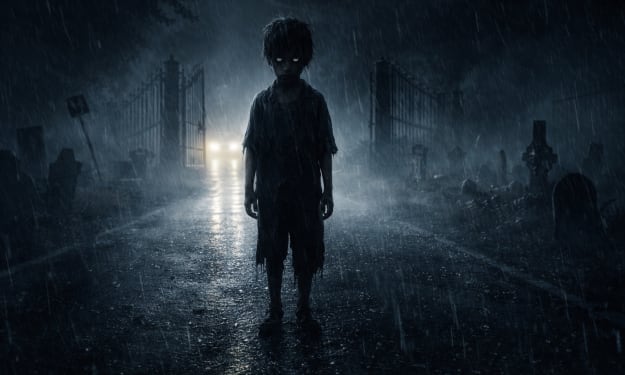
No one had been there in years. It was blocked off by a rusted gate and a wooden sign warning DANGER: UNSTABLE GROUND. We usually avoided it, not because of the sign but because of the stories: a miner who vanished, an echo that didn’t sound like anyone’s voice, a shadow that lingered too long after you left.
But that night, we walked straight up to the gate as if we’d been invited.
When we reached it, the whisper came again—this time drifting across the quarry like a breeze over water.
“Together.”
People gasped. I felt goosebumps explode across my arms. Somewhere behind me, a child started crying, but her mother didn’t pick her up; she just squeezed her hand and kept moving forward.
The gate swung open on its own.
We stepped through.
At the center of the quarry, the ground pulsed faintly, glowing with a soft blue light, as if lightning had struck there and forgotten to fade. The light formed a perfect circle the size of a small pond.
My best friend Jonah, who had wandered beside me without either of us acknowledging it, whispered, “This can’t be real.”
I didn’t answer. The air buzzed around my ears like a thousand tiny wings. The circle brightened.
Then the third whisper came.
“Remember.”
It hit us like a wave.
Not physically—emotionally.
I was suddenly eight years old again, standing in my father’s workshop, watching him carve a wooden bird. I could smell sawdust. I could feel the warmth of his hand on my shoulder. He looked down at me the way he did before the long illness that took him.
For the first time in years, I remembered his exact voice.
When I blinked, the workshop vanished, and I was back in the quarry, tears streaking my cheeks.
Around me, people were crying, kneeling, clutching each other. Some were smiling. Some had fallen to the ground, overwhelmed. We weren’t seeing the same memories; I could tell from the reactions. Each of us was being shown something deeply personal—something lost.
Mrs. Carby whispered her late husband’s name like it was a prayer.
The little girl stopped crying and reached upward as if someone were holding her hand.
Even Jonah, usually stoic, had his face buried in his palms.
But the light wasn’t done.
It pulsed again—brighter, then brighter still—and for a split second, just before it vanished entirely, I thought I saw a figure standing at the center of it.
Tall.
Silent.
Watching.
And then everything went dark.
When we woke—because it felt like waking—the quarry was quiet. The circle was gone. The gate was closed. The night sky looked normal again, stars scattered like nothing had happened.
We drifted home without speaking.
The next morning, no one met each other’s eyes. Entire families sat at breakfast tables in silence. People went to work late. Some didn’t go at all.
We never fully talked about the Whisper. Not as a town. Some called it a dream. Others called it madness. A few called it a miracle.
Most of us tried to move on.
But sometimes, when a breeze curls gently around a corner, carrying a sound too soft to name, I freeze and listen.
And I wonder if it’s coming back.
Not to warn us.
Not to frighten us.
But to remind us of something we’re always forgetting:
We’re not alone.
We never were.
About the Creator
Kitsune's Intervention: A Very Inconvenient Yokai
"I'm telling you, Christie, he is CHEATING on you!" She sighed hard. "Min... I know you think that, but Darryl would never cheat. He is so thoughtful and so, so loyal. He is just the absolute sweetest. I lucked out so hard marrying him. It feels like a dream."
By Alicia Anspaughabout 5 hours ago in Fiction



Comments
There are no comments for this story
Be the first to respond and start the conversation.