
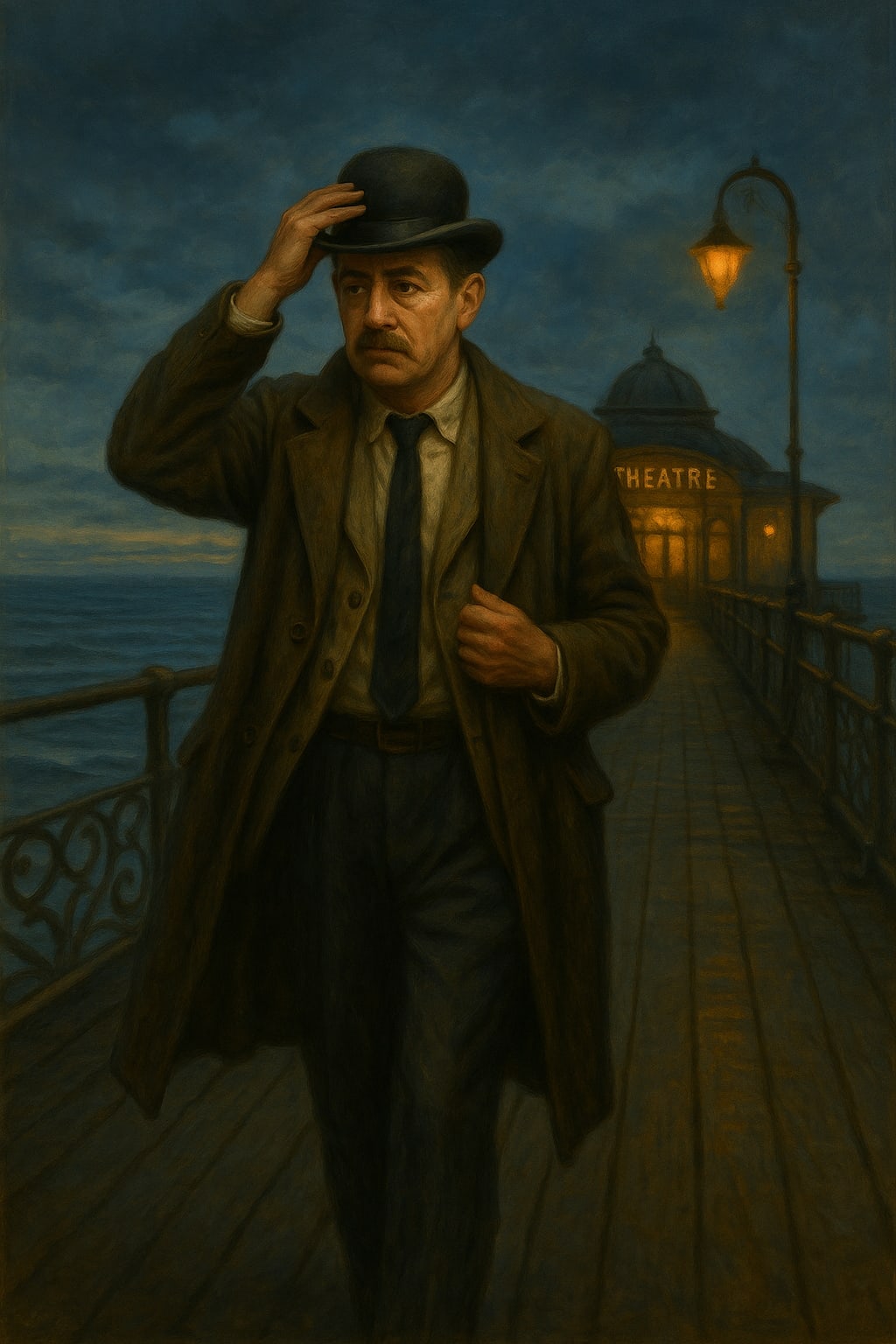
The poster went up on a Tuesday, which was never a good day for anything. The wind off the Channel had already started lifting its corners before the paste was dry. Tommy Blythe stood watching from the railings, his coat collar up against the drizzle.
Across the top, the words practically shouted through the fog:
THE NEW SEASON!
Comedy! Music! Variety!
And halfway down, tucked between a pair of tumblers from Blackpool and a singer described as “The Voice of Tomorrow,” came the smallest print of all:
Tommy Blythe — Classic Comedy Spot
Tommy took off his hat, brushed a fleck of sea spray from the brim, and studied it as though the poster might change its mind.
“Classic,” he muttered. “That’s what they call you when they’ve run out of patience.”
A young lad pasting the bills turned and squinted. “That you, mister?”
“It was,” Tommy said, putting his hat back on. “Now I’m a footnote.”
The lad laughed politely, uncertain whether he’d been included in the joke. Tommy tipped his hat and went inside the theatre.
The manager’s office had been repainted in the sort of beige that hides damp but not despair. There was a smell of polish, wet carpet, and ambition. Behind the desk sat Vic Sanders, the new entertainment manager — all cufflinks, pomade, and cheerful certainty.
“Mr Blythe!” he said, springing up to shake his hand. “Grand to have you back. We’re making a few changes this year. Bit more sparkle, bit more pace!”
“I’ll do my best not to dazzle,” Tommy said.
Vic laughed too loudly. “No, no, that’s splendid. We’ve had the decorators in, new lighting rig, new programme. You’ll be on before the interval — ten minutes, tight, modern. Something bright to get the crowd warmed.”
“Modern?” said Tommy, sitting slowly. “You mean faster?”
“Faster, sharper — that’s the ticket. The public haven’t got the patience they used to. They want punchlines, not paragraphs.”
Tommy crossed his legs. “And here’s me with a fondness for paragraphs.”
Vic shuffled some papers. “Tell you what — I’ve a few ideas for trimming the act. Lose the bit about the landlady, and the one with the policeman on the bicycle. Bit dated.”
“Dated?” said Tommy. “You’ll be telling me next to drop the English language.”
Vic grinned in that managerial way that meant “yes” but couldn’t afford to say it. “We’re calling you the Classic Comedy Spot this season. It gives the programme balance.”
Tommy nodded. “Ah, balance. Something old to make the new look newer. Very sound.”
“Exactly!” said Vic, missing it entirely.
The rehearsal the next afternoon was as grey as the sky outside. The stage smelt of floor polish and last year’s rain. Tommy stood beneath the lights, facing the empty seats. He began his opening in the same voice he’d used for twenty years:
“Evening, ladies and gents. Lovely to see so many smiling faces.
I said that last week, but the manager said it was cruel.”
The joke echoed around the theatre like a paper aeroplane that had lost direction. Somewhere in the balcony, a pigeon clattered its wings.
From the front row, Vic scribbled something in his notebook and said, “Smashing, but could we pick up the tempo a touch? People like it snappy now. More, well, American.”
Tommy frowned. “You mean louder?”
“Not louder — just… faster. Think television, Mr Blythe. Think modern entertainment.”
Tommy sighed. “The only thing faster than my patter these days is the way audiences leave the theatre.”
Vic smiled thinly. “That’s the spirit.”
Back at his lodgings that night, Tommy sat by the small gas fire and looked over the “new script” Vic had typed up for him. It was neatly done, double-spaced, and lifeless. The jokes were shorter, safer, emptier — the sort of thing you could hear on the wireless and forget before the tune came back.
He tried one aloud:
“A fellow told me I should speed up my act. I told him I would, once my pension came through.”
He winced. “There’s a line that knows it’s unloved.”
He picked up his old notebook instead — battered leather, pages worn soft as cloth. Inside were the lines that still made sense to him: the boarding house sketches, the policeman routine, the monologue about the audience that coughed in unison. He knew every pause, every shrug, every look.
He closed the book, smiling faintly. “Well, old friend,” he said, “one last go round the block.”
Opening night came with drizzle that couldn’t be bothered to commit to rain. The pier lights blinked weakly in the fog. Inside, the audience rustled like an unmade bed — day-trippers in plastic macs, locals who’d come because they always did, and the occasional optimist still dressed for summer.
Backstage, the acts lined up. A pair of tumblers argued in whispers. The Voice of Tomorrow was having a row with her mother about sequins.
Tommy stood at the edge of the stage, bowler tilted, nerves held together with habit.
The band struck up. The tumblers went on first, followed by a conjurer whose dove refused to leave its box. The crowd applauded politely, more out of sympathy than delight.
When it was his turn, Tommy stepped into the light.
The orchestra gave him three uncertain bars. He took the microphone stand, adjusted it to his height, and smiled.
“Evening, ladies and gentlemen. I’m your Classic Comedy Spot.
Classic meaning old enough to remember when applause lasted longer than adverts.”
A chuckle or two. Encouraging.
He launched into the trimmed routine Vic had approved — the quick gags, the “modern” patter. It lasted barely three minutes and felt like an eternity. The laughs came in the wrong places, or not at all.
He stopped. Looked out across the rows of polite faces. Then down at the folded pages on his stool.
He put the new script in his pocket.
“Ladies and gentlemen,” he said quietly, “you’ll forgive me if I take a little detour. I’ve been told to go faster, but I find that only works downhill.”
A ripple of laughter. He took a breath and slipped into the old material. The landlady sketch. The one about the Punch and Judy man with a sideline in gambling. The policeman on the bicycle. Each joke landed like a pebble dropped in water — small splash, widening rings.
The crowd began to warm. Proper laughter now — the sort that shakes a coat lapel. By the time he reached the line about the bishop and the broken deckchair, the theatre had forgotten the cold.
He bowed once, neat and modest. The applause that followed wasn’t thunder, but it had weight.
Backstage, Vic was waiting, his face the colour of old blancmange.
“You went off-script!” he hissed. “We agreed you’d stick to the new routine!”
Tommy removed his hat and brushed an imaginary fleck from the brim. “We also agreed it should be funny.”
“That isn’t the point!”
“It’s the only point I’ve got left.”
Vic rubbed his forehead. “You’ll have to tighten up for next week, Mr Blythe. We can’t have this sort of… improvisation. There are schedules.”
Tommy smiled faintly. “Schedules are for trains, lad. I just tell jokes.”
The Voice of Tomorrow passed by, still in her sequins, still glowing with youth. “You were marvellous, Mr Blythe,” she said shyly. “You’ve got timing you can’t learn.”
“Thank you, my dear. You’ll learn the rest soon enough.”
He watched her disappear into the dressing rooms — all light and promise. Then he picked up his coat and hat.
“Don’t worry, Mr Sanders,” he said to Vic. “I won’t be any trouble next season.”
The rain had stopped by the time he reached the promenade. The lamps along the pier glowed like small, patient moons. The tide was turning in, smoothing the footprints from the sand.
Tommy stood by the railing, the sea breeze tugging gently at his coat. He took the folded script from his pocket, tore it neatly in half, and let the pieces fall into the water. They drifted away, white and pointless.
He watched them go, then placed his hat squarely on his head. “There’s your audience,” he murmured.
He began to walk home along the boards, the sea muttering below like an old crowd reluctant to leave. Behind him, the theatre lights dimmed one by one, leaving the pier in its proper darkness.
He didn’t mind. The night had always been the best part of the show.
The wind carried the faintest sound — not waves, not gulls — but something that might have been applause, too far away to be sure.
Tommy smiled. “The season’s new,” he said softly, “but the sea’s the same.”
He kept walking, hat steady, footsteps measured, until the fog folded him gently out of sight.
About the Creator
Keep reading
More stories from Stephen Stanley and writers in Fiction and other communities.
A Hat and a Prayer
There was a certain sense of relief for Tommy as the train picked up speed to something resembling movement faster than a trotting horse. He opened the carriage window to feel the fresh air crash against his tired face, hoping it would wash away the remnants of the hangover from the previous night’s attempt to forget his troubles and sorrows. Another year, and another summer season starts for his well‑past sell‑by date stand‑up comedy act. Almost bottom of the bill in some end‑of‑the‑pier show, headlined by a young girl he had never heard of. But it was work. It was money. It was another day in paradise, he said, as he grinned to himself.
By Stephen Stanley5 months ago in Fiction


Comments
There are no comments for this story
Be the first to respond and start the conversation.