
A Hat and a Prayer
An Englishman, a Train, and the End of the Line
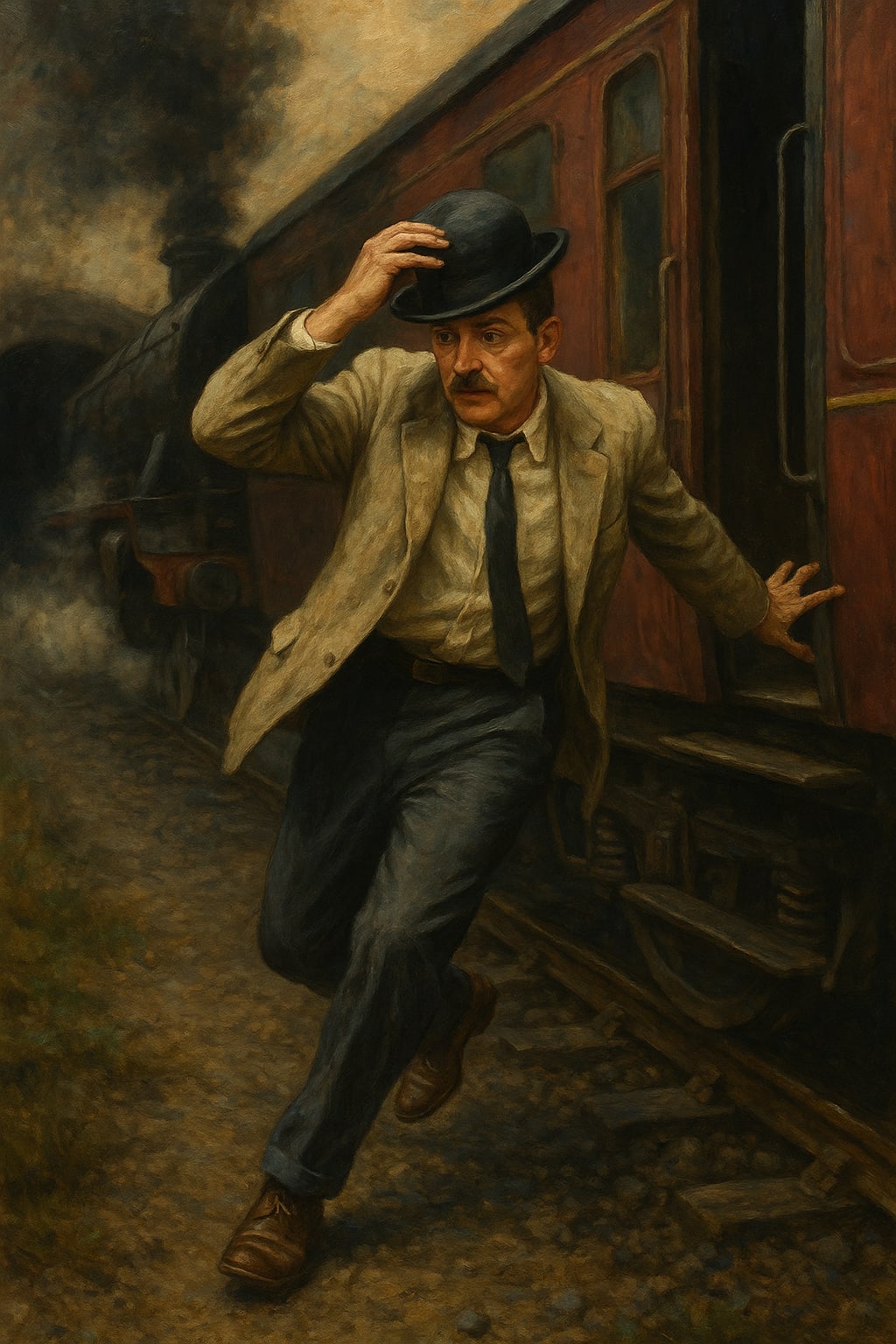
There was a certain sense of relief for Tommy as the train picked up speed to something resembling movement faster than a trotting horse. He opened the carriage window to feel the fresh air crash against his tired face, hoping it would wash away the remnants of the hangover from the previous night’s attempt to forget his troubles and sorrows. Another year, and another summer season starts for his well‑past sell‑by date stand‑up comedy act. Almost bottom of the bill in some end‑of‑the‑pier show, headlined by a young girl he had never heard of. But it was work. It was money. It was another day in paradise, he said, as he grinned to himself.
Tommy was a name once, if only to his agent and accountant. But he had entered and left many a stage door surrounded by autograph‑hunting pretty girls. The only trouble was, no one ever hunted his. The ink pen he always kept in his inside pocket for such occasions never came into use. The only signatures he gave these days were for bank cheques that paid for his almost frugal existence and continued to rapidly reduce his ‘retirement’ kitty for when that day comes. Albeit, that day came about five years ago, and he still wasn’t ready for it.
A look to the right of the open train window and Tommy caught a glimpse of his reflection in a somewhat dirty closed window. A reflection that showed his most valued possession: a very smart and bold bowler hat resting on his head. The glimpse was momentary, as the exit from a long train tunnel increased the air pressure to the open window, forcing his hat to be dislodged and sucked through the window into the darkness outside.
---
Tommy’s fingers found the little red porcelain handle above the corridor door, and—before his better judgment could introduce itself—he gave it a sharp yank.
The brakes screamed like a seaside organ grinding out a tune no‑one had requested. Tea slopped in third‑class cups, *The Times* folded itself against startled noses, and somewhere down the rake a guard let loose language that would have got both of them sacked if the Bishop of Bath and Wells happened to be on board.
Tommy lurched down the passage as the carriages juddered to a grudging halt, patting every pocket for the apology he knew he didn’t possess. “National emergency,” he muttered to a pair of horrified newlyweds, “millinery crisis.” By the time he reached the end vestibule the train was sighing out steam like a fat man denied pudding, and the July sun poured into the gap between coaches, revealing a stretch of embankment thick with nettles, cinders and the faint smell of creosote.
He jumped—not gracefully, his shoes more accustomed to lino than ballast—but with the sort of determination that used to get him three laughs a minute back when laughs were priced in shillings. The tunnel mouth yawned twenty yards behind, black as last night’s blackout curtains, and somewhere inside that artificial night lay his bowler: the crown scuffed, the ribbon defiantly tidy, the one thing in his life that still knew how to keep its shape.
Inside the tunnel the air cooled, damp and coal‑dust thick. And there, perched absurdly between the sleepers as though it had paused to admire its own reflection in a puddle, was the hat. He lifted it with something close to reverence, knocked the grit from the brim, and settled it back where it belonged. The felt bore a new dent—character, not damage, he decided.
Behind him the guard’s lantern beam leapt about like a searchlight.
“Sir, do you realise the penalty for improper use of the communication cord?”
Tommy turned, tipped the bowler just so, and mustered the smile that used to bring the house down before the war and television conspired to make every seat empty.
“Improper, my good man? This is the most proper hat in all of England. It merely requested a brief constitutional.”
The tunnel echoed with the guard’s reluctant laughter, and Tommy clambered back aboard beneath the still‑wobbling lantern, dusting coal flecks from his cuffs as though they were autograph requests he could casually decline.
---
At the junction between second‑ and first‑class he nearly collided with a man built like a hat‑stand draped in gabardine. A silver‑knobbed cane tapped the lino—one, two—then halted, as its owner’s eyes tugged the years into sharper focus.
“Good Lord,” the fellow breathed, voice walnut‑rich and faintly amused, “Tommy Blythe. I thought you’d retired to the Isle of Wight to grow roses and grievances.”
Rowland Fisk, *The Sunday Mirror’s* resident oracle of the footlights—the critic who could close a play with a phrase and had done so more than once. His thin moustache now carried more white than nicotine, but the gaze was still a limelight that left no corner mercifully dim.
Tommy tipped his rescued bowler. “Evening, Rowly. I tried roses; they heckled. Thought I’d stick to audiences—fewer thorns.”
Fisk laughed in that low, cultured rumble that suggested finishing schools and unfinished bottles. “Still turning a phrase, I see, though now apparently turning trains as well.” He gestured toward the emergency cord still jerking on its spring like a guilt‑stricken marionette. “Causing quite the commotion for…?”
“My hat,” Tommy said, patting it. “A man must keep a roof over his head—even if it’s a bungalow these days.”
The critic’s smile thinned into something almost tender. “I remember opening night at the Bedford, ’37. You took the stage in that hat like a lad stepping onto a pier expecting the sea to part. My editor sent me to savage the bill, but I couldn’t quite do it. Wrote that you were ‘fresh as a razor cut, and twice as sharp.’”
Tommy’s grin faltered under the compliment’s soft‑edged weight. The razor had dulled; everyone knew it. But Fisk continued:
“Tell me, where are you bound?”
“Weston‑super‑Mare. End‑of‑the‑pier summer season. Third on the bill, right between a vent and a singer who yodels Cole Porter.”
“Ah.” The syllable held the smallest tremor of pity—well‑bred, politely hidden, wholly audible. Fisk reached into a breast pocket and produced a calling card. “I’m reviewing the new revue at the Pavilion there next week. Perhaps I’ll stroll along the pier beforehand. If I happen to find myself seated during your turn, I shall try to forget the yodeller—out of mercy for Mr Porter.”
Their eyes met: Tommy’s, bright with the stubborn spark that refused to gutter; Fisk’s, reflective, like a mirror wondering how it suddenly got old. The critic tucked the card into Tommy’s lapel.
“Keep the roof on, Blythe,” he said, tipping an imaginary hat of his own. “Even a bungalow looks grand from the right distance.”
The guard’s whistle shrieked; brakes released with a sigh that suggested the train had decided to forgive them both. As the carriage began to clatter forward, Tommy felt the familiar tremor underfoot—half momentum, half hope. He straightened his bowler in the grubby glass of the compartment door, pocketed the card, and allowed himself one small, treacherous thought:
Maybe the sea would part once more. Or at least leave a gap wide enough for a middle‑aged comic to squeeze through and take a bow while someone who mattered watched.
About the Creator
Keep reading
More stories from Stephen Stanley and writers in Fiction and other communities.
The Review
The train sighed into Weston-super-Mare with all the enthusiasm of a man told there’s a meeting after lunch. Tommy Blythe stepped down with his suitcase in one hand and his bowler in the other, nodded to the gulls as if they were ushers, and followed the smell of salt and fried batter toward the front.
By Stephen Stanley5 months ago in Fiction
Silken Chains
Silhouettes of the female form were given flesh and bone. Silken skin glistened under the spotlight. Dry ice rose around our Icons as they danced atop their podiums in the Square. Heralded for their beauty, their movements were slight, powerful, and sensual.
By Paul Stewart4 days ago in Fiction
Puphive n.25
Neptune has arrived. Shining white marble institution stands alone in the middle of nowhere, surrounded by green grass and a luscious garden, ridiculous in it’s austerity, an indiscreet display of wealth in a world suffering from drought and famine.
By Taimi Nevaluoma5 days ago in Fiction
Top tipple tricks
Been thinking a lot about drinking, lately. Not least because of a recent episode of over-indulgence and the inevitable after effects. Some readers may recall the earlier articles I wrote about beating the booze. Here I set out an experiment in techniques for cutting down on my alcohol intake. The experiment was successful, the techniques worked, and I have armed myself with an arsenal of weapons in the war against the demon drink. I have yet to fire the first round however. It's all a question of timing (perhaps procrastination).
By Raymond G. Taylora day ago in Psyche




Comments
There are no comments for this story
Be the first to respond and start the conversation.