
The Necromancer's Nightmare
His Undead Workforce Just Demanded a Raise (and More Brains)

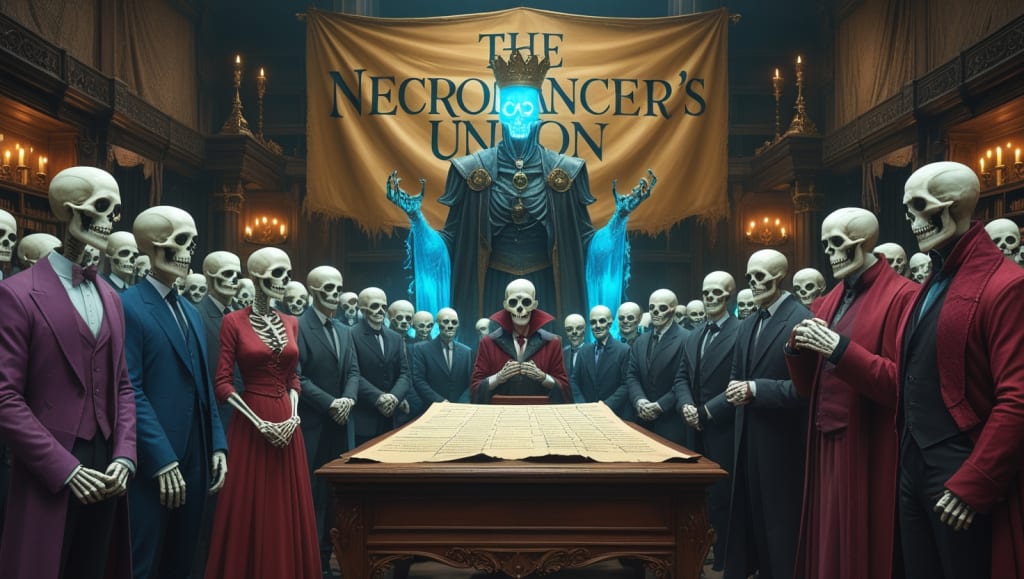
The skeleton laborers of the Necromancer's Union moved silently out of the damp vaults of the ancient city under the pale glimmer of a crescent moon in a world where magic dominated and life and death were but currencies in an eternal commerce. Bound by terrible contracts and old curses, they had worked for millennia in the service of predatory sorcerers—bound to revive, mend, and reinterpret the dead into a relentless workforce. Now they had assembled to demand something long denied: respect, fair treatment, and the promise of restoration rewards when their own mortal coil eventually failed them. Bones clanking in unison and empty eyes flaming with newly acquired purpose.
Once a proud knight who fell in combat and was reanimated by a heartless necromancer without permission, Mordecai had become the unannounced union leader. His mouth, always locked in a scowl, hid the fiery fury coursed through every fragile bone of his body. He remembered the days when his goals and dignity had meant something to him—a period when, albeit brief, life was treasured. Now he and his fellow undead labors were treated as disposable tools, expected to toil without rest or relief in building towering monuments of magical power, cleansing the magical ruins of blasted battlegrounds, and even performing ghastly menial chores that no living soul would ever endure.
The sorcerers had used the reanimated for their sinister experiments in the days before the uprising, gathering illicit energies to conducting ceremonies that warped the very fabric of life. Though they considered these slaves as nothing more than replaceable resources—soulless automaton, bereft of agency and dignity—necromancers delighted in their ability to command the dead. Every skeleton, every shaking zombie, every reanimated husk compelled to work under the lash of terrible enchantments had absorbed a pervading hopelessness into its core. It was a suffering so great that the spark of resistance started to stir even the cold-blooded cadavers.
Late one hot night, in the subterranean depths of a collapsed mausoleum, Mordecai called a covert union conference. The assembly took place in a large, echoing cavern illuminated by flickering, ghostly orbs bordered with crumbling stone. Here voices long hushed came to life in a symphony of resolve. For a necromancer known only as Master Caligo, Selene—a once-beautiful soul now imprisoned in a skeleton frame—had been obliged to carry great amounts of magical debris. Beside her stood Garrick, a thin man whose eyes, while lifeless, appeared to bear the grief of a thousand wasted lives—a former student who had once loved poetry and philosophy before being degraded to a tool for grim work. Offering his deep, rumbling approval, even the massive, patchwork amalgamation known as Grindle stitched together from the remnants of numerous warriors.
The room was filled with hoarse yet strong voice from Mordecai. We are not the dumb slaves they claim we are. Though our body is gone, our soul survives on these bones; we are the echoes of formerly lived life. Our wills have been shattered by the evil magic of our captors, and we have suffered millennia of mistreatment compelled to work without breaks. Tonight we stand together to demand improved working conditions, fair remuneration in the form of energy essences, and—most importantly—the right to appropriate resurrection benefits so that, when our duty is finally ended, we may pass on with dignity rather than be thrown away as relics of degradation.
The gathering dead trembled with the whispers of agreement. It was a bold statement, a challenge to the accepted order and an insult to the traditional hierarchy of magic. The necromancers had considered their works as just throwaway tools for too long. Now the union promised to strike, with union flags fashioned from magical parchment and the voices of the reanimated rising like a ghastly flood. Even if they were no longer living in the conventional sense, they would recover their dignity and, in doing so, redefine what it meant to be really alive—even if they were no more just puppets in the game of the sorcerers.
The demands of the union were basic yet revolutionary. They would insist on a rigorous timetable, a constraint on the never-ending loop of work draining their residual vitality. When their employment ended or when they were permanently injured by their cruel activities, they insisted on a minimum quota of "resurrection tokens," which could be traded for a respectable rebirth. They demanded frequent restorative rites that would heal their worn-out bones and reenergize their fading spark of uniqueness as well as a stop to the arbitrary use of decay accelerators—magnetic poisons sped in breakdown.
From the decaying catacombs under busy magical universities to the gloomy crypts in the midst of dark woodlands, the repressive necromancers started to pay attention as news of the union's creation traveled around the undead communities all over the world. Strikes and demonstrations were whispered to the towers of the sorcerers. Furrowed as he read the reports, Master Caligo, covered in flowing dark robes embroidered with the sigils of forbidden power, in the towering, ivy-clad spires of the Arcanum Sanctum browsed. His usually perfect manner faltered when he considered the boldness of his works seeking rights and privileges.
"Who dares question the accepted magic order? He snarled at his acolytes in a low, torch-lit hall. "The dead are not supposed to be self-conscious thinkers. They exist only for our designs. Should this union rabble continue, they will not only cause disturbance to our activities but also jeopardize the very basis of necromancy! ”
Caligo called a council of fellow sorcerers, a meeting of evil minds meant to put down the revolt. They said that the union threatened their authority; that the outrage of the reanimated masses would nullify all their dark experiments should the undead start to exercise their rights. But among their passionate debates, a chilling certainty descended over them: the marriage had already taken root and any effort to destroy it would just fan further resistance.
On the edges of the necropolis, a young sorcerer called Alaric—still a student of the black arts but with a conscience that had not yet completely eroded—saw the happenings through troubled eyes. Alaric had always had questions regarding the morality of such actions, unlike his friends who thrived in the exploitation of the undead. He had witnessed himself the quiet misery his skeleton helpers endured as they worked without breaks. Now he was caught between his ambition and a developing sympathy for the same creatures he had helped to create as the demands of the union started to blaze throughout the subterranean systems.
Alaric was preparing his own experiments in a remote lab surrounded by old grimoires and strange, phosphorescent fungus one fateful evening when he was visited unexpectedly—a skeleton messenger from the Necromancer's Union. Alaric's misgivings solidified into resolution in that instant as the courier's bones shook with urgency and sent a simple, passionate message: "Join us, or be permanently complicit in their suffering." In a succession of clattering clicks and subdued movements, Alaric communicated. He could no longer stand aside while his fellow sorcerers used the dead without thought for their welfare. Quietly, he decided to assist the union—not by overt revolt but by compiling proof and bargaining on behalf of the zombie workers.
Alaric started subtly documenting the terrible working circumstances the reanimated workers endured. He recorded the relentless effort, the degrading chores, and the brutal punishments meted out to any zombie who dared to slack down or challenge their directives. Written in a meticulous hand and tucked between the pages of a dusty grimoire, his private ledger gradually became evidence of the suffering of those who lacked voice in the field of the living.
Underground meetings in abandoned crypts and forgotten mausoleums took place as the movement of the union expanded. There, the undead leaders—Mordecai, Selene, Garrick, and others— hatched strategies to meet their needs. They planned nonviolent demonstrations, withholding their work from the projects of the sorcerers and let great constructions of evil magic fall apart. A detachment of unionized skeleton workers stopped building a huge necromantic tower in one spectacular act of disobedience, leaving it half-finished and swinging in the midnight breeze. The sight sent waves of horror among the necromancers, whose power was entwined with such terrible structures.
The strike's news traveled fast. Now together under a shared cause, the exploited laborers started to communicate via a network of magical bone-chimes that rang out each time a fresh injustice happened. Each resonant with the sound of clattering bones, these chimes became the union's rallying cry, a symbol of their rejection to be reduced to simple tools of work. The sound cannot be disregarded even among the once-dismissive necromances. It reverberated across the power corridors, a terrible reminder that the dead were no more quiet.
The turning point occurred when the union sought a meeting with the Grand Conclave of Necromancers—a council of the most powerful sorcerers controlling the dark arts under an iron grasp. The leaders of the Necromancer's Union— Mordecai personally—stood before the gathered sorcerers in a great, terrifying cavern carved out of black stone and lighted by the terrible glare of magical braziers. The undead emissaries' complaints—the repressive working hours that left them eternally tired, the lack of restorative magic to mend their fractured bones, the absence of any benefit upon their ultimate "death" on the job, and the general disrespect for the legacy of the life they once lived—created a charged environment.
The remarks of Mordecai were measured and strong. "You have been using our strength for far too long without appreciating our value. We are the remains of once-beautiful lives turned against our will into relentless work. Every soul, alive or reanimated should be entitled to the right to appropriate rest and restoration. Let us create plans that respect our constraints, practices that help us, and assurances that our memories will be treasured rather than thrown away after our service ends.
Shown in black and lit by flickering candlelight, the features of the necromancers exhibited a combination of wrath, incredulity, and a reluctant admiration for the daring of the union's demands. Some of the older sorcerers, whose own methods were firmly rooted in custom and violence, laughed at the idea. The union was seen by them as an abomination, a transgression of the natural order in which the dead were not supposed to talk or negotiate. Others, younger and more realistic, stirred conscience differently. Standing silently at the edge of the assemblage, Alaric felt his heart—or what left of his vestigial human compassion—beating with will.
The council decided after hours of fierce argument. They would not just destroy the union by force as such an action would only aggravate the emotions of the reanimated masses and run the danger of upsetting the fragile equilibrium of necromantic power. Rather, they agreed to a temporary truce whereby the necromancers would negotiate a set of reforms including a reduction in mandatory working hours, the establishment of regular restoring ceremonies to mend the undead, and the creation of "resurrection funds," a stock of magical energies that could be invoked when an undead worker's service was no longer viable, allowing for a dignified end and, if fate allowed, a respectful rebirth.
The word of the concessions went through the subterranean like wildfire. Celebrating not just a triumph over their immediate oppressors but also a step toward recovering their autonomy and humanity amid the dark alleys and abandoned crypts. The magical bone-chimes sounded in ecstatic cacophony, a sound that would always be associated with the rattle of revolt.
Alaric developed into an unusual middle ground between the two worlds in the next weeks. He made a rational and morally urgent argument using his painstakingly maintained ledger and moving union official testimony. Although flawed, his efforts contributed to create a formal pact that, for the first time in millennia, gave the undead rights in the magical world. The agreement said that no necromancer could force an undead worker to work beyond a designated limit without appropriate restoring ceremonies, and that any instance of catastrophic magical mishaps resulting in the early "death" of an undead would have the responsible party pay to a communal fund for a decent rebirth ceremony.
Still, the road to real transformation was not without difficulties. Among the necromancers, hardliners persisted in opposing, using hidden threats and subdued curses to compromise the work of the union. To get around the changes, some sorcerers even tried to reanimate fresh bodies without union supervision. In response, the union set up a network of "watchers" among the reanimated—a clandestine cadre assigned to keep an eye on their old employers and guarantee that the conditions of the new agreement were maintained. Though physically delicate, these observers had a steely will derived from years of slavery. Reporting any infractions and even planning little acts of sabotage when they came across obvious mistreatment, they walked the labs and towers of the necromancers.
A gang of rogue sorcerers tried to release a prohibited spell that would unite the souls of an entire town of reanimated workers into a single, hideous monster one especially dark night when storm clouds veiled the moon and the air buzzed with magical energy. Under Selene and Garrick's direction, the union's supporters got moving fast. The unions battled to destroy the ritual in a spectacular clash lighting the stormy sky with blasts of eldritch fire and the clatter of thousands of bones. Her eyes ablaze with ghostly light, Selene faced the lead necromancer with words that went further than any spell. "You treat us as if we are nothing but refuse but claim authority over the dead. We take back tonight our right to be remembered as we once were. We won't be thrown to the margins of your avarice.
The next fight was a haze of metal and sorcery. Bone fragments raced across the air as magic clashed with fierce will. Alaric reappeared among the anarchy, shielding the struggling zombie workers with his knowledge of old spells, therefore acting as a barrier. His interference caused the ritual to fall apart and the rogue necromancers to flee into the shadows of their hidden lairs. The triumph was hard-earned, and the price was expressed in the broken remains of once-proud employees. But a new day had started as the storm passed and the faint light of dawn crept over the horizon—a day when the union's power was indisputable and its voice rang throughout the magical domains.
Following this, the union planned a large-scale gathering open to all reanimated workers to honor the advancements achieved and plot the direction for further changes. Speeches abound in hopes and recollections of lives lost, tales of bygone glory, and the promise of a future wherein even the dead may live with dignity. Standing before a gathering ranging from ragged zombies to painstakingly reanimated aristocrats, Mordecai said, "Today, we take our first steps toward a world where our existence is not defined by exploitation but by our shared heritage and the unquestionably truth that every life—even one that has passed—deserves respect." Let our bones be the cornerstones of a new age, when our voices—quiet in death—will resound loudly in the hallways of history.
Every part of the country could still hear the echoes of their resistance as the assembly broke up and union members went to their jobs—duties now shaped by fresh rights and safeguards. Though still strong and feared, the sorcerers had to negotiate a world in which the undead were active players in the complex dance of magic and power instead than quiet tools of their will.
Still working from inside the Arcanum Sanctum, Alaric—now identified as a mediator and union advocate—kept on Combining old knowledge with contemporary ideas of justice, he authored books on the moral application of necromancy. His works were distributed widely, even to the ears of necromancers in far-off nations. Over time, his actions motivated other magically reanimated creatures—a federation of zombie unions challenging exploitative policies across every school of magic. The ripple effects were significant, changing the whole magical economy in addition to the way necromancers saw their reanimated minions. No longer could the living just commandeer the dead without consequence; every act of exploitation was greeted with opposition, every forced labor strike repeated as a moral condemnation of the exercise of power.
For Mordecai and his friends, the fight was far from done. Though there was a long road ahead, the union had won a major triumph. Within the undead, there were sections that still carried resentment and hopelessness and questioned if any change could ever reverse millennia of slavery. Among the necromancers, some were driven to challenge the new order covertly by blindness for tradition and profit. Still, the union persisted in the face of these difficulties, supported by the understanding that their battle was for the very spirit of magic itself—not just for improved working circumstances.
Sometimes the zombie workers would talk in subdued tones about a future when the union's history would be preserved in the quiet hours after a hard day of bargaining and vigilante justice as they gathered together in their meager lodgings under the old stone arches. They dreamed of a time when the contributions of every reanimated worker would be honored in epic ballads and where the necromancers, having learned the terrible lessons of exploitation, would come to regard the undead not as mere tools, but as partners in the ongoing cycle of creation and renewal.
And so, among the whispers of enchanted stone and beneath the always wary gaze of old spirits, the rattling of revolt became a lighthouse of hope—a clarion cry that resonated far beyond the murky paths of exploitation. Born from generations of pain and inspired by a spark of rebellious dignity, the Necromancer's Union marched forward into the unknown future, their bones joined in a cause that would permanently alter the terrain of magic.
The path of the union was evidence of the continuing power of justice and the unwavering human spirit—resurrected in bone and bound by a shared promise—that even in death, there is honor and even in the darkest of magics there can be light in that world where death was not the end but a new beginning.
About the Creator
Waleed Ahmed
I'm Waleed Ahmed, and I'm passionate about content related to software development, 3D design, Arts, books, technology, self-improvement, Poetry and Psychology.
Keep reading
More stories from Waleed Ahmed and writers in Fiction and other communities.
Avoidant Personality Disorder vs. Social Anxiety: Diagnosis and Therapeutic Approaches
From what I know, the terrible self-consciousness of Social Anxiety Disorder (SAD) and the excruciating solitude of Avoidant Personality Disorder (AVPD) differ subtly but profoundly. I have seen over the years that although these two disorders can have common symptoms — a deep-seated fear of rejection, pervasive self-doubt, and a propensity to withdraw from social events — their origins, clinical presentations, and therapy needs differ greatly. Today I will go into great detail on these events, delving into the nuances of diagnosis and the several treatment modalities used to enable people to take back their life. This in-depth, into the world of Avoidant Personality Disorder versus Social Anxiety Disorder clarifies the diagnostic subtleties, dissects the treatment approaches, and finally provides a road map for restoration.
By Waleed Ahmed11 months ago in Psyche
Lightning Never Strikes Twice
The distant rumble, the sudden deluge, the crescendo of sound, the flash of light, the explosive energy — it never gets old. I became an amateur storm chaser about two years ago. My wife, Cindy suggested it. Sort of. She said, "Alex, you know this cancer is killing me. I've come to terms with that, but you're smothering me. Go join a band, write a book, or become a storm chaser, for all I care. I love you, but you need a hobby."
By Julie Lacksonen6 days ago in Fiction
A Knight of the Seven Kingdoms Review – Small Stakes, Strong Impact
As one of the most celebrated fantasy universes ever created, A Song of Ice and Fire continues to command a loyal global audience. After diving deep into Targaryen history with House of the Dragon, the franchise now pivots to something more intimate. A Knight of the Seven Kingdoms trades dragons and dynastic wars for a grounded, character-driven journey—and the result is surprisingly refreshing.
By Fawad Ahmad3 days ago in Fiction


Comments
There are no comments for this story
Be the first to respond and start the conversation.