
The Monster
It just slipped inside in broad daylight
I
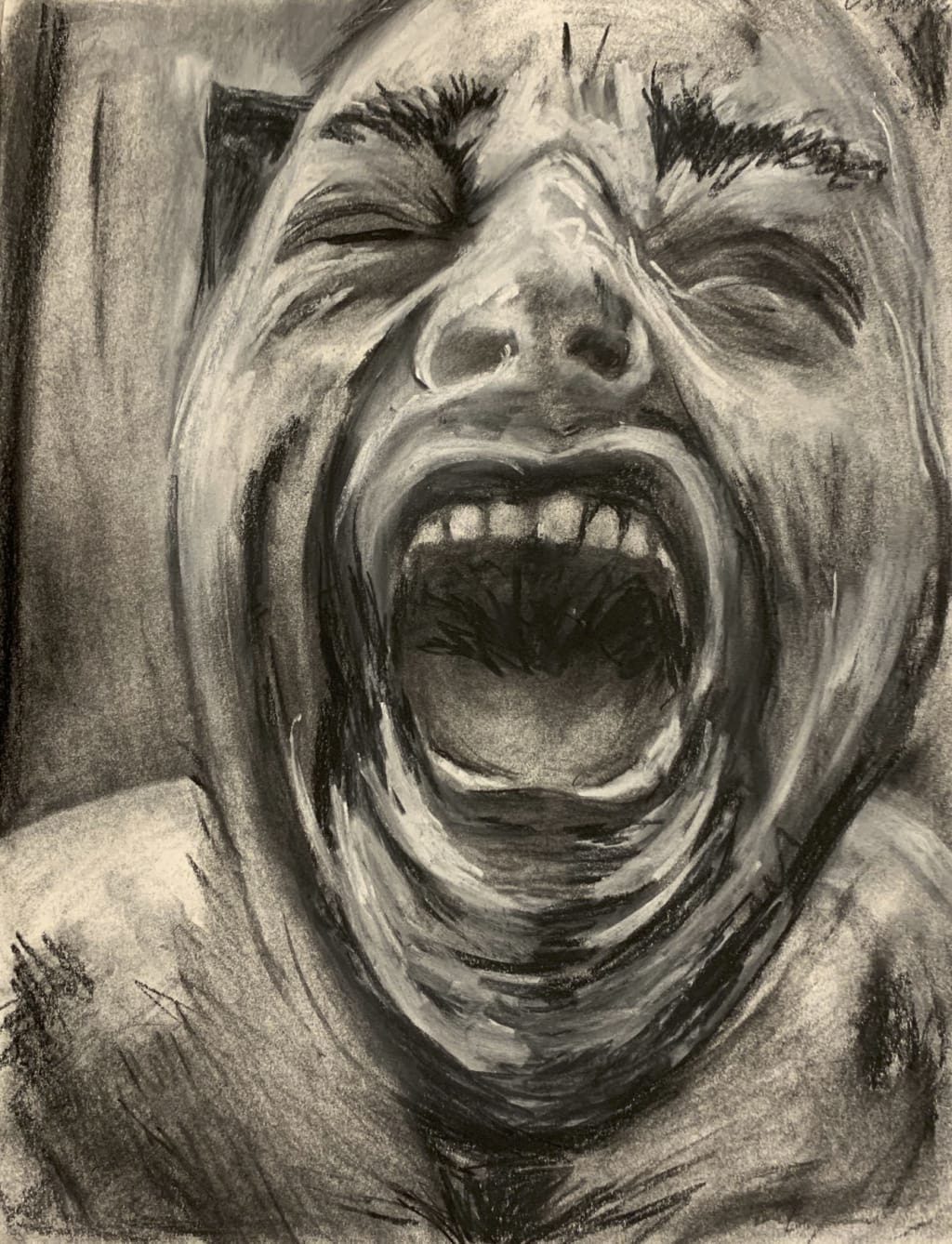
The monster entered the house through the back door. The back door, which was really the front door. The sign in the window told everyone to go around to the back door, beside the woodpile, with the foreboding axe foolishly left out – perhaps the axe would have deterred it – but monsters can’t read, so it just slipped inside in broad daylight.
It slipped easily past Grandad, who was asleep on the couch. Grandmother was out at the Legion. Breaking and entering is one thing, and well within the behaviour commonly expected of monsters, but once you offer a monster milk and cookies, it will interpret that to mean that your home now belongs to it as well – a different matter entirely. Such as it was, the monster neither had to break in, nor was it invited. The door had been left ajar, an act of carelessness from when we’d been playing there Thanksgiving weekend.
At first, we weren’t positive that we had a monster in the house. We’d often play make believe when the family got together, and tended to become overly embroiled in our games, especially hide-and-seek. We didn’t love playing so much as we enjoyed pretending there was something sinister hiding in some of the best spots. So, when we told our parents about the monster, they presumed it was a game.
At the risk of interrupting the flow of this story, I want to take a moment to tell you that I am a character in this tale. Perhaps by telling you I am one of the characters, you will think I have damaged my credibility. And if I should now justify myself by saying this all really happened, you will think I am doubling down in trying to convince you of something, and therefore suspiciously brazen. Most narrators would never do such a thing. But most narrators never lived in a house with an honest-to-God monster.
And it was an actual monster, although there was never any way to prove it. Indeed, there would be many opportunities for it to be seen by the neighbours. But the thing about monsters is they are exceptionally good at hiding in plain sight. Had you happened to catch a glimpse of it through one of the upstairs windows, you’d have likely thought it a trick of the light. A monster will only reveal itself if it wants to be seen. It can’t turn invisible – not exactly – but sometimes if it stands very still, people can be standing right beside one and not realize it.
Some might ask how we knew any of this, since monsters are so difficult to detect. My cousins and I would only come to stay in our grandparents’ house on special occasions – Christmas, Easter, or when someone had a reason to celebrate. But in time, we became certain of the monster’s existence. We were able to point to simple things like the way it would nibble at the little icing flowers on the dummy wedding cake in Grandmother’s china cabinet. Or the way Grandad was always running short on sugar cubes after that day. But the most damning evidence was Grandmother’s broken plate. It was smashed on the ground when the monster accidentally knocked it from the wall with its wingspan. The noise caused Grandad to wake. For a moment, he wondered if he saw the monster standing at the bottom of the stairs, but once his eyes adjusted, he saw only the gold-flecked mirror with its swirling designs that play tricks with the eyes.
II
And so it was that the monster came to live upstairs.
Upstairs was a series of bedrooms surrounded by attic corridors on either side in which it was rather convenient for the monster to hide .
At the top of the stairs was the door to the north bedroom. We called it the flower room, because in those early days, it had vintage wallpaper with bright orange flowers. It featured direct access to the attic, and an adjoining wardrobe (which was the final resting place for all unwanted garments ever belonging to the grown-ups.)
To the southeast was the blue room, named for its periwinkle wallpaper. There were drawers built directly into the walls, and a tiny closet (which was possibly the worst hiding place in the whole house because the squeak of the door was so unique that anytime anyone went inside, the seeker was alerted so they knew someone must be there.)
Next to the blue room was the green room. It was named for the bedspread, which was not a bright, lively green, but a rich, mossy green. In the corner of the room was another small closet which opened into the attic. It was directly above the wood stove and the pipe went right through to the chimney where sometimes we would slip inside and look through the little cracks in the wall. (This is how we knew the monster was always watching, in all the rooms.)
Then came Christmas Eve. There we lay, Nicholas and I, in the blue room, still awake at 3 A.M, waiting for the grown-ups to fall asleep. We’d planned to sneak downstairs to find what riches awaited us the following morning. When we were certain everyone else was asleep in their beds (including the twins, fast asleep in their crib in the flower room), we crept into the upstairs hallway. Nicholas heard a strange sort of scuttling coming from the attic wall, which he thought was a mouse, but it made too much noise for that. It was so loud it woke my stepfather, who stormed out of the green room without any clothes on, yelling for us to get back in bed. (The sight of an enraged, naked, overweight, British man wasn’t something we could easily unsee.) We might have tried again, had we not heard the closet door squeak open, followed by something breathing inside, both cold and unfamiliar. Neither of us slept that night, nor did we leave our bed until our parents came to get us in the morning.
When our other cousin Michael arrived in the afternoon, he didn’t believe the story, so we opened the closet together, all three. Of course, there was nothing there, so I suggested we check the attic. Michael went inside the flower room to open the attic entrance. We stood outside at the top of the stairs, terrified. When Michael described opening the little door, he described the smell as a cross between wet dog and burnt hair. It was so off-putting that he closed the door and dropped the matter entirely. He wouldn’t admit there was a monster, but he stopped trying to convince us there wasn’t.
From that night on, Nicholas and I protested sleeping in the blue room, but our parents insisted. Once again, we heard the same cold, harrowing sound of something breathing. Something unwanted.
Each of us had come to experience the monster’s presence. Nicholas had been the first to hear it. Michael, the first to smell it. The twins had been the first to touch it (although they were too young to remember it visiting them in their crib), and Grandad had (technically) been the first to see it. But I would be the first to know its power.
III
In time, we learned to communicate with the monster.
It began subtly at first, through sights and sounds. We would imagine a sound in our minds, and then we would hear it. We would imagine something, like a bunny, or a tree branch, or a lion, and then the shadows in the room would take on that shape. We pretended it was our superpower, but really, we were engaging in a dialogue.
It was Michael who decided to up the ante. We’d return to the house on special occasions – usually birthdays, Easter, and Christmas – then choose an object (usually a gift one of us had just received). We’d hold the item out in front and look directly at the cracks in the wall. Then we’d place the item in the squeaky closet, close the door, and run downstairs. From below, we could hear the door squeak open again, and when we’d return a few minutes later, the item would be gone.
The monster soon began leaving gifts for us as well. By that point, the twins were old enough to join in, and more cousins were born. We started a club, in a little storage room next to the attic, with codenames, secret knocks, and passwords. We called it ‘Monster Squad’, like the movie. The difference being… our monster was real.
IV
As we grew older, the effects of the monster grew more apparent.
The day our great grandmother died – we called her Granny – the monster helped us cope with her loss by introducing a new game. Us boys would pull our pants down in front of the girls, and then the girls pulled their pants down in front of us boys. We pulled them up almost as quickly as we’d pulled them down, but it was enough to catch a glimpse of everything underneath. Once wasn’t enough, so we kept it going, like a conversation where the currency was the glee of seeing something we shouldn’t. I could tell you it wasn’t us, but the monster who had grown curious. I could lie and tell you that the monster made us do it; that it wasn’t us, but the monster who had grown curious. But it was still our choice.
Then the day my aunt took Nicholas’ word over mine, I ran upstairs in a fit of rage. I went there to brood. As I sat in the blue room next to the window, I could tell I wasn’t alone. It wasn’t a voice, but a thought, what will happen if you just push this glass to see how far it will bend? Again, I’d be lying if I said the monster was responsible. It was I who chose to push the glass. The monster had only been curious. But moments later, that curiosity was quickly followed by a crash as the glass shattered and a shard tore open my arm. As I ran shrieking from the bedroom, I could hear the monster crying apologetically from where it had been watching in the corner, I’m sorry, sorry, sorry, sorry.
The monster’s secret was becoming apparent: whatever it felt, we felt. From its vantage point, it witnessed everything, and it the emotions it felt spilled over, until we felt them too. It was extraordinary, and no one suspected any danger. We’d learned to commune with the monster. Funny no one thought to ask why it came to us in the first place, or what it had been searching for.
V
Years passed, and in time, my mother and I both came to live in the house.
She moved into the green room. I moved into the cellar and built a proper shrine for the monster against a crumbling stone wall. We were growing up, and my cousins didn’t come around as frequently, so I continued to dialogue with the monster myself. We took turns leaving items on the shrine – books, masks, photographs, sketches, poems.
But with age, communicating grew more difficult. Not just with the monster, but with everyone. I struggled to express my thoughts clearly. I began missing deadlines at school. I could no longer find reasons to make time for the monster. I wasn’t certain the monster even existed.
Then came the night everything changed. My mother and I had the worst fight of our lives. I can’t even remember what it was about, but it involved me throwing my most prized DVDs down the stairs into the basement to make a point. I’d never done anything like that before. It was as if there was someone else living deep inside me, longing to be noticed. My frustration morphed into rage, and I felt compelled to tear a door from its hinges. I’d never been strong enough to do something like that on my own. It was the monster feeding on our emotions.
The fight continued to play out in the kitchen, with my mother and I screaming over each other. I tried to stop it; I think she might have as well, but the monster wouldn’t let up. When Grandmother came and stood at the entrance of the kitchen, I was worried the rage might frighten, or perhaps destroy her. Instead, she planted herself in the kitchen. Not in-between my mother and I, so much as near us. She sat there with open eyes and cried. She didn’t try to stop the shouting. She simply sat there. And I felt the monster’s rage diminish. Grandmother was able to calm the monster. This was new.
In the days that followed, the monster tried to ensnare Grandmother. It taught me to learn her signature so that I could use her money to get the things I wanted, just to see what she would do. When Grandmother learned what was going on, she kindly asked me to stop (no shouting), and then hugged me in her special way until I cried. Then in the kitchen, she put together a plate of milk and cookies, and left them on a little table in the living room. They were gone by morning.
When Christmas again came ‘round, Grandad opened a gift from Grandmother: a wine-coloured sport jacket which she’d always thought he’d look good wearing. Grandad packed up the jacket and tossed it aside in protest, but he felt the room staring back at him, appalled. So, he turned back to look at Grandmother, and then… the monster got Grandad to say thank you. (Grandad had never really said thank you, it was usually just ‘okay’ or ‘mm-hmm’.) I think that was the moment the monster truly began to feel like family.
VI
But nothing gold can stay.
Years passed, and with it, so did Grandmother. She passed peacefully in her sleep. The monster was inconsolable for weeks afterward. Out of desperation, the monster began to project its memories of Grandmother onto Grandad. For the final year of his life, he sounded softer, gentler, not at all the gruff man who we had known as children.
The night Grandad had a bad fall, no one quite knew what had happened. He’d been watching a baseball game and had stood up to take his dinner plate when he lost his balance. Several hours passed before any of us returned home. I like to think that the monster was there with him, that it revealed itself to him, that he wasn’t alone for those final moments at home.
Grandad spent the next week somewhat incoherently in the hospital until the day he passed. His memorial was a wonderful night of music and dancing. I know the monster was glad to be surrounded by so much love. Some of us wondered if the monster might finally show its face among us, but the thought of being misunderstood made it fearful and anxious, so it continued hiding.
After that, the house became an empty shell of its former stature. Whenever family members turned up, they left with my grandparents’ belongings. There were harsh words shared between siblings. The cousins grew further apart, feeling betrayed for no reason. The monster hadn’t betrayed us. We’d betrayed it. But we couldn’t stop the feeling since we couldn’t admit that the monster was real.
On the morning I drove away, I wondered if it would forgive me for leaving. I felt something tugging at me, so I stepped out of the car, and looked up. For a moment, I thought I saw the monster’s dark purple eyes. For a moment, I almost stayed. Almost.
As I drove away, I thought I heard its painful shriek, resentful that we’d left it there alone.
VII
Years later, after the trees had been chopped down, and the great fire had reduced rooms to ash, and the house was condemned... I went back to see the monster.
It was no secret (to us) that it still lived in the house. There’d been multiple sightings, although no one could prove that it was a monster. Monsters aren’t real.
Near the front entrance (which was really the back) was a woodpile. Beside the woodpile was an axe. If Grandad had still been around, he would have wanted it locked away, but he was gone. I took the axe with me and entered the crumbling ruin.
It was seventeen steps into the cellar. I counted each one, painfully aware of my task. The walk felt much further away than I remembered. I stood there at the bottom of the stairs, waiting, thinking. I almost went back up. Almost.
I turned the corner and looked down beside the shrine. There sat the monster, bent, and ragged, and wispy. After years of smoke inhalation, the monster had a difficult time breathing, and it couldn’t walk on two feet like it once had.
I’d returned with the intent of ending its life. A mercy killing. But then… seeing it there, cowering in fear, I had to question what killing it would mean.
I couldn’t tell it to leave on its own; it could no longer walk, having sat by itself for so long. Its wings had been burned in the fire. I couldn’t bear to put it out in the cold, or leave it alone again...
So, I did what we should have done the day we all left.
I carried it out with me and brought it to my new home with my wife and our two children. There was an attic entrance in the ceiling of the walk-in closet, so I built some steps for it and left it, but not far. We kept the curtains drawn. We didn’t light candles. After a few weeks, I felt its anxiety ease. A few weeks later, it crawled out, still a shell of its former self, but real, and alive.
Its wings could never grow back, but it had regained use of its legs. It crawled to the corner of our living room, and simply sat there for a few minutes at a time, before returning. My wife couldn’t see it at first, but our children taught her to see peripherally, never making eye contact.
Each time it stayed longer. On good days, we’d feel its presence, but we learned to speak to it indirectly until it revealed itself. On the more abrasive days, we’d hear it scampering on the roof, and feel its emotions churning within.
Now.
Some days are better than others. The monster still has terrible lows when it feels like the world might end. Occasionally, the couple living in the basement will pick up on the monster’s emotions and begin arguing. When that happens, I go sit in the closet, next to the attic entrance. I sit with my guitar, and I play. I try my best to embody Grandmother. I know it soothes the monster. Eventually the shouting stops. Then I leave a glass of milk and cookies out on a little table, like she would have done.
The monster can’t live forever. I get that. But I want to keep it alive for as long as I can. It’s not that I couldn’t end its life. Some days I still want to. After all, I am a character in this story. But people have come face to face with me on my darkest days. If they could find a way to sit with me without condemning me, maybe I can too.
About the Creator
Keep reading
More stories from writers in Fiction and other communities.
Seattle Nightlife Report: Pony
Mid-winter Friday night. Early but already so dark. The days are getting longer but 6 PM is still pitch black. “Firepit!” You declare things after just a few seconds of solemn thought – not a request or suggestion, not a demand. Last week you walked around saying, “Hot tub?” to anyone who would listen. Or one afternoon you pointed at two men holding hands as they crossed 12th Avenue, looked me in the eyes and said, “Boyfriends.”
By Joe Nasta | Seattle foodie poet6 days ago in Wander

Comments
There are no comments for this story
Be the first to respond and start the conversation.