
The Mischievous Monkey of Sat Fatah: A Tale of Friendship, Chaos, and Redemption
In a quiet Pakistani village, a wise scholar’s loyal monkey turns the town upside down — until one day, his mischiefs teach everyone a lesson in patience and forgiveness.

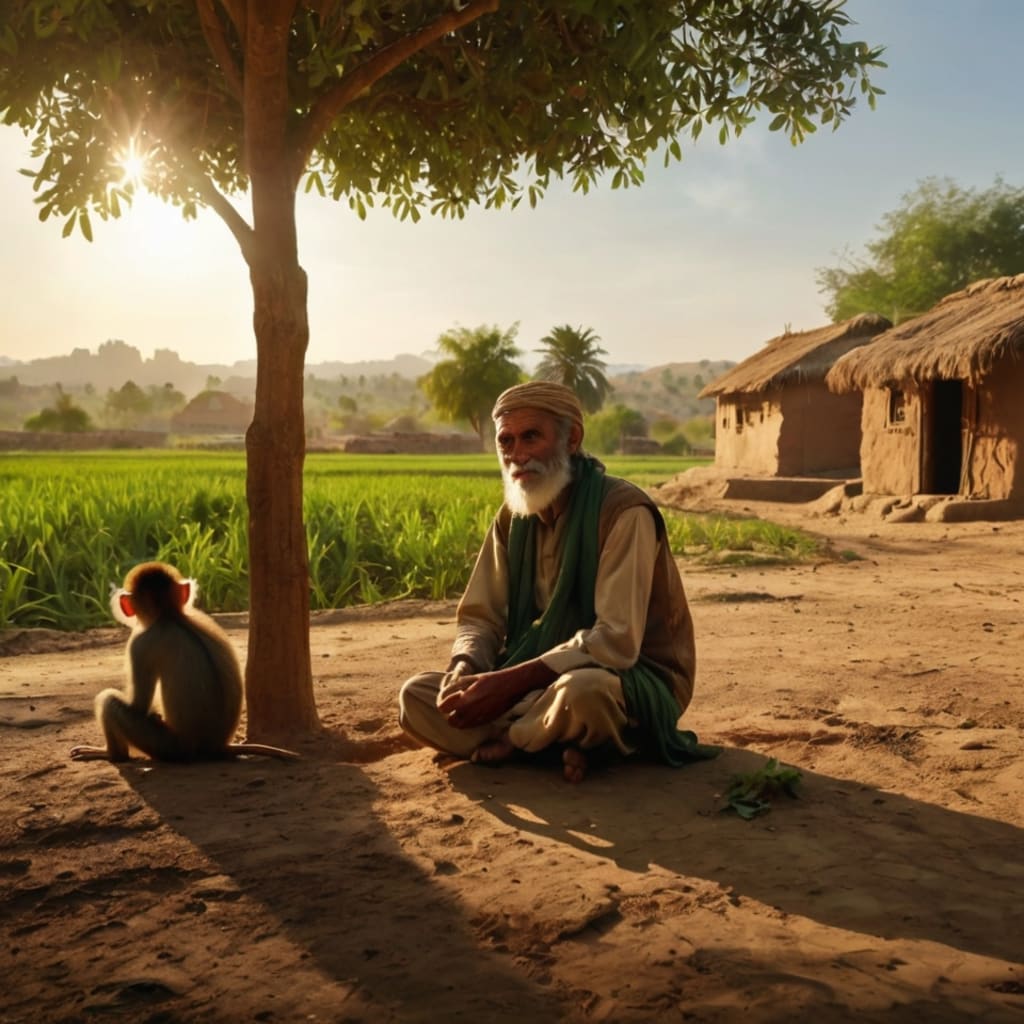
The Tale of the Mischievous Monkey of Sat Fatah
BY: Ubaid
They say that in the old village of Sat Fatah, there once lived a wise and pious man named Allama Ikram Hafeez. For some time, Allama Hafeez chose to live in a nearby forest, seeking peace and reflection. During his stay, he befriended a group of monkeys who, over time, grew deeply devoted to him. These monkeys were unusually disciplined — each one had a specific duty and performed it with great care.
Every morning, they brought the old scholar breakfast — coconuts, figs, bananas, grapes, and other forest fruits. In return, Allama Hafeez would feed them flaxseed sweets prepared by his mother in pure desi ghee. The monkeys adored these treats and became even more lively after eating them.
The wise man also had a daily habit — he would chew fennel seeds early every morning to keep his digestion and mind clear.
When the time came for Allama Hafeez to return to his village, he decided to leave the monkeys a gift — a circle drawn on the ground that acted like a sun clock. Whenever sunlight touched its center, it revealed the time of day. The monkeys were delighted with this magical gift and buried it carefully under soil to protect it from damage.
As the scholar departed, the monkeys presented him with a small, clever monkey as a travel companion. “This will make your journey joyful,” they chattered. The scholar accepted the gift happily, glad to have some company on his long trip home.
When Allama Hafeez arrived in Sat Fatah with the little monkey, the villagers were fascinated. His two loyal students, Mazhar and Ahmad, prepared a grand welcome and even arranged a comfortable room for the new guest — the monkey.
Soon, word of Allama Hafeez’s return spread, and his old friend Allama Abdul Salam came to visit. Seeing the monkey, he laughed and said, “Now your days will be cheerful, my friend. This lively creature will keep you company.” He even invited them to his own village for a visit.
Days passed peacefully — but then, Allama Hafeez passed away. Mazhar took responsibility for caring for the monkey and treated him kindly. The monkey would often ride on Mazhar’s shoulder as they visited the nearby village of Solah Murad, returning every evening.
The monkey, now spoiled with affection, grew more mischievous by the day. One morning, he went to the house of an old woman known as Aapa Bee Jamalo, a miserly lady. “Aapa,” he said sweetly, “do you know how to make rice pudding?”
“Of course I do!” she replied proudly.
“Well,” said the monkey, “we monkeys make the best pudding. We cook it in the open air so that fresh breeze adds a wonderful flavor. You should try it too — keep your kitchen doors and windows open while cooking.”
The next morning, Bee Jamalo followed his advice. She made a pot of pudding with the windows and doors wide open. But she grew tired and lay down for a nap. The sly monkey crept in, ate most of the pudding, and carried the rest to Mazhar.
When Bee Jamalo woke up, she was furious to find her pudding gone. She screamed so loudly that the entire village gathered, demanding justice. A council meeting was called before the two village elders, Syed Ashfaq Shah and Syed Tabassum Shah.
The monkey calmly sat beside Mazhar, reading a newspaper, pretending to be innocent. When people accused him, he scoffed, “Shame on you! Do you have any proof I ate your pudding?”
The crowd fell silent. No one had actually seen him do it. The elders dismissed the case, and the monkey smugly offered Syed Tabassum Shah a treat: “Come to our house sometime, sir. My master and I will serve you milk with jaggery and fennel — and a fine hookah too!”
The elder laughed and agreed. From then on, no one dared to scold the monkey. He became bolder, snatching Syed Ashfaq’s new kurta one day and tearing the postman Abdul Salam’s letters another.
Finally, the villagers held another meeting. Ahmad Rahmani suggested, “Let’s marry him off! Maybe that’ll settle him down.” Everyone agreed. The monkey was told: marry or leave the village.
Panicked, the monkey ran to Bee Jamalo again. She was getting ready for a wedding, covered in gold bangles and silver anklets. “Aapa,” he begged, “lend me some jewelry so I can find a bride in the jungle.”
Touched by his plea, she gave him a few ornaments. The next day, the monkey, along with Mazhar and Ahmad, went to the forest and returned with a beautiful female monkey. The village rejoiced. “Now he’ll behave!” they said.
For a while, peace returned. But soon the monkey couple had four children — and chaos came back. One child jumped on the school roof, another stole the milkman’s bicycle, a third snatched the imam’s stick, and the youngest tormented Bee Jamalo and the postman endlessly.
Finally, the elders decided to drive the monkey family out of Sat Fatah. Beaten and humiliated, the monkey and his family fled to Solah Murad, where Mazhar’s friend Adeed Sarwar lived. Adeed offered them a small room and said kindly, “Stay here peacefully, or my grandfather will drive you away. Eat all the guavas and bananas you like — but behave.”
For a time, they did. But soon, the monkey’s children broke the spectacles of an old man named Saddam and pulled down the turban of Khushi Kajla. The angry villagers beat them, and Adeed had no choice but to send the monkey family back to Sat Fatah.
When they returned, bruised and broken, the people of Sat Fatah felt pity. The monkey apologized humbly for his mischiefs, promising never to trouble anyone again. Bee Jamalo took in his children and cared for them, making them swear to live in peace.
From that day on, the once-mischievous monkeys lived quietly among the people of Sat Fatah — a lesson for all that even the wildest hearts can find peace through kindness and forgiveness.
About the Creator
Ludacris and Nelly draw backlash over bookings at MAGA-coded music festival
Ludacris and Nelly headlining a mostly right-wing event is good for them. It’s also great for the genre of hip hop. The two rap veterans have showcased their talents on other stages. Why can’t they perform for mostly MAGA folks and grab that bag?
By Skyler Saunders5 days ago in Beat




Comments
There are no comments for this story
Be the first to respond and start the conversation.