


The dress was whispered about before it was ever seen.
They called it Le Crépuscule, “The Twilight.” Midnight-blue silk, stitched with threads fine as moonlight, and tiny sapphires that shimmered like stars on moving water. The house of Vivienne Moreau unveiled it at her final show—Paris, 1979. Two weeks later, the designer vanished. Not into retirement. Into myth.
Forty years later, the gown reappeared.
Elizabeth Vale had spent her career unspooling riddles — missing art, falsified provenance, thefts staged to look like disappearances and disappearances staged to look like deaths. She didn’t believe in curses. Only motives.
So when Julian Devereux, a velvet-voiced gallery director, summoned her with the words, “The Moreau gown has resurfaced. And someone killed for it,” she listened.
“Why call me?” Elizabeth asked, brushing rain from her coat as she stepped into his Mayfair office. The place smelled like old leather and cold incense.
“Because you don’t scare easy,” he said. “And because I think this gown is cursed.”
That was nonsense, of course. But the file he handed her wasn’t.
A private collector — Madeleine Sinclair — had housed the gown in a biometric vault beneath her estate. Last night, it was stolen. The security footage showed nothing. No breach. No movement. Just a flicker — a glitch — at 3:07 a.m., and when the guards checked the vault the next morning, the gown was gone.
And Sinclair was dead.
The Sinclair estate sat at the edge of Hampstead Heath, silent under slate-gray skies. Elizabeth moved through the house like she was tracing old dreams — antique mirrors, heavy velvet drapes, the scent of something faintly floral and wrong.
Madeleine Sinclair’s body was found in her dressing room, seated in front of a mirror, perfectly still. No wounds. No signs of struggle. Just her reflection — a look of wide-eyed wonder. Or was it terror?
The coroner’s report called it cardiac arrest. But Elizabeth had seen fear like that once before — during the Goya theft in Madrid. A night guard had died mid-sentence. They’d blamed his heart. But Elizabeth suspected otherwise.
She stood in the vault, now empty. The room was bone-white, sterile, humming faintly with electricity. But near the pedestal where the gown had been displayed, Elizabeth found something — a single thread of dark blue silk, too fine for modern fabrication, curling like a snake on cold tile.
She pocketed it and left, the sound of the house closing behind her like a held breath.
Vivienne Moreau had disappeared in 1979. Officially, it was ruled a voluntary isolation. Her last sketches, recovered from her Paris atelier, were cryptic — not fashion designs, but arcane symbols threaded into dress forms. Runes, geometry, odd script that linguists still couldn’t agree on.
Elizabeth followed the trail to Paris. The Moreau archives had long since been boxed and hidden in a museum vault, off-limits to the public. But for a fee — and a favor owed — she was granted an hour alone.
Inside the last box was a photograph. Moreau, standing behind a mannequin draped in Le Crépuscule. But it was the background that caught Elizabeth’s attention: the mirror.
In it, Vivienne’s reflection was facing away.
Her breath caught. She flipped the photo. A note was scrawled on the back in faint pencil: The gown must never be worn. It sees through us.
She returned to London, heart racing.
Two days later, another body was found.
This time it was Arjun Malik, a textile historian and former consultant on the Moreau collection. Found dead in his study, mirrors covered, his notes shredded. The only intact item? A polaroid pinned to the wall: the gown, floating mid-air, sleeves outstretched like arms.
Elizabeth’s phone rang. A private number. She answered.
“They’ll come for you next,” the voice said, low and trembling. “Once the gown marks you, it never stops.”
Click.
She sat in silence, the weight of the blue thread in her coat pocket suddenly unbearable.
The breakthrough came by accident.
At her flat, Elizabeth spread the silk thread under a microscope. It wasn’t natural. Under magnification, the fibers moved — almost imperceptibly, like muscle responding to breath.
She ran a thermal scan. The thread pulsed faintly, like it retained heat from a long-dead body.
And then she saw it: woven along the filament, impossibly small, were patterns. Not random. Language. Circular, recursive. Like a prayer… or a spell. a curse?
She contacted Devereux.
“This wasn’t theft,” she said. “This was a release. Someone didn’t steal the gown to wear it. They stole it to possess it.”
His silence confirmed her fear.
“Where is it now?” she asked.
“Berlin,” he said. “A private auction. Midnight.”
Elizabeth arrived at the underground venue — a derelict ballroom hidden beneath Berlin’s old opera house. Crystal chandeliers sagged with dust. The crowd was sharp-dressed, sharp-eyed — the kind who paid fortunes for relics of power.
The gown stood center stage, displayed behind glass. But something was wrong.
The glass fogged from inside.
As bidding began, Elizabeth moved through the crowd, scanning faces. There — near the back — a woman in a black veil. Watching. Not bidding. Just… listening.
Elizabeth moved closer.
The woman turned, slowly.
It was Madeleine Sinclair.
But Madeleine was dead.
Their eyes met.
And the lights went out.
Chaos erupted. Screams. Shouts. The sound of shattering glass. When the backup lights flickered on, the stage was empty. The gown was gone.
Elizabeth staggered outside, breath sharp in her throat.
A voice whispered behind her.
“You should’ve stayed away, sister.”
She turned.
Vivienne Moreau stood in the shadows, her eyes hollow, her smile like a knife.
And she was wearing the gown.
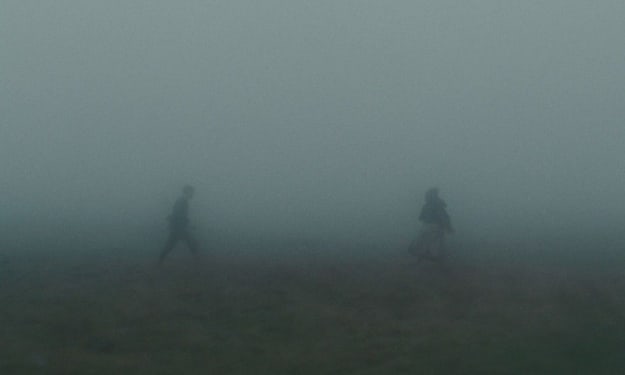
Elizabeth ran.
Not from fear.
From understanding.
The gown didn’t vanish.
It inhabited.
Whoever wore it… became someone else. A vessel for whatever consciousness was stitched into that thread. A being without time. Without self.
Vivienne. Madeleine. Who knew how many before them.
The gown wasn't cursed.
It was alive.
And it had chosen her next.
End.
About the Creator
E. hasan
An aspiring engineer who once wanted to be a writer .
Bomb Scare
It was 2027, and the world never thought it would happen. A missle hit the United States, but it wasn't where they had anticipated. A little town in the northeast was hit by a missile strike, they didn't know why, and they didn't know exactly where it hit, but they did know it was a coastal community, somewhere between Maine and Delaware.
By Gregory Paytona day ago in Fiction
The BAFTA Awards
By now, in a stunning departure from recent years, most of the world is aware of what happened at the BAFTA film awards. Social Media Headlines will tell you the bare bones: that John Davidson, a Tourette's Syndrome advocate, shouted a racial slur at two Actors of Colour, Michael B Jordan and Delroy Lindo.
By Natasja Rose3 days ago in Psyche



Comments
There are no comments for this story
Be the first to respond and start the conversation.