
The Memory Vending Machine
In the dim light of the subway, a man finds a machine that sells moments worth reliving—until one memory changes everything.

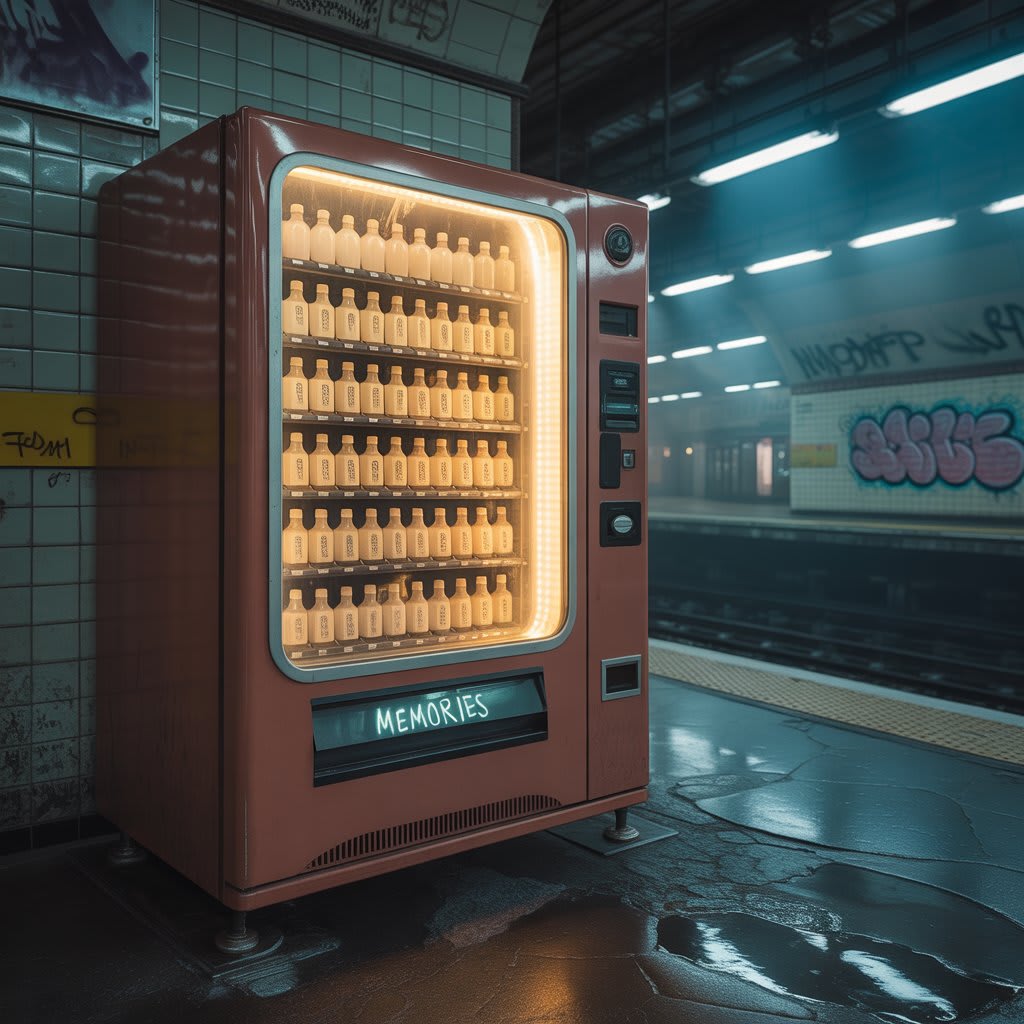
I first saw the vending machine on a Tuesday night, half-hidden between a cracked pillar and a graffiti-covered bench on the lower platform of East 12th Street Station. It didn’t sell chips or soda. Instead, rows of tiny glass bottles lined the inside, each one glowing faintly, a handwritten label tied around its neck. Above the coin slot, in faded gold letters, were the words: “Memories — $3 each.” I almost laughed. New York was full of gimmicks, but this one was charming enough to make me stop.
Curiosity won. I slid three crumpled bills into the slot, pressed the blinking button, and waited. A bottle clinked down into the tray. The label read First Kiss. Before I could wonder what that meant, the moment I touched the bottle, the station vanished. Warm summer air wrapped around me. I was sixteen again, standing under a streetlamp outside my old high school, the taste of mint gum and trembling laughter on my lips. Her face was as clear as if no years had passed. Then, as suddenly as it came, the memory faded, leaving me back on the cold platform, bottle empty in my hand.
Over the next week, I went back every night. Father’s Laughter. Winning Goal. Rain on the Porch. Each one hit differently — some bittersweet, some bursting with joy. I started timing my visits so I could be alone with the machine. It felt like a secret I wasn’t ready to share. These weren’t random clips from strangers; somehow, they were mine. Memories I’d lost to time, buried under years of bills, emails, and quiet loneliness.
On Friday, I noticed something new. A bottle glowed brighter than the rest, its label written in ink that shimmered like fresh tears. It read: The Day She Left. My chest tightened. I hadn’t thought about that day in years, not properly. I’d avoided it the way you avoid a wound that never healed right. But my hand moved before my mind caught up. The coin slot swallowed my last few bills, and the bottle was mine.
The platform dissolved into that small apartment on West 34th Street. The smell of rain came through the half-open window. She stood by the door, suitcase in hand, eyes red but voice steady. “I can’t stay,” she said, and I could hear my younger self’s silence — not anger, just a hollow kind of surrender. I felt it all over again: the stubborn pride, the ache in my throat, the way I let her walk away without asking her to stay. The memory ended, but this time, the ache didn’t fade.
The next night, I returned with more money. The machine seemed to know me now. The labels were sharper, more personal. The Day You Should Have Spoken. Your Mother’s Last Words. The Time You Lied. Some bottles I bought. Some I couldn’t bring myself to touch. Each one cost more than just money. The more I used it, the heavier I felt, as if I was carrying all these moments on my back, moments I’d never been able to change.
One night, I found a label that froze me in place: Tomorrow. My fingers hovered over the button. This wasn’t a memory. It was something else — a promise or a warning. I fed the coins in slowly, heart pounding. When I touched the bottle, the vision hit me like a wave: I was back on the subway platform, but the lights were flickering, and a sound — a deep metallic groan — echoed through the tunnel. A rush of wind came before a blur of steel and screaming brakes. The memory cut out before I saw the end.
When I came back to myself, the bottle was gone. The machine’s lights were off. I stepped back, staring at it, waiting for the hum to return. It didn’t. I left the station that night with the uneasy knowledge that not all memories were meant to be lived twice — and some, maybe, not even once.
The next day, I didn’t take the subway. I walked instead, every footstep echoing with the thought of that bottle. Part of me wanted to forget I’d ever seen it. But another part — the part that kept glancing at shadows, searching for flickers of glass and faint golden letters — knew it was still out there, waiting for someone else to feed it coins and open the past like a wound.
About the Creator
Musawir Shah
Each story by Musawir Shah blends emotion and meaning—long-lost reunions, hidden truths, or personal rediscovery. His work invites readers into worlds of love, healing, and hope—where even the smallest moments can change everything.
Keep reading
More stories from Musawir Shah and writers in Fiction and other communities.
The Last Screenshot on Her Phone
The house had fallen into silence since Sana’s funeral. It was the kind of silence that sticks to the walls, clings to the curtains, and curls itself around your chest like a fist. Her room remained untouched — books still stacked on the nightstand, perfume bottles still half-used, and her phone… still on her bed, blinking occasionally as if waiting for her to return.
By Musawir Shah6 months ago in Fiction
The Case of the Missing Ring
It was an average Moonday. My mead was hitting me in the right spot as the elvish weed propped me up and forced me to consider the day ahead. I had a feeling in my guts that there would be a very serious disturbance to my day, like two orcs fighting over who gets to eat a dwarf, or whatever those thugs like to chow on. I was in no mood for big surprises, but I also wanted to pay my rent for the month. You can only have so many elves wondering if the loves of their lives are cheating on them before you develop a rep as the bearer of bad parchment. No one really wants the truth...but they want the things they lost to get found, even if it's from a hobbit on his last drop of mead.
By Kendall Defoe about 4 hours ago in Fiction



Comments
There are no comments for this story
Be the first to respond and start the conversation.