
The Man Who Repaired Memories.
In a near-future world, a quiet repairman “fixes” damaged memories for a living. One day, a client brings him a memory he knows belongs to him—but he remembers it differently.

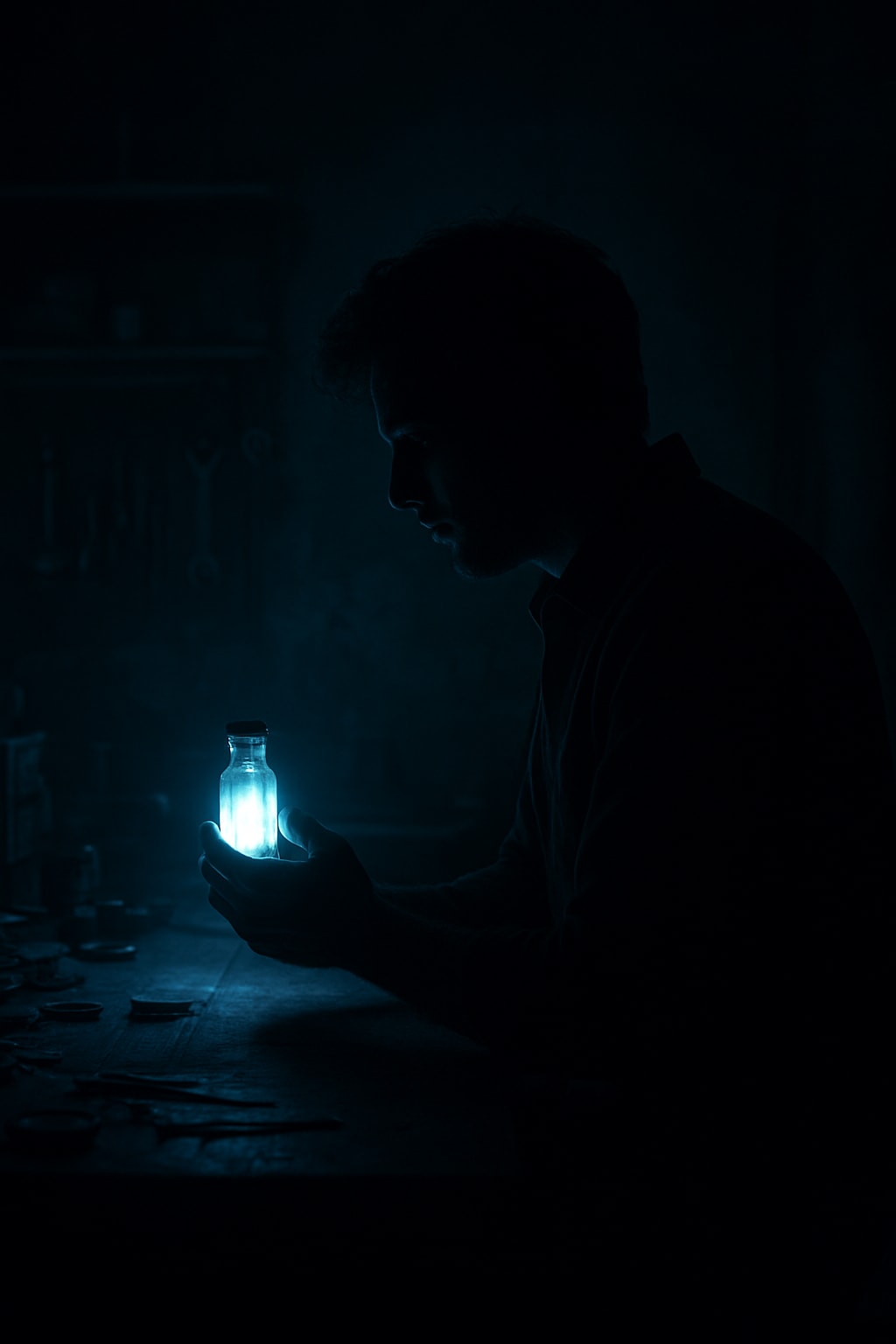
The Man Who Repaired Memories
In the near-future city of Lumen, memories were fragile things—small electric storms sealed inside glass vials. People carried them the way previous generations carried phones or photographs, tucked in pockets or clipped to necklaces. A single drop could shatter years. A sharp magnetic pulse could erase a childhood.
And when memories broke, people came to Elias Ward.
He wasn’t famous. He wasn’t wealthy. He wasn’t even especially talented, according to himself. He simply knew how memories were supposed to feel. It was a gift he never advertised, not even on his tiny metal shop door. The sign said nothing fancy, just:
WARD’S REPAIRS
Memories. Clocks. Small Machines.
Elias preferred it that way. The world was too loud already.
His shop smelled faintly of gears, rainwater, and lavender—the memory-scent he used to calm agitated clients. Most days he sat at his workbench under a dusty skylight, sipping lukewarm tea, while someone explained through tears that they dropped their wedding ceremony on the subway steps or that their long-dead father’s laugh had gone staticky in the jar.
He never judged. Everyone broke something eventually.
He extracted fractured recollections with micro-tweezers, rewired the emotional filaments, polished the sensory edges, then resealed them. It was delicate, patient work. He liked that. Machines and memories behaved better than people.
But everything changed the day the woman in the green coat walked in.
She hesitated at the door, clutching her purse like it might fly away.
“Are you Elias Ward?” she asked.
He nodded. “What do you need repaired?”
She reached into her coat and removed a violet memory-vial, its liquid swirling in sluggish, uneven streaks. A damaged emotional core. Possibly trauma. Possibly betrayal. He braced himself; those were always the hardest.
“It stopped playing correctly,” she said. “And I think… I think it’s important.”
Most people believed that. Most were wrong. But sometimes—just sometimes—Elias felt the thin hum of something true.
He extended his hand. “May I?”
She placed it carefully in his palm.
The moment his fingers closed around the vial, Elias’s heart seized.
He knew this memory.
Not figuratively. Not professionally.
He knew it—like a childhood scar, like a name he hadn’t spoken in years, like the echo of a song he’d once fallen asleep to.
He kept his face neutral. “This is yours?” he asked.
“Yes,” she said softly. “Well… I think it is. I bought it.”
Of course she did. Memories were traded now—good ones, sad ones, exciting ones. Sometimes people bought experiences the way they bought movies. But Elias rarely handled resales; they were messy, overwritten, often counterfeit.
“Where did you get it?” he asked.
“A vendor in East Miner’s Market. He said it was ‘verified authentic nostalgia.’ I’ve been collecting other people’s happy moments.” Her cheeks flushed. “I know it’s strange. But it helps me sleep.”
“Happy moments?” Elias repeated, his thumb brushing the warm glass.
“Yes. This one is labeled ‘The Lighthouse Morning.’ But when I open it…” She hesitated. “It doesn’t feel happy. It feels… wrong.”
His breath caught.
The Lighthouse Morning.
He hadn’t heard that phrase in decades.
“You’ve opened it?” Elias asked, voice carefully steady.
“Twice. Both times I see a lighthouse on a cliff. A man sitting at the edge. His hands are shaking. I can’t tell if he’s going to jump or stand up.”
Her eyes searched his. “I thought it was supposed to be a peaceful memory. Why would someone sell this?”
Elias lowered his gaze before she could read the truth in it.
Because he had lived it.
Because he had forgotten it—on purpose.
Because someone must have stolen it from him before he erased it.
He cleared his throat. “I’ll need some time with it.”
She nodded, relieved. “Please. Fix it if you can. I want to know how it’s supposed to feel.”
When she left, he locked the shop door behind her. His hands trembled as he lifted the vial to eye level.
Inside the swirling violet haze, tiny sparks flashed like stars in a storm. A memory in distress. His memory in distress.
He sat, adjusting his lamp.
“Alright,” he whispered to the vial. “Let’s see what you’ve become.”
He unclasped the seal, letting the memory bloom across the table in shimmering tendrils. It formed an image: the coast, the lighthouse, the man on the cliff’s edge.
Him.
Younger by decades. Wearing the navy coat he used to love. Wind whipping his hair as waves crashed far below.
He remembered none of this clearly—only fragments. The smell of salt. The weight in his chest. The quiet.
He reached toward the memory’s edge, touching it gently to read the emotional core.
A shock ran up his arm.
Grief. Overwhelming, tidal, suffocating.
He gasped and pulled back.
Why grief? Why that morning?
He forced himself to try again. He slipped into the recollection the way he had entered thousands of others—carefully, consciously, like stepping into a pool.
Suddenly he was standing on the cliff beside his younger self.
But he wasn’t watching. He was feeling.
The world pressed in on him: the cold wind, the sting of tears he didn’t remember shedding, the terrible ache of losing someone—someone important.
A name surfaced from deep, muddy waters.
Lena.
Her laugh. Her freckles. The warmth in her palms when she held his.
His wife.
Elias staggered. He had erased this memory. He had asked for it removed after she died, because the pain had swallowed him whole. The technicians back then had complied—legally, ethically.
So why was it here? Why had it returned? And why did a stranger buy it in a market?
Unless someone had extracted a duplicate before the erasure—someone who wanted to sell raw grief as “authentic emotion.” It wasn’t impossible. It wasn’t even uncommon.
But the part that didn’t make sense was this:
The woman in the green coat…
Her face.
Her voice.
Her hesitation.
She reminded him of someone.
He closed his eyes, trying to reshape the memory. Trying to remember Lena’s voice clearly.
And then it hit him like a blow.
The client…
looked like Lena.
Not exactly. But enough—the same sharp cheekbones, the same steady gaze, the same way of standing like she was bracing against an invisible wind.
He opened his eyes, breath quickening.
Was it possible?
He sealed the vial and waited for her return.
She came the next morning, earlier than he expected.
“Did you fix it?” she asked.
Elias held the vial between them. “Before I answer… may I ask why you collect memories?”
She frowned. “Because I don’t have many of my own. I was adopted. My parents told me the orphanage lost most of my early records. Sometimes I feel like I’m missing… something.”
Elias’s heart hammered.
“What is your name?”
“Lena.” Her smile was soft. “Lena Maren.”
His world tilted. His hands went cold.
Not his wife.
But named after her.
“Lena,” he said carefully, “how old are you?”
“Twenty-six.”
Twenty-six. The same number of years since—
He swallowed.
He extended the vial to her. “This memory… is not what you think. And it isn’t yours.”
“I know,” she whispered. “But when I opened it… I felt something. Like a… connection.”
Elias’s throat tightened.
He realized then:
This wasn’t just his memory.
It was hers too. A prenatal echo. She had not been adopted randomly. She had been adopted because he couldn’t raise her alone after losing her mother.
He had erased the pain—
and accidentally erased her too.
Tears slipped down his cheeks.
“Lena,” he said, voice breaking, “this memory is the day your mother died. And the day I nearly gave you up.”
He placed the vial in her hands.
“I think… it’s time we repair this one together.”
She looked at him slowly—as if seeing him for the first time.
“Are you saying… you’re my father?”
He nodded.
The vial pulsed softly between them.
And for the first time in years, Elias felt a memory heal itself.
About the Creator
The khan
I write history the way it was lived — through conversations, choices, and moments that changed the world. Famous names, unseen stories.
Miss Persephone's Manual to a Seemingly Ordinary Life
Miss Persephone was found at the dining table, her blue eyes swollen, her tears arriving and retreating like the tides of the ocean. Earlier that day, her family had visited her in the retirement home where she had lived for eight years. It was her eightieth birthday.
By Imola Tóth2 days ago in Fiction
Center Stage with Paul Stewart
*** I'm keen to republish the interviews I did for my series with Vocal creators. It's been a few years and I thought it might be nice to revisit these wonderful conversations. I'll be releasing them one at a time for a few weeks/months.
By Heather Hubler2 days ago in Interview




Comments
There are no comments for this story
Be the first to respond and start the conversation.