
The Man Who Loved War
Some battles are not worth winning.


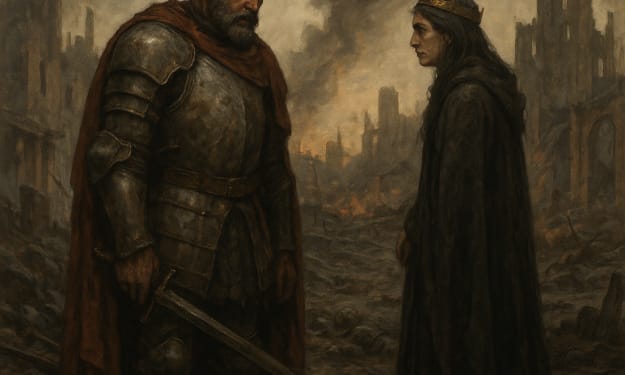
There was once a man named Kael Durnhart, known across the lands not as a king or prophet, but as a soldier—a man who loved war.
From a young age, Kael was fascinated by the clash of swords, the roar of battle, and the tales of glory sung by old warriors beside the fire. He didn’t fear death. He didn’t crave peace. What he sought was purpose—and to him, purpose lived in the heart of conflict.
He joined his first war at seventeen, fighting for a lord he barely knew. His blade was steady, his eyes sharp. While others trembled at the whistle of arrows, Kael felt alive. He rose quickly, not just for his skill, but for his hunger. He didn’t just fight battles—he hunted them.
War became his language, his rhythm. He moved from kingdom to kingdom, never settling, offering his sword to whoever promised the next great fight. Mercenaries followed him. Songs were written about him—some in awe, others in warning.
To Kael, peace was stagnation. He’d walk through quiet towns and feel out of place, like a wolf in a field of sheep. The stillness bothered him. He’d sit in a tavern, drinking in silence, staring at clean streets and laughing children, wondering how long before it all crumbled—and hoping he’d be there when it did.
Then came the great war—The Red Rift.
Two empires. A thousand banners. Cities burned. Rivers boiled with blood. Kael grinned as he rode into it, sword in one hand, fire in his heart. This, he thought, was the masterpiece. He fought with ferocity, led charges that tore through enemy lines, and bathed in victory after victory.
But something strange began to happen.
The war dragged on, year after year. Villages vanished. Friends died. The men under Kael’s command no longer sang before battles. Their eyes grew dim, their voices hoarse. Each triumph felt emptier than the last.
One evening, after a brutal siege that left an entire city in ruin, Kael stood alone atop a crumbled wall. The fires below crackled softly. Bodies lined the streets. There was no cheer, no celebration. Just the wind and the stink of death.
A young soldier approached him, barely older than a boy. His hands trembled, not from fear—but exhaustion.
“Commander,” the boy said quietly, “why do we keep fighting?”
Kael stared at him. For the first time, he had no answer.
He walked through the city that night. Not as a warrior, but as a witness. He saw mothers weeping beside rubble. He saw a child holding a broken toy, asking if his father would come back. He saw a cathedral turned to ash, its bells silenced forever.
The glory Kael once loved was nowhere to be found.
And then he saw her.
In a small ruined garden, a woman knelt, wrapping the body of a man in cloth. She looked up as Kael passed. Their eyes met.
“Was it worth it?” she asked.
He didn’t respond.
She turned away, whispering to the man as if he could still hear her. “He was a farmer. We wanted nothing to do with any of this.”
Kael stood frozen.
In all the battles he had fought, in all the wars he had pursued, this moment pierced deeper than any blade.
He returned to camp and sat alone. He thought about every man who had followed him. Every village reduced to dust. Every cheer that masked a cry.
The war ended months later—not with parades, but with exhaustion. The empires broke, their rulers dead or in exile. No one won. There was no treaty—just silence.
Kael left the battlefield and never returned.
He wandered for years, nameless, weaponless. He worked as a laborer in distant towns, helping rebuild the homes he once destroyed. He lived quietly, with no medals, no songs.
One day, while planting trees in a burned valley, a child approached him and asked, “Were you a soldier?”
Kael paused. “I was.”
“Did you like it?”
“I thought I did,” he said. “But liking something doesn’t make it good.”
The child nodded and skipped away, leaving Kael alone among the soil and seeds.
He looked at the horizon—the same one he had once charged toward with a blade—and now saw it differently. Not as a battleground, but as a place for healing.
Kael never sought forgiveness. He never told the full story. But with every stone he laid, every seed he planted, he tried to unmake the war he had once loved.
And in the end, when he closed his eyes for the last time, it wasn’t the roar of battle he remembered.
It was the
l
Loving war is like loving fire—it can consume everything, including the one who starts it.
About the Creator
Keep reading
More stories from Intresting Stories and writers in Fiction and other communities.
No One Won the War
Once, nestled between the shimmering rivers and towering mountains, lay two powerful kingdoms—Elaris, proud and radiant in the west, and Dravorn, vast and resolute in the east. For generations, they coexisted in a fragile peace, their borders thick with tension, but their hands tied by trade, tradition, and an old, uneasy respect.
By Intresting Stories8 months ago in Fiction



Comments
There are no comments for this story
Be the first to respond and start the conversation.