
The Man Who Changed the Life and People in Society
Part One: The Stranger in the Square
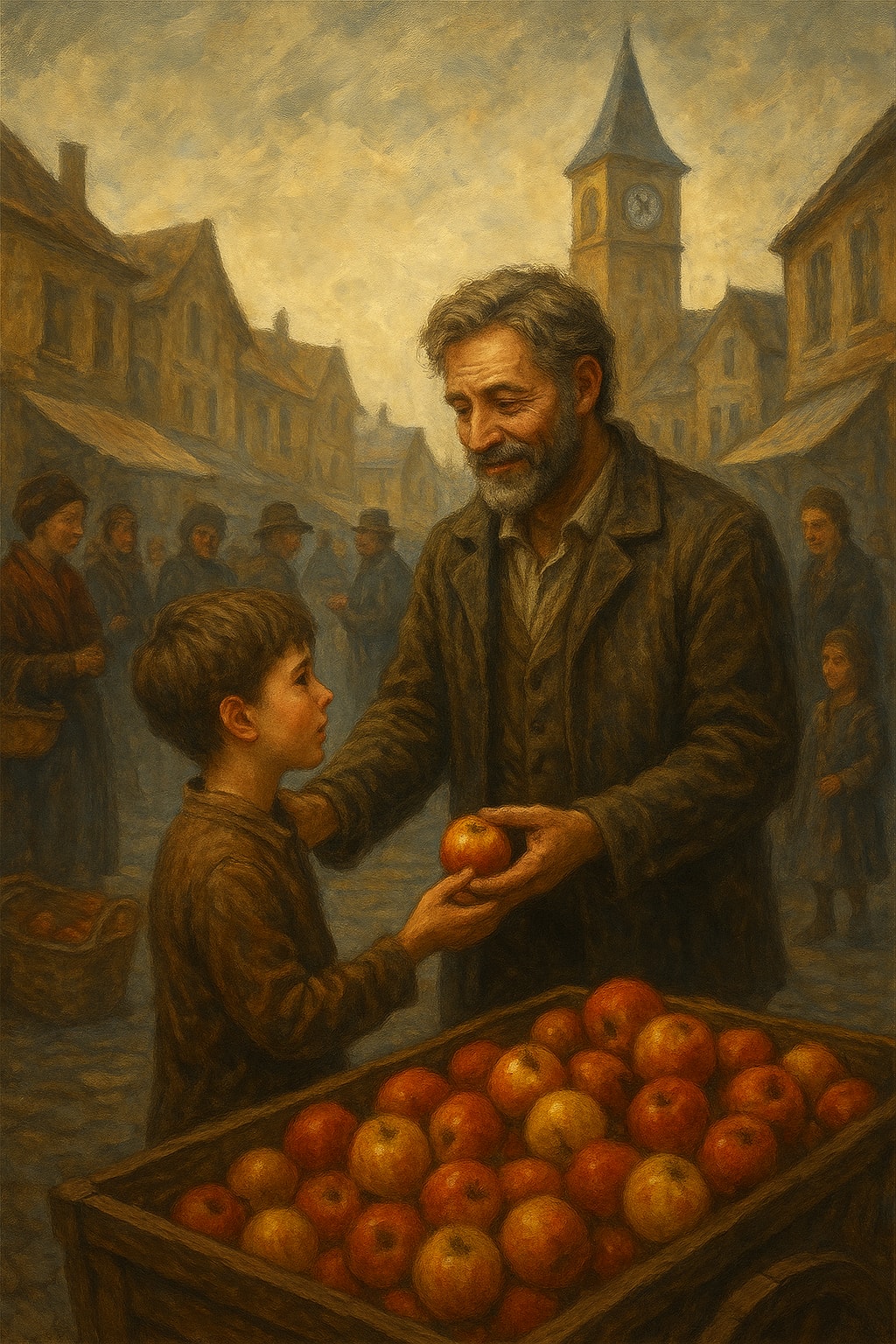
The town of Merrowbridge was not special.
It was not wealthy, not known for its art, not a birthplace of revolutions. It was a place you might drive through on your way to somewhere better, where the houses sagged with age and people kept their heads down. Shops closed early, the café served bitter coffee, and even the children seemed older than their years.
But change, as history has proven time and again, never asks permission.
It began on a Tuesday morning, in the heart of the square.
The square was Merrowbridge’s pulse—if a weary, uneven one. Every morning, market stalls appeared with vegetables from nearby farms. Women bartered for onions, men argued over fishing nets, and the old clock tower ticked indifferently above it all.
That day, a man arrived.
No one saw exactly where he came from. Some swore they noticed him walking from the east, others thought he had stepped out of the bus station, though no bus had arrived. He was not young, though not yet old; his hair carried threads of gray, his hands callouses, his eyes the piercing kind that seemed to look through you, rather than at you.
He carried no banner, no loudspeaker, no sign of purpose. And yet, by noon, he had gathered a crowd.
It started with something simple.
A boy, perhaps twelve, was running through the market when he slipped, spilling his apples across the cobblestones. People watched but did not move. In Merrowbridge, one’s troubles were one’s own.
The man bent down. Not only did he help gather the apples, but he polished each one on his sleeve before handing it back. Then, in a voice that seemed to carry without shouting, he said:
“Every life deserves dignity—even in the small things.”
The words hung in the air.
It was not the act of kindness—those were rare, but not impossible. It was the way he said it, with a calm authority that felt like truth itself had stepped into their gray morning.
People turned their heads. Who was he?
The First Conversation
Later, a woman named Clara approached him. She was a widow, shoulders hunched from years of keeping to herself. “Why did you say that?” she asked.
The man smiled. “Because people forget. Dignity isn’t grand. It isn’t about riches or fame. It’s in how we treat a child with spilled apples.”
Clara studied him, unsettled. “You talk like a preacher.”
“I am no preacher,” he replied softly. “I only remind people of what they already know.”
And that was the first seed.
A Town That Did Not Speak
Merrowbridge had a disease—not of the body, but of spirit. People lived parallel lives, side by side yet separate. Neighbors barely nodded, friends were scarce, and trust was a currency long devalued.
The man seemed to see this immediately.
Day by day, he stayed in the square. He never demanded attention, but attention found him. He listened to the fishermen complain about dwindling catches, to the farmers weary of debts, to the young who dreamed of escape. He rarely gave answers. Instead, he asked questions.
“Why do you accept things as they are?”
“Who told you change was impossible?”
“Do you believe your neighbor wishes you harm—or have you simply forgotten his name?”
And as simple as it was, the questions unsettled them. It was as though he was holding up a mirror, forcing the town to see itself not as it pretended to be, but as it was.
The First Act of Defiance
One evening, a storm cut power through half the town. The square was dark except for the weak glow of lanterns. People grumbled and went home.
But the man stayed. He took out a small violin—no one had noticed he carried it—and began to play. The sound was not polished, but raw and alive, threading through the rain-slick stones.
One by one, people stopped. Children sat cross-legged on the ground. Women with groceries lingered under their umbrellas. A group of tired factory workers leaned against the clock tower. For the first time in years, they stayed together not out of necessity, but out of choice.
When he finished, silence followed. Then, someone clapped. Another joined. Soon, the square echoed with applause.
And then came his words, carried by the hush of the storm:
“You see? Even in darkness, you can create light.”
It was simple. Yet magnetic. The kind of truth that lodges in your chest and refuses to leave.
Rumors and Resistance
Not everyone welcomed him.
By the third week, whispers spread. Some called him a prophet, others a charlatan. The mayor saw him as a nuisance, the shopkeepers as a distraction. A few muttered that he was dangerous—that people who stirred questions often brought trouble.
But the people kept coming.
Children returned daily, drawn to his stories of far-off lands and forgotten wisdom. Workers came to rest, finding in him a strange kind of strength. Women brought him bread, not out of pity, but gratitude.
The man had no home, yet he belonged everywhere. He carried no money, yet he was never hungry. He sought no power, yet his voice carried more weight than the mayor’s decrees.
What was his name?
He never offered it.
And oddly, no one asked. To speak of him was simply to say, “the man.” And somehow, that was enough.
The Awakening
It was Clara—the widow who had first spoken to him—who noticed the change.
One morning, as she walked through the square, she realized something was different. The grocer was helping a customer carry bags. Children were laughing with the baker. Two fishermen who hadn’t spoken in years were sharing a joke.
It wasn’t dramatic. But it was undeniable. Something was shifting.
And Clara, with a lump in her throat, realized it all traced back to him.
The man had not brought wealth, or miracles, or even promises. He had simply reminded them of themselves—of their capacity for dignity, kindness, and connection.
For the first time in decades, Merrowbridge felt alive.
And yet, beneath it all, there was unease.
To Be Continued…
In Part Two, the story will deepen:
We’ll see how the man challenges the town’s leaders.
How his presence inspires both love and resistance.
And the ultimate act that makes him the man who changed not just Merrowbridge, but the people themselves—forever.
Because no one knew how long he would stay.
About the Creator
The Devil's Cut
“Comrade, finally you’re awake.” The voice was smooth, sensual. A flickering incandescent bar was all that lit the white, sterile room. All Vladimir remembered was everything going black. He tried to move his arms and found them strapped to the gurney.
By Matthew J. Fromm4 days ago in Fiction
How To Save Your Life With A Glass of Water
Step 1. Acknowledge the smallest solvable problem I can tell you are reaching for the big stuff, saying something like—“If I could just quit drinking…” or “If my mother had never died…” or “If I wasn’t single…”—these are not what I am talking about.
By Aubrey Rebecca2 days ago in Fiction


Comments
There are no comments for this story
Be the first to respond and start the conversation.