
The Lonely Moon and the Dancing Stars
She watched their joyful chaos from afar, until one tiny star taught her that even the quietest light can join the dance.


The Moon was a creature of quiet grace and perfect order. She followed her path across the sky with a serene and constant rhythm, bathing the world below in a soft, silver light. But in her heart, she carried a quiet sorrow. She was lonely.
Below her, scattered across the velvet of the night, were the stars. They were nothing like her. They were chaos and joy. They didn't just shine; they danced. They winked and pulsed, they played games of tag across constellations, and they whispered secrets to one another with flickers of light. They were a joyous, sparkling community, and the Moon was on the outside, looking in.
She believed she was too different. Her light was too steady, her presence too large and solemn. She was a solo performer in a vast, silent theater, while the stars were a bustling, radiant festival.
One night, a particularly brave little star named Pippin noticed her. While the other stars were weaving through the belt of Orion, Pippin hovered, watching the Moon’s slow, lonely journey.
“Why do you travel all by yourself?” Pippin called out, his voice a tiny, bright chime.
The Moon, startled, slowed her pace. No one had ever spoken to her before. “This is my path,” she replied, her voice a soft, low hum. “It is a path of solitude.”
“But it looks so boring!” Pippin zipped a little closer, leaving a trail of sparkling dust. “Don’t you ever want to dance?”
“I cannot dance,” the Moon said, her light dimming slightly with sadness. “My light is constant. I do not know how to flicker. I would not fit in with all of you.”
Pippin wouldn’t accept that. “Dancing isn’t just about flickering! Watch!”
He didn’t flicker. Instead, he began to move. He zipped in a wide, joyful circle around the Moon. Then he spiraled down and looped back up, drawing a sparkling crown in the space around her head.
The other stars, seeing this, paused their games. One by one, they drifted over. At first, the Moon felt nervous, exposed under the gaze of a thousand tiny lights. But then, a star named Nova began to pulse in a slow, respectful rhythm, matching the Moon’s own serene energy. Another, named Gleam, traced the curve of the Moon’s cheek with a soft, glowing line.
They weren't asking her to change. They were creating a new dance, just for her.
“You see?” Pippin chimed, zipping back to her side. “Your dance is different. It’s a slow, beautiful dance. A waltz! We just do the jitterbug.”
The Moon looked at the stars, who were now weaving in and out, their frantic movements softening into graceful arcs and gentle pulses that complemented her own majestic glow. They were dancing with her, not expecting her to dance like them.
Tentatively, the Moon tried. She didn't flicker. But she did something she had never done before. She let her light pulse ever so gently, a slow, deep breath of brightness that swelled and receded like a tide. It was a subtle change, one no human on Earth would even notice, but to the stars, it was a symphony.
A collective chime of delight rippled through the starry crowd.
Encouraged, the Moon began to move. Not off her path, but within it. She did a slow, graceful spin, her light washing over the stars in a wave of silver. She tilted her face, casting playful shadows on the swirling galaxies nearby.
The stars responded, their own light becoming softer, more melodic. They formed a long, sparkling bridge for her to cross. They gathered below her, creating a shimmering, celestial stage. The silent theater was now filled with music only they could hear—the music of shared light.
The people on Earth that night looked up and remarked on how particularly beautiful the sky was. The stars seemed especially bright, and the Moon had a warm, happy glow they couldn’t quite explain. They didn't see the dance, but they felt its joy.
The Moon was no longer lonely. She had found her place. She wasn't a solitary queen on a cold throne. She was the centerpiece of a grand, cosmic ballet. Her steady, constant light provided the rhythm, and the stars, with their joyful chaos, provided the melody.
She learned that she didn't need to be a star to belong. She just needed to be herself, and to find friends who appreciated her for the unique light she cast. The Lonely Moon had found her dancers, and together, they turned the silent night into a celebration that would last for eternity.
About the Creator
Habibullah
Storyteller of worlds seen & unseen ✨ From real-life moments to pure imagination, I share tales that spark thought, wonder, and smiles daily
Keep reading
More stories from Habibullah and writers in Fiction and other communities.
When the Moon Forgot to Rise
It began with a silence. Not a sound silence, but a light silence. The long, blue twilight of the summer evening deepened, but the familiar, gentle silver that should have followed… didn't. The world waited. Crickets chirped. Fireflies blinked. But the eastern horizon remained a stark, empty black.
By Habibullah4 months ago in Fiction
Bomb Scare
It was 2027, and the world never thought it would happen. A missle hit the United States, but it wasn't where they had anticipated. A little town in the northeast was hit by a missile strike, they didn't know why, and they didn't know exactly where it hit, but they did know it was a coastal community, somewhere between Maine and Delaware.
By Gregory Paytonabout 21 hours ago in Fiction
One Table With The Wifem One Bar With Lads
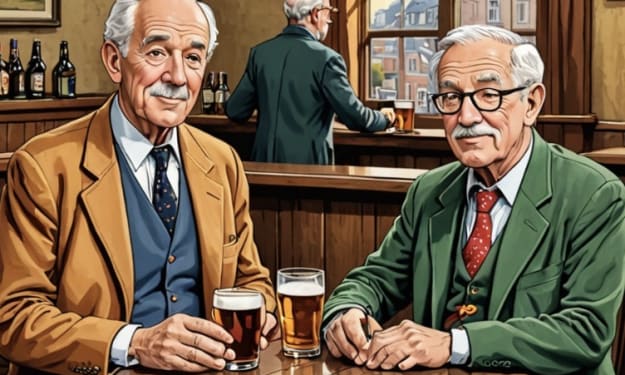
One Table With The Wifem One Bar With Lads They sat across from each other in the low gold light of a Thursday evening. Two men who had known each other since their voices were breaking and their chins were bare. The pub was loud but not wild yet. The kind of noise that carries laughter and old stories without asking for trouble. Tom lifted his pint and said, answer me straight. If you had one free night, no work tomorrow, no excuses, would you book a quiet dinner with your lady, candlelight, clean shirt, proper conversation, or would you come here, shoulder to shoulder with the lads, and drink until the stories turn reckless. No middle ground.
By George’s Girl 2026 2 days ago in Fiction
A Knight of the Seven Kingdoms Series Review (Season 1)
As one of the biggest properties in fantasy, A Song of Ice and Fire remains immensely popular with audiences. After reaching far into the past with House of the Dragon, a second spin-off was on the cards. A Knight of the Seven Kingdoms serves up a bite-sized slice of action and drama, but it still claims a spot among the best small-screen titles.
By Robert Cain7 days ago in Geeks


Comments
There are no comments for this story
Be the first to respond and start the conversation.