
When the Moon Forgot to Rise
The sky stayed dark, and the world held its breath. It was the silence that taught us to make our own light.

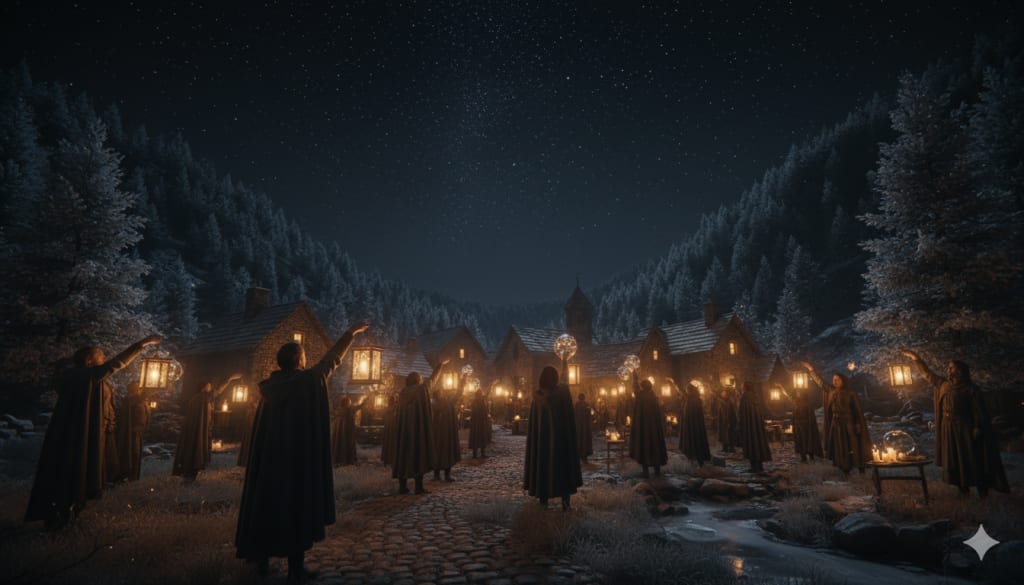
It began with a silence. Not a sound silence, but a light silence. The long, blue twilight of the summer evening deepened, but the familiar, gentle silver that should have followed… didn't. The world waited. Crickets chirped. Fireflies blinked. But the eastern horizon remained a stark, empty black.
The Moon had forgotten to rise.
In the village of Stillwater, nestled in a fold of the hills, people came out of their cottages and looked up. There was no panic, at first. Only a profound and growing confusion. The sky was a vast, star-pricked void, beautiful and terrifying in its completeness.
Old Man Hemlock, who claimed to remember every night for eighty years, shook his head. “It’s never done that,” he murmured, his voice softer than usual. “Not once.”
Elara, the baker, felt a cold knot in her stomach. Her nightly ritual of sitting on her porch, watching the moonbeams dapple the river, was a comfort as steady as the bread she baked. Without it, the world felt unbalanced, like a table with one leg missing.
Children, who were usually tucked into bed by the moon’s gentle arrival, stayed at their windows, peering into an unfamiliar darkness. The night animals were confused; an owl hooted questioningly, and the usual nocturnal rustling in the forests was subdued.
The village council met under the feeble glow of the old gas lamp in the square. They debated. Had something happened? Was it an eclipse? An omen?
“We can’t just wait,” Elara said, her voice cutting through the anxious chatter. She was covered in a dusting of flour, having found solace in kneading dough. “The moon has always been our friend. What if our friend is just… tired? Or sad? What if it needs to know we’re still here?”
The council members looked at her as if she’d suggested they build a ladder to the sky. But the alternative—sitting in the dark, waiting for a terror they couldn’t name—was worse.
So, they decided to make their own moon.
It started with Elara. She brought out every candle from her bakery and lined them along her porch railing. Their warm, flickering light pushed back the shadows around her home.
Seeing her light, the blacksmith, a burly man named Kael, fired up his forge. He didn’t shape metal; he just let the great furnace blaze, its orange heart a defiant roar against the darkness.
One by one, the villagers joined. They brought out lanterns and oil lamps. They hung strings of festival lights from their eaves. Children gathered jars and caught fireflies, creating tiny, captive constellations to place on their windowsills. Fishermen rowed their boats to the middle of the river and hung lanterns from their masts, creating a shimmering, duplicate river of stars on the water.
They didn’t try to replicate the moon’s cool, silver light. Theirs was a patchwork of warmth—golden, orange, and yellow. It was a humble, human light, but it was theirs.
They gathered in the square, not with speeches, but with quiet determination. They shared bread from Elara’s oven and stories under the man-made constellations. They sang old songs, their voices softer and more harmonious without the moon to compete with. For the first time in years, everyone was truly looking at each other, their faces illuminated not by a distant celestial body, but by their shared effort.
They were not trying to replace the moon. They were keeping a vigil for it.
And as the night reached its deepest, blackest point, something shifted.
A soft, collective gasp went through the crowd. High above, a sliver of silver appeared on the eastern horizon. It was hesitant, frail. It was the Moon.
It rose slowly, as if ashamed, its light a pale, questioning whisper.
But as it climbed, it seemed to grow stronger, as if drawing strength from the thousand points of light the villagers had made. It saw their lanterns, their candles, their brave, tiny fires. It saw that the world had not been lost to the dark.
When the Moon finally reached its zenith, it shone with a clarity and a sweetness they had never seen before. Its light didn’t just illuminate; it seemed to listen. It felt like an apology and a thank you, all at once.
The villagers blew out their candles one by one, saving the lantern oil. But they didn’t go inside. They stayed, watching their old friend in a comfortable, newfound silence.
The Moon had forgotten to rise. But in its absence, the people of Stillwater had remembered something they had forgotten: that they, too, could be a source of light. They didn’t need to wait for a savior from the sky. The light had been inside their homes, and inside their hearts, all along. And from that night on, the moon seemed to shine just a little bit brighter on their village, as if it was proud of the lesson it had, quite accidentally, taught its friends below.
About the Creator
Habibullah
Storyteller of worlds seen & unseen ✨ From real-life moments to pure imagination, I share tales that spark thought, wonder, and smiles daily
Keep reading
More stories from Habibullah and writers in Fiction and other communities.
Bomb Scare
It was 2027, and the world never thought it would happen. A missle hit the United States, but it wasn't where they had anticipated. A little town in the northeast was hit by a missile strike, they didn't know why, and they didn't know exactly where it hit, but they did know it was a coastal community, somewhere between Maine and Delaware.
By Gregory Payton7 days ago in Fiction


Comments
There are no comments for this story
Be the first to respond and start the conversation.