

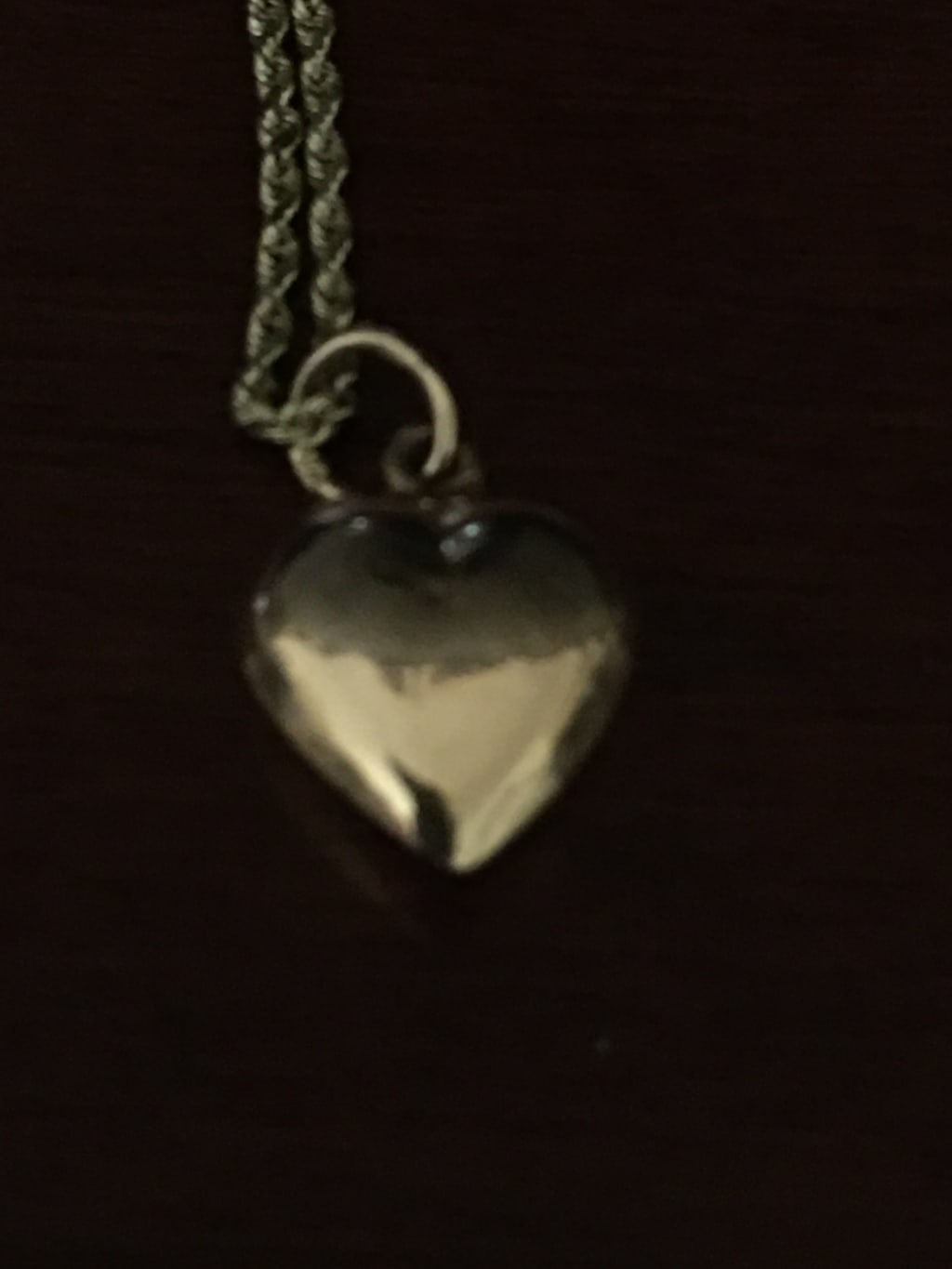
From the day I received it at two years of age, I treasured the rose gold puffed heart locket. My dad bought it for me while he was working in Saudi Arabia. The locket was too small to hold a photo or other keepsake, but it contained a perfect yet invisible memory of my dad. It became all the more precious when he passed away the day before my fourteenth birthday.
I kept the locket safe throughout my moody teenaged years, getting married, raising children and now, a grandchild. Liam stayed with me each weekday while my daughter and her husband worked. They once worked in offices. Since the onset of the Covid pandemic they both worked from their home, picking up Liam at the end of each day.
For a time, it seemed the pandemic had subsided and office workers began to return to their employers’ locations. Finally the world could breathe a cautious sigh of relief. Sadly, the Covid variants soon swept through the population, and no vaccine could keep up with the new strains of the virus. Offices and public places closed again. Everyone retrieved the masks they had hoped they were finished wearing. Children returned to virtual learning and a life without sports or other extracurricular activities. The world became a scarier and darker place than ever before.
I walked past the spare bedroom, where Liam was using his laptop for his class’s Zoom meeting. I softly touched the locket at my throat. I had begun to wear it daily since the second lockdown, perhaps as a symbol of hope or a good-luck talisman. Now was a time for treasuring simple things like a peaceful day at home or an heirloom locket that had survived the years and the changes to our daily lives that we never dreamed would occur, not once but twice in our lifetimes.
I stopped watching the daily news toward the end of the first lockdown. The misinformation, the changing narrative, environmental concerns and the civil unrest taking place on a daily basis were robbed me of the tranquil existence I tried to maintain. I wanted to shield myself and Liam from as much of it as possible.
The first lockdown was a surprise to me; I never really saw it coming. There were rumors that the virus could force the office building I worked in to close, but I couldn’t imagine that would happen - until the day it did. Literally overnight my colleagues and I became remote workers, setting up our home offices in spare bedrooms, at kitchen tables, wherever we could find a quiet place. Schools closed simultaneously, making it difficult to find quiet places in homes containing bored children. Churches, community centers and bars were closed, and curfews were enforced in an effort to thwart the inevitable spread of the virus through socializing.
We were simply swept along on the first wave of the Covid virus. We didn’t know what to expect and didn’t stop to consider how we reacted. Going to extreme measures to purchase toilet paper and cleaning materials just became the way things were. We didn’t gather with family and friends, restaurant meals became take-out, masks and antibacterial hand soap were stowed in cars at all times.
The second lockdown was mentally and emotionally devastating. How could this happen twice? We had barely returned to a new normal when it was cruelly taken away. Whether you trusted the government or not, you knew things must be bad for the world to return to lockdown, which nearly crushed our spirits and our economy the first time.
I quietly went downstairs, in order to keep Liam’s distractions to a minimum, and decided to watch a home makeover show on TV while I prepared our lunch.
I opened a loaf of bread to make sandwiches when the TV screen went black. I pulled sliced turkey, lettuce and mayonnaise from the refrigerator, and waited for the cable to reset, as it sometimes did.
I looked up when I heard the harsh blare of the emergency broadcast system on the TV.
Words scrolled across the screen while a recorded voice intoned, “This is not a test. Seek shelter immediately. The National Aeronautics and Space Administration is tracking a number of large asteroids hurtling toward Earth. The impact of one of these asteroids could result in high winds, shockwaves, earthquakes and tsunamis, along with widespread destruction of property and loss of life. Take immediate shelter in an interior, windowless room at ground level and brace for impact. This is not a test.”
Oddly enough I felt prepared for this event, even as panic gripped me. All of the turmoil of the past two years – the riots, global warming, the closings of businesses, the shortages of food and supplies – somehow made it seem as if asteroids crashing into the Earth was the next reasonable step.
My mouth went dry, my heart pounded in my chest, and I had to force myself to breathe. Instinctively, I ran up the stairs to Liam. He was staring at his laptop in open-mouthed horror, watching the same message I just saw in the kitchen. He whispered, “What’s happening? What does this mean?” I felt as if the world was tilting on its axis, but recognized that the sensation resulted from shock and panic.
Liam was seven years old. I had reluctantly given up carrying him in my arms two years ago because he was too heavy for me. Now I gathered him into my arms easily and carefully took him down the stairs to the couch in the den.
I sat down with Liam in my lap, his head against my chest. I put his hand around the locket on its chain, and told him all about the grandfather he never met, but just might see for the very first time.
About the Creator
Pamela Burris
I am an aspiring freelance writer.
Keep reading
More stories from writers in Fiction and other communities.
TUS NUA - ch 49
TUS NUA – ch 49 New Beginnings – Mia and Midnight (*)(*)(*) As Mia spoke on the phone to Ali’s sister, Ellen, Finola slipped quietly away and walked to the stream behind Tus Nua. Carefully, she put a block on her family so no one could know what she was about to do.
By Margaret Brennan4 days ago in Fiction
One Hard Thing
Stop me if you’ve heard this one before: You have the number, you know your schedule- you’ve even picked out the perfect day and time to make this appointment. Shoot, you’ve even picked out alternative days and times just in case their schedules can’t accommodate you!
By Taylor Rigsby4 days ago in Motivation
10 Times Rotten Tomatoes and I Disagreed
***Disclaimer*** I will be ranking these movies in the following manner: The greater the divide between Rotten Tomatoes and I, the higher up on the list (and I am referring to the critic's score, not the audience score). I will also show Rotten Tomatoes' score on each one in addition to my score. I am curious to know what everyone thinks, please let me know in the comments below!
By Madison "Maddy" Newton4 days ago in Geeks


Comments
There are no comments for this story
Be the first to respond and start the conversation.