
The Locked Drawer of Emily Dickinson
How Dickinson's Poems Were Nearly Lost to Time


For as long as I’ve been writing, Emily Dickinson has been a guiding star. Her clipped intensity, her fierce quiet, her way of saying what others circle around—I’ve spent years trying to write like that, trying to listen the way she must have listened. So, the story of how her poems nearly vanished before the world ever saw them has always struck me as not just literary history, but personal.
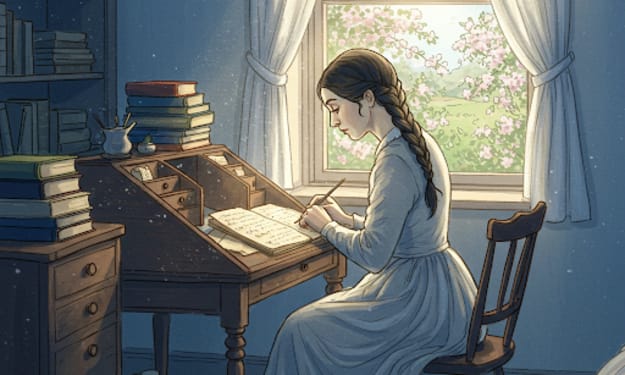
It begins in the spring of 1886, in a brick house on Main Street in Amherst, Massachusetts. Lavinia Dickinson—Vinnie, to those who knew her—stood in her sister’s bedroom, facing a small cherrywood desk. Emily had died just weeks earlier, and Vinnie was doing what the living do: sorting, clearing, trying to understand the space the dead leave behind.
Then she opened the drawer.
It was packed with folded sheets, bound into tidy bundles with thread. Forty packets in all. The handwriting was unmistakable. Emily’s spidery script, sharp and slanting, filled every page.
Vinnie knew, instantly, that she had found something important. What she may not have known—what none of them could yet know—was that those quiet stacks would alter the course of American poetry.
Emily Dickinson had written nearly 1,800 poems. In secret. Late at night. On envelopes, on scraps, on backs of old recipes. And then, more deliberately, she copied them onto matching sheets and bound them into handmade booklets called fascicles. She told almost no one.
Only a handful of her poems were published while she lived, and even those were edited nearly beyond recognition. Titles were tacked on. Her punctuation was flattened. The dashes—those sudden stops and leaps that pulsed like breath—were erased. Her odd capitals, her fractured rhythms gone. The raw electricity of her voice was smoothed into something easier to shelve.
But she kept writing. Despite being dismissed. Despite not being heard. She kept at it, fiercely private but ferociously committed.
When Vinnie found the poems, there were no instructions. No will. No request to destroy or preserve. Just the work, quietly waiting.
She could have left them there. She could have thrown them away. Instead, she made a promise to herself: the poems would be published.
At first, she turned to Susan Gilbert Dickinson—Emily’s sister-in-law, neighbor, and longtime correspondent. Susan had been close to Emily, arguably closer than anyone else. Many of the poems were addressed to her. But Susan, deep in mourning, moved slowly.
So, Vinnie made a bold choice. She brought the poems to Mabel Loomis Todd, a family friend with a complicated connection to the Dickinsons—she was having an affair with Emily’s brother, Austin. Mabel had never actually met Emily, but she admired the poems and saw their potential.
Together with Thomas Wentworth Higginson, a writer and former war colonel who had once exchanged letters with Emily, Mabel began editing the poems for print. They meant well. They wanted the public to understand her. But they made the same old mistake: they edited her voice into something more acceptable. Again, the dashes disappeared. The slant rhymes were cleaned up. The wildness, the weirdness, the spark—all softened.
Still, the first volume, published in 1890, was a hit. Readers were captivated. Some found her strange, some thought her childlike, but they couldn’t look away. More volumes followed. The poems spread. Clipped from newspapers. Memorized. Shared.
But the real Emily—the one who wrote like no one else—was still buried in those fascicles, unseen.
It took decades to change that. In the 1950s, scholar Thomas H. Johnson began the painstaking work of returning Dickinson’s poems to their original form. He studied her handwritten manuscripts, preserving her punctuation, her capital letters, her line breaks. In 1955, his edition of The Poems of Emily Dickinson revealed the force of her voice as she had written it: spare, elliptical, shattering.
Only then could readers fully see what Vinnie had saved.
Because of her—because she opened that drawer and refused to keep it closed—we have the true Dickinson: intense, inward, alive on the page. Her fascicles are now seen as a radical act of authorship, a kind of quiet rebellion. She didn’t wait to be understood. She wrote, even when no one was listening.
I think of that often when I write. Of the silence she faced. Of the risks she took, not with volume, but with precision. She trusted the work enough to hide it away, but she trusted it to last.
And it nearly didn’t. The poems could so easily have been lost—burned, tossed, ignored. But they weren’t. Because someone opened the drawer. Because someone believed in her sister's writings.
We’re lucky. That’s what it comes down to. We are unbelievably lucky.
About the Creator
Tim Carmichael
I am an Appalachian poet and cookbook author. I write about rural life, family, and the places I grew up around. My poetry and essays have appeared in Beautiful and Brutal Things, My latest book. Check it out on Amazon
Keep reading
More stories from Tim Carmichael and writers in Fiction and other communities.
The Solitude of Emily Dickinson
In the upstairs bedroom of a large white house in Amherst, Massachusetts, Emily Dickinson lived most of her adult life, unseen by many and misunderstood by nearly all. She was not a ghost, though some neighbors suspected she might be one. She was not a saint, though her letters held a kind of quiet gospel. She was not crazy, as some whispered after she stopped attending church or appearing at town functions. She was simply herself—fiercely private, deeply observant, and impossible to categorize.
By Tim Carmichael10 months ago in Fiction


Comments (1)
Excellent piece, Tim. I knew a little of this but not that she had or work edited in this way. Yes how lucky we are. 😊