
The Lighthouse That Blinked Back
A story of loneliness, light, and the language of waves

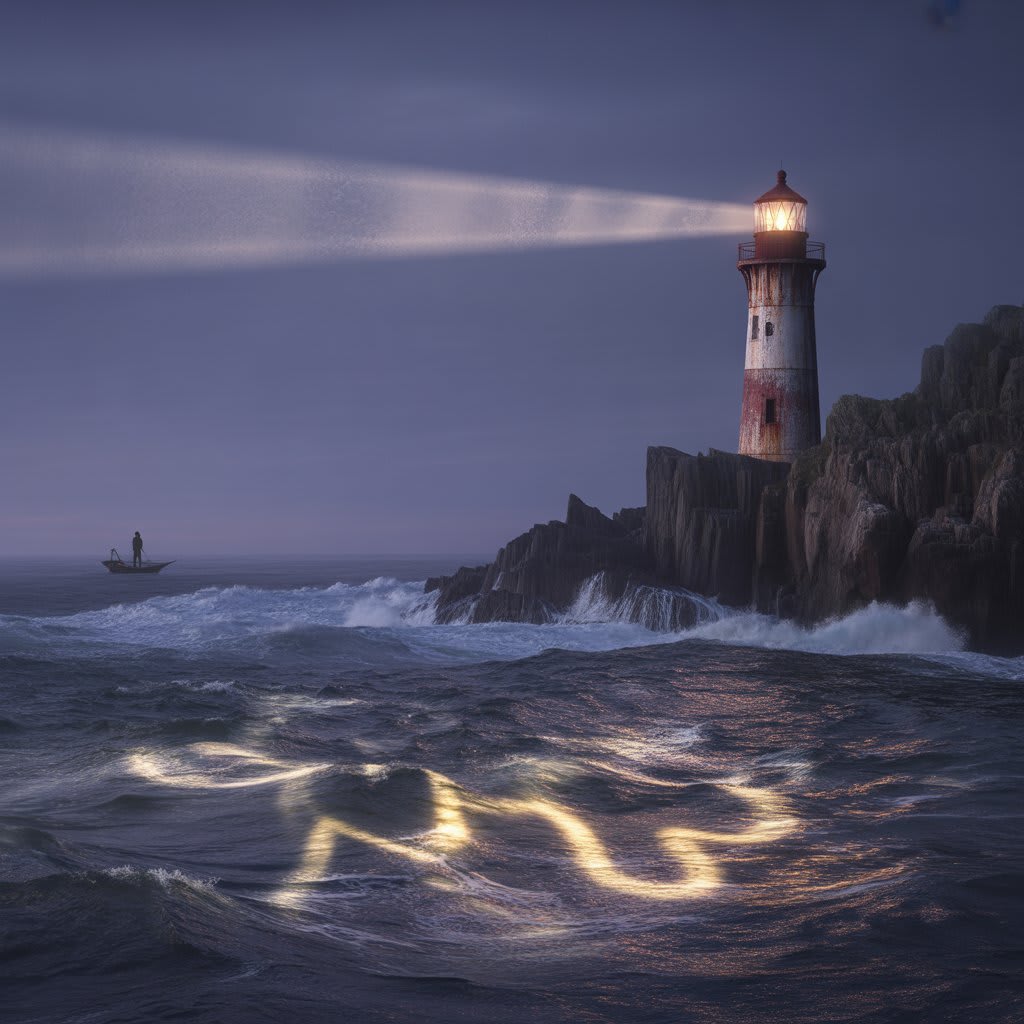
The first time the lighthouse blinked back, Elias thought he was losing his mind.
He stood at the edge of the pier, coat flapping wildly in the cold wind, staring across the black water. The beam of light swept across the sea, paused, and then, impossibly, flashed twice in quick succession, as if winking. The pattern repeated, steady and deliberate. Elias’s heart thudded. Lighthouses didn’t blink back. They warned ships, not lonely men.
He rubbed his eyes, laughing softly to himself. “I’ve been alone too long,” he muttered, turning toward his cottage. But even as he walked away, the light flashed again, once, twice, like a stubborn hello that refused to be ignored.
Elias had been the keeper of the Whaler’s Edge Lighthouse for almost seven years. The town had long since forgotten its purpose. No ships came anymore, only the endless hum of the sea and the cries of gulls that seemed to echo his own isolation.
He kept records of tides and storms, cleaned the lenses, fixed the wiring, and waited for nothing in particular. But tonight felt different. The light had moved wrong. Lighthouses didn’t move wrong.
He climbed the spiral stairs, each step groaning beneath his boots. The tower smelled of salt, rust, and kerosene. At the top, he reached the lantern room, silent except for the hum of machinery. Everything was in place. Yet the beam felt alive.
“Are you trying to talk to me?” he whispered. The wind pressed against the glass, answering only with a mournful howl.
Still, Elias stayed there for hours, staring into the darkness until the first blush of dawn erased the stars.
The blinking continued the next night, and the one after that.
Sometimes it was two short flashes, sometimes three. Once, it pulsed in rhythm with his heartbeat, and he had to step away, dizzy with fear, or maybe something stranger than fear. He started writing down the patterns in his logbook, though he knew how it looked: the madness of a man too long alone.
One night, as thunder rolled across the horizon, he took his lantern and rowed toward the base of the cliff where the lighthouse stood. The sea was restless, waves slapping the boat as if to turn him back. But the light was calling again, once, twice, once.
“Fine,” he muttered. “If you’re real, show me.”
The next flash came lower, closer to the water’s edge, like the lighthouse was bending down to meet him. Elias gasped. It wasn’t the lens; something beneath it, behind it, was glowing faintly through the fogged glass. Then, just for a second, he saw a shadow move. Someone was inside.
By morning, he convinced himself it was exhaustion. The storms had been rough lately. Maybe it was the lightning. Maybe he just wanted company so badly that he’d invented it.
But on the seventh night, he found proof.
When he climbed to the lantern room, there was a message scrawled across the condensation on the inside of the glass.
HELLO.
Elias froze. His lantern slipped from his hand, clattering against the iron grate. He stared at the word until it vanished with the warmth of the glass. Then he wrote back, his finger trembling.
WHO ARE YOU?
The wind pressed against the panes again, and for a heartbeat, everything was still. Then, slowly, letters formed beneath his own.
YOU KNOW ME.
Sleep deserted him. He started hearing things—soft footsteps on the stairs, the whisper of a woman’s voice humming a tune he couldn’t quite place. When he checked the logbooks, the old entries, the ones he’d written years ago, were altered. Words he didn’t remember writing now appeared between the lines.
You left me.
I waited.
The waves remember.
He tore the pages out, heart pounding. “Who are you?” he shouted into the empty tower. “What do you want from me?”
Only the sea answered, roaring below.
But when the light blinked that night, the pattern was new—slow, patient, mournful. It wasn’t random anymore. He realized, with a jolt, that it was Morse code.
He scribbled frantically, translating each pulse.
COME BACK. COME BACK. COME BACK.
Memories returned like shards of glass.
Years ago, before the lighthouse, before the silence, there had been someone—Mara. Her laughter had filled his small house like sunlight. She loved the sea, even when it frightened her. One night, during a storm not unlike this one, she’d taken the boat out, saying she needed to feel the waves beneath her again.
She never came back. The sea had kept her, as it did all secrets.
Elias gripped the railing now, wind tearing at his coat. “Mara?” he whispered. “Is it you?”
The light blinked once, then twice, then once again. It was their old code, the one they used to share from shore to sea. He sank to his knees.
Days blurred. Elias stopped eating. He spoke to the lighthouse as though it could hear him. Maybe it could. The machinery responded to his voice—shutters shifting, light dimming, almost breathing. He told it stories of the past: of the day he proposed by the cliffs, of the song she hummed when she painted the kitchen walls.
And every night, the light answered back.
Then one evening, the blinking stopped.
Panic seized him. He rushed to the lantern room, heart hammering. “No,” he cried. “Don’t stop now!”
But the beam was steady, silent. He turned to leave, and froze. In the reflection of the glass stood a woman, pale as the moonlight, hair drifting like seaweed in unseen water. Her eyes were calm. Familiar.
“Mara,” he breathed.
She smiled faintly, lips moving without sound. Then she pointed to the sea.
He looked. The waves below shimmered, glowing faintly with the same light as the tower. A rhythm pulsed through them, echoing the heartbeat of the earth itself. The language of waves. He understood.
The next morning, the townsfolk found his boat drifting near the rocks. The lighthouse still burned, but something was different. It blinked now, every few seconds, slowly and rhythmically, like the beating of a heart.
Those who watched closely swore it pulsed three times, paused, and pulsed again. Some said it was a signal to ships. Others whispered it was a message, someone talking to someone who could still hear.
No one ever saw Elias again.
But on quiet nights, when the wind carries the sea’s soft hum, you can stand at Whaler’s Edge and see the light flicker twice, like a wink, before fading into the mist. And if you listen long enough, you might hear a voice beneath the waves, whispering back.
About the Creator
Wahdat Rauf
I am an article writer who turns ideas into stories, poems, and different type of articles that inspire, inform, and leave a lasting impression.
Keep reading
More stories from Wahdat Rauf and writers in Fiction and other communities.
The Photographer Who Couldn’t See Faces
The old man’s hand trembled as he rested the pen above the pristine white page. The studio was silent except for the occasional scratch of graphite on paper, a sound that seemed louder in the stillness of the room. He leaned back in his chair and closed his eyes, letting a shiver pass through him. Memories of faces, faces he had captured for decades, now hovered just beyond the reach of his vision, blurred and distorted, as if the world itself had grown shy.
By Wahdat Rauf2 months ago in Fiction
Miss Persephone's Manual to a Seemingly Ordinary Life
Miss Persephone was found at the dining table, her blue eyes swollen, her tears arriving and retreating like the tides of the ocean. Earlier that day, her family had visited her in the retirement home where she had lived for eight years. It was her eightieth birthday.
By Imola Tóth3 days ago in Fiction


Comments
There are no comments for this story
Be the first to respond and start the conversation.