
The lighthouse keeper's secret
The island nobody wanted
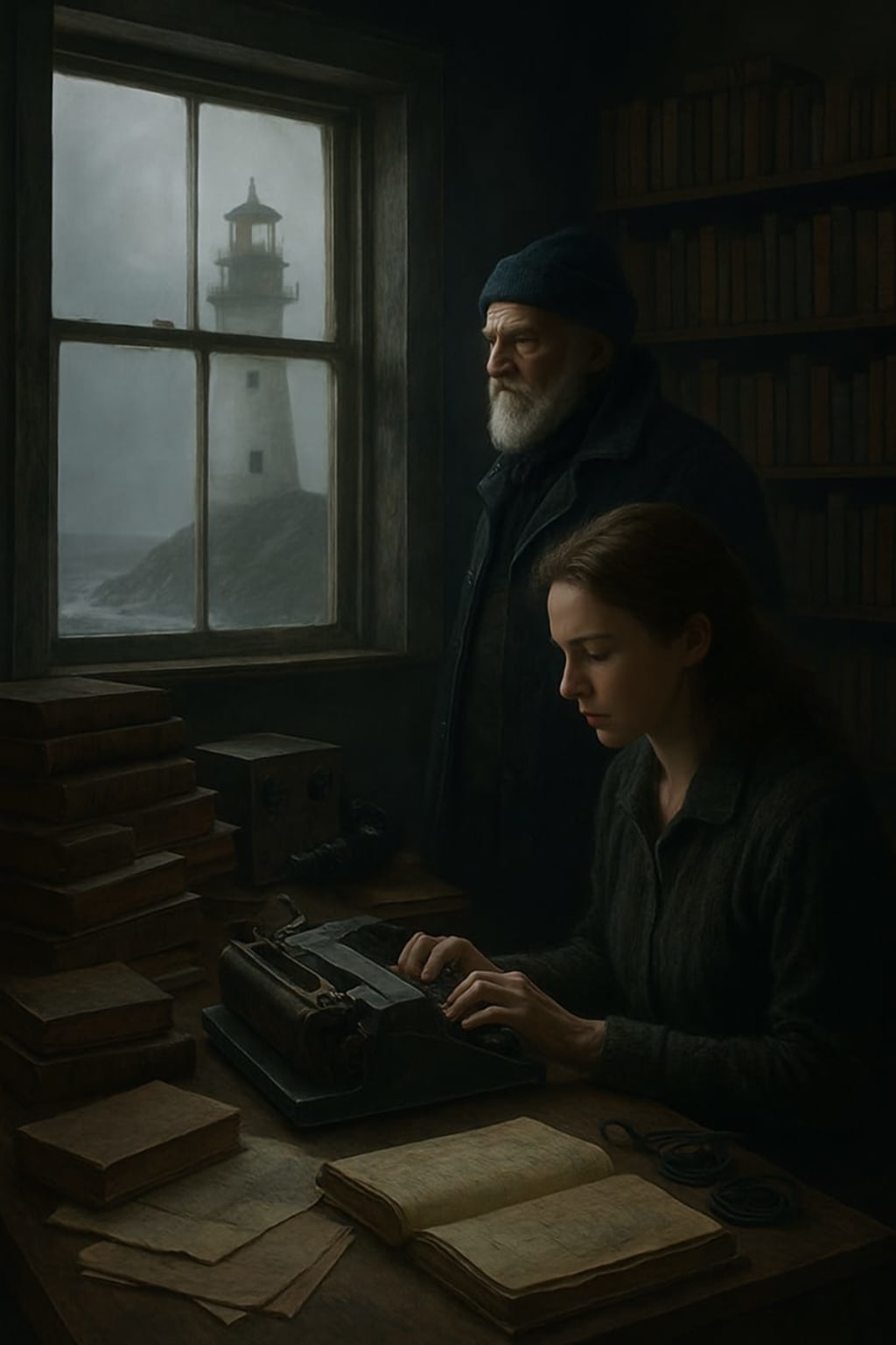
Part One: The Island Nobody Wanted
Few people knew about Norwyn Island. A lonely rock sitting off the jagged coast of Maine, it was perpetually surrounded by thick fog, icy winds, and waves that crashed like angry fists against its cliffs. The lighthouse stood like a weary sentinel, watching the ocean, stubbornly enduring the elements.
Ever since the automation of lighthouses, Norwyn had no reason for a keeper. But for the past eighteen years, one man had stayed there anyway. His name was Thomas Graye.
No one really questioned why. He was granted permission by the Coast Guard and left alone, supplied once a month by a small fishing vessel. Locals said he used to be a professor, a marine biologist, or a cryptographer. Others claimed he was hiding from something — or someone.
Whatever the truth was, Thomas Graye lived alone with a journal, a pair of binoculars, and a secret only the sea seemed to understand.
Part Two: The Newcomer
Cassie Mirel was not the adventurous type. A failed novelist and part-time waitress, she had come across the listing purely by chance: “Research assistant needed. Remote work. Must be comfortable with isolation, fog, and asking strange questions.”
She applied as a joke.
Three days later, she received a reply:
"Meet me at Dock 17, Harwick Bay, at 6 AM. Bring a coat. — T.G."
Cassie arrived, more out of curiosity than commitment. A bearded man in his late sixties greeted her with a nod and motioned for her to board a fishing trawler. He didn’t speak until the island came into view.
“You’ll stay three weeks. If you last that long, we’ll talk about extending.”
“Doing what?” she asked.
He glanced at her. “Listening.
Part Three: The Journal
Inside the lighthouse, time folded in on itself. The air smelled of salt and kerosene. Books filled every shelf. Stacks of yellowing journals crowded the desks. A dusty phonograph played old jazz records when the generator allowed.Cassie’s first task was transcription. Thomas handed her a worn leather-bound book and pointed to a typewriter.
As she typed, she read:
March 7th, 2008: The whispers started again. Three short pulses, two long. I recorded them. Same frequency. Same timing. They’re not mechanical. They’re not random. And they’re not from any ship.
March 12th, 2008: Something moved beneath the water. It responded to the signal. For one full minute, the sea stopped moving.
Cassie paused. “Is this fiction?”
Thomas didn’t answer. He stared out the window, watching the fog like it might conspire against him.
Part Four: The Signals
Two weeks in, Cassie began hearing them herself — faint pulses, like a Morse code heartbeat, barely perceptible over the wind.
Thomas had equipment in the basement: old hydrophones, analog recorders, frequency monitors.
“Animals?” she asked.
“Too consistent,” he replied. “Whales don’t speak in five-hertz pulses every third night.”
“What is it, then?”
He hesitated. “A conversation.”
Part Five: The Archive
Cassie couldn’t sleep. The sounds haunted her dreams. She took to exploring the lighthouse at night, discovering rooms filled with more journals, drawings, star charts, and pages of decoded signals.
One chart caught her eye — a spiral, drawn in thousands of tiny dots. Below it: They are mapping us from beneath.
She confronted Thomas.
“You think there’s something under the island?”
“No,” he said calmly. “I think the island is sitting on something much older than itself. And it’s waking up.”
Part Six: The Dive
On her nineteenth day, Thomas gave her a wetsuit.
“We’re diving?” she asked, half-horrified.
“Just to the shelf. Ten meters. You need to see it.”
Underwater, the world fell silent. Cold. Black. Timeless.
They reached the edge of a rocky outcrop. Then Cassie saw it — lines. Not coral. Not natural. Straight, metallic, and glowing faintly with bioluminescence.
She surfaced gasping. “A structure? That’s—no way. It’s impossible!”
Thomas simply nodded. “Now do you see why I stayed?”
Part Seven: The Visitor
That night, a boat appeared in the distance. No lights. No sound. Just a black shape on the water.
Thomas turned off every generator and light.
“Is it them?”
He shook his head. “Not the ones below. The ones above. The ones who want to bury this.”
Cassie peered through binoculars. The boat vanished into fog like it had never been there.
Part Eight: The Truth
On her final day, Thomas gave Cassie a key.
“To the cellar. The far room.”
Inside, she found his earliest journal. The first entry read:
July 19, 1977: I was part of the team that found it. We were supposed to keep it quiet. But I couldn’t. I saw what it was. Not a machine. Not an animal. A language written in time itself, buried under ocean and myth. I left everything. I came here.
This is not just a message. It’s a countdown.
Part Nine: The Departure
When the boat arrived to take her back to the mainland, Thomas didn’t say goodbye. He handed her a box — inside were his journals, signal tapes, and a note:
Your job wasn’t to help me. It was to replace me. When the sounds change again, return. The sea remembers everything. And soon, so will we.
Part Ten: The Return
Cassie published nothing. Told no one. The world moved on, oblivious.
But every year on March 12th, she’d listen.
One night, thirteen years later, the pattern changed.
And she knew: it was time to go back.
About the Creator
Keep reading
More stories from noor ul amin and writers in Fiction and other communities.
THE MEMORY THIEF
Chapter 1: The Blank Spaces Dr. Sarah Mitchell stared at the photograph in her trembling hands—a wedding picture she didn't remember taking, featuring a man whose face felt familiar yet completely foreign. According to the date stamp, it was taken just six months ago, but in her mind, there was nothing. No ceremony, no kiss, no joy. Just an empty space where love should have lived.
By noor ul amin5 months ago in Fiction
Logic and reason are not always explanation enough.
Logic and reason are not always explanation enough. Understanding is elusive He sat looking at the half empty glass but not seeing it, he was cold but not feeling it, he was in pain but not hurting from it. His mind was numb, his memory a jumble of conflicting events, as if from a nightmare but were in fact real. The phone rang for a long time before it gained his attention and then he tried to turn it off, an automatic reaction against coming back to reality. His mind preferred the numbness to anything else that was available. In this distracted state he accidentally accepted the call and put it onto speaker, the voice from the speaker jolted him into giving it his full attention. This was a call from the dead. The voice was full of concern, “where are you John, why haven’t you called, what is going on?” Even to his own ears his tone sounded subdued, defeated, “I am in the cabin, in the woods but I am OK will call you later” and he turned the phone off both ending this call and not accepting any other.
By Peter Rose7 days ago in Fiction



Comments
There are no comments for this story
Be the first to respond and start the conversation.