
The Lighthouse Keeper’s Journal
He was the last man on the cliff, keeping light for ships that never came... until one did.

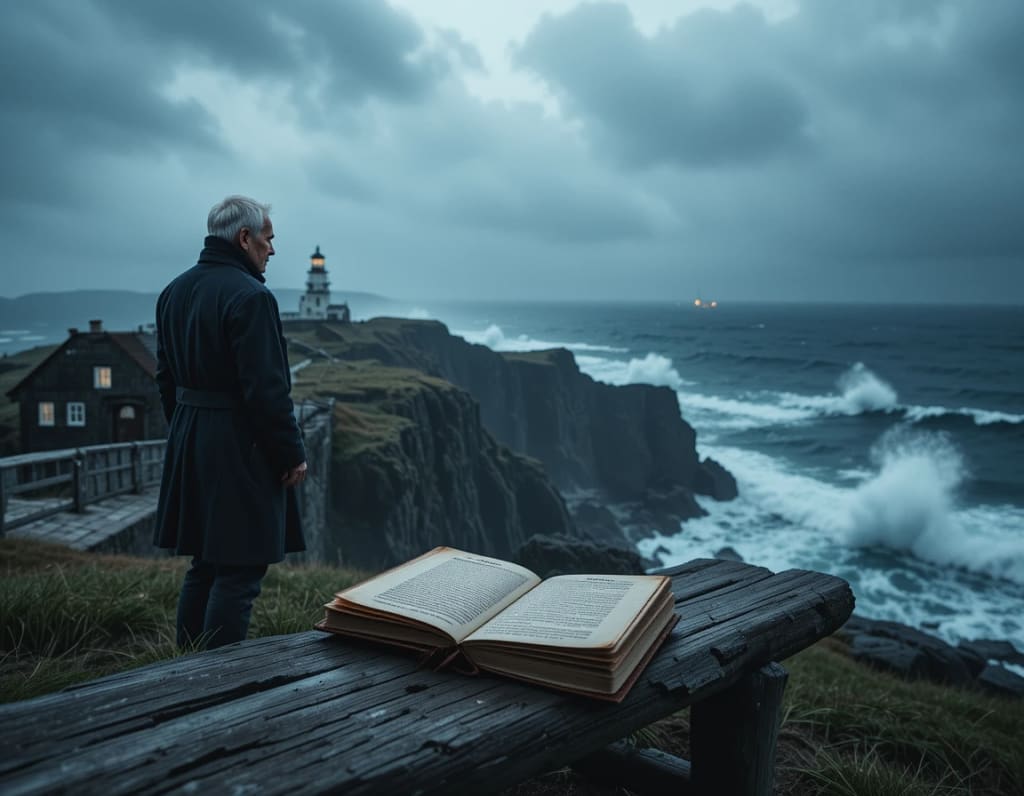
The Lighthouse Keeper’s Journal
Written by Shah Zeb
The lighthouse stood like a forgotten relic at the edge of the world. Perched high on the weather-beaten cliffs of the Scottish coast, it had long ceased to guide ships. Satellite navigation and modern systems had made it obsolete. Yet inside its stone shell, the light still turned, maintained by one man whose presence was as old and steady as the sea spray.
Ewan Fraser, seventy-three, had been the lighthouse keeper for nearly five decades. He refused to leave even when the government decommissioned the facility. He argued, perhaps foolishly, that the ocean still remembered the light—and so did the souls of those who had once passed beneath it.
Every morning, he brewed tea in a dented kettle and wrote in his journal—a thick, leather-bound book with a broken spine and pages yellowing like sea maps. The entries were rarely about the weather or lighthouse mechanics. They were letters, unsent, written to a woman named Isla.
June 6, 1995
The light flickered last night. I thought of you again, of course. I always do when storms come. Remember how we stood in the lantern room and watched the sea fight the sky? You were never afraid. You said storms made you feel alive. It was the calm that frightened you.
Isla had been Ewan’s wife—if only for six months. They were married under a gray sky, with seagulls as their choir and waves as their witness. She was an artist, with fire in her voice and salt in her spirit. She painted the sea not as it was, but as it felt. Six months after their wedding, Isla vanished in a boating accident. No body. No goodbye. Just her paint-streaked scarf found on a washed-up piece of driftwood.
He had no one else. No children. No close family. The town slowly forgot about Ewan, except the postmaster who still delivered parcels once a month. Inside were canned goods, paper, pens, and batteries. Always the same. And a small, quiet hope that maybe one day something else would come.
Then, one October evening, as the fog thickened like wool and the waves slapped rocks like angry fists, Ewan heard it—a knock.
Not the wind. Not the groan of old wood. But a knock.
Heart pounding, he opened the iron door. A girl stood there. Soaked. Pale. No older than seventeen.
"I'm looking for my mother," she said. “She used to live here.”
Ewan blinked. “What’s her name?”
"Isla."
Her name was Cora. Her voice shook when she spoke, not from cold, but from hesitation. She carried an old photo—one of Isla, covered in paint, laughing on the lighthouse steps. The same photo Ewan had tucked into his journal. Except this one had writing on the back.
To my daughter, should you ever find this. Start with the light.
They sat by the fire, a pot of stew between them. She told him her story in pieces, like a broken bottle being slowly glued back together.
Isla had survived the accident. Rescued by a passing trawler. But a head injury had taken her memory. She was taken in by a woman on the Isle of Skye, where she worked as a seamstress, never knowing who she truly was. Until her final days, when fragments returned. Names. Places. A face she had once loved.
She died two years ago, Cora said.
“But before she passed,” Cora added, eyes bright with pain and wonder, “she told me: 'If you ever want to know where you come from, go to the place where the sea meets the light.' So I did.”
Ewan didn’t speak. His hands shook too hard to hold his cup. Instead, he opened the journal. Flipped to the first page. Handed it to her.
Each word, each entry, was a letter to Isla.
Cora read until morning.
She stayed three days. Helped him oil the light. Took photos of the cliffs. They didn’t talk much, but when they did, it was as if silence had become a language of its own—passed down between those who have lost and those who remain.
On the last day, she asked, “Why did you stay?”
He looked toward the horizon, where the sea kissed the sky.
“Because she might come back. And someone had to keep the light on.”
January 14, 2020
She came, Isla. Our daughter. She’s kind. Brave. Just like you. I told her everything. The light, the cliffs, the stories. She carries your fire. I think... I think you sent her.
When Cora left, she took a small canvas with her—one of Isla’s old sea paintings, faded but still beautiful. She promised to return every year on the same day. Ewan didn’t ask for it, but it filled something in him that had been hollow for twenty years.
Three years later, Cora came back with a son. His name was Fraser. He ran up the stairs of the lighthouse as if the place had always belonged to him.
April 2, 2024
I am tired, Isla. But I’m not lonely anymore. The light’s still turning. And I think... when it stops, it won’t matter. Because you sent me one last message, through her. And it reached me.
That night, as the wind howled and the tide rose, the light blinked its steady rhythm—one last heartbeat for the ships and souls it guided.
By morning, Ewan was gone.
The journal sat on the desk, closed, a final message on the last page:
Keep the light turning.
Cora did.
Every year.
And now her son does.
Because some lights never truly go out.
About the Creator
Keep reading
More stories from Moonlit Letters and writers in Fiction and other communities.
The Library of Forgotten Names
The Library of Forgotten Names Written by Raza Iqbal The building had no sign. Tucked between a shuttered bakery and an abandoned tailor shop in a quiet corner of Bruges, the heavy oak door didn’t creak when opened—it sighed, like someone waking up from a long sleep. Emilia Laurent stood on the cobblestone threshold, a letter trembling in her hand. The letter had come without return address, sealed with wax bearing the insignia of an hourglass wrapped in ivy.
By Moonlit Letters8 months ago in Fiction
Bomb Scare
It was 2027, and the world never thought it would happen. A missle hit the United States, but it wasn't where they had anticipated. A little town in the northeast was hit by a missile strike, they didn't know why, and they didn't know exactly where it hit, but they did know it was a coastal community, somewhere between Maine and Delaware.
By Gregory Payton6 days ago in Fiction
Writing To Succeed
If you want to find something that will help readers find your writing, possibly expand your audience, and maybe even get you noticed for other things, then you’re not alone. But how can you get it done in a world full of want-to-be writers? Look less at what you’re writing now, and more at what other writers have used to boost their views and reads.
By Jason Ray Morton 4 days ago in Writers




Comments
There are no comments for this story
Be the first to respond and start the conversation.