
The Library of Forgotten Names
A young archivist discovers a secret room full of books—each containing a name no one remembers.


The Library of Forgotten Names
Written by Raza Iqbal
The building had no sign.
Tucked between a shuttered bakery and an abandoned tailor shop in a quiet corner of Bruges, the heavy oak door didn’t creak when opened—it sighed, like someone waking up from a long sleep. Emilia Laurent stood on the cobblestone threshold, a letter trembling in her hand. The letter had come without return address, sealed with wax bearing the insignia of an hourglass wrapped in ivy.
"You have been chosen," it said. "To remember what others forgot."
Inside, dust danced in golden shafts of afternoon light. Wooden shelves towered to the ceiling, bending under the weight of books so old their spines no longer bore titles. A clock ticked somewhere, its chime echoing like breath through the silence.
A man appeared from behind a column, his shoes making no sound. His eyes, pale and unblinking, met hers.
“You must be Emilia,” he said. “The new Archivist.”
She swallowed. “Yes, but... I don’t understand. What am I meant to archive?”
He stepped aside and gestured toward a spiral staircase. “Follow me.”
The Room Beneath
The staircase led deep underground, into a room that pulsed with an eerie hum. It was circular, lined with curved bookshelves. But these books were different. Bound in deep blue cloth, they were identical in size and shape. Each spine had a name.
Only a name.
No author, no date, no title—just a name.
Emilia approached one. Margot Delarue. Another: Thomas Keller.
She frowned. “Who are these people?”
“They are the forgotten,” the man replied.
“What does that mean?”
He looked at her, sadness tugging at his expression. “These are names no one remembers anymore. No family left to mourn them. No record in history. No grave visited. When the world forgets, we remember. That is the purpose of this place.”
She opened a book. Inside were pages filled with handwriting—dreams, thoughts, memories, moments. A first love. A missed opportunity. The smell of lavender on a spring morning. Even favorite meals, childhood fears, unfinished songs. A life, bound in ink.
"Where do these stories come from?"
The man tilted his head. "They find their way here. Some say the souls themselves write them. Others believe it's memory given form. But one rule remains: once a name enters this library, it must never be removed."
A Life Unwritten
Days turned into weeks. Emilia stayed in a small flat above the library, venturing out only for bread or tea. She had taken to reading one book each evening, whispering the names aloud before sleep. It felt like prayer.
And then one morning, as she was shelving a volume, she noticed a blank book on the floor. The cover was the same. But the spine bore no name.
She opened it.
Empty.
Every page: blank.
She took it to the man—whose name she still did not know.
“This one... it hasn’t been written yet.”
He touched the cover reverently. “That’s impossible. The books come when someone is forgotten. But this—this suggests someone is being forgotten right now.”
Emilia felt her skin prickle.
“What happens,” she asked slowly, “if a person is completely forgotten... before their book is written?”
The man didn’t answer. He simply looked at the clock, now ticking louder.
The Forgotten Boy
That night, Emilia dreamt of a boy. He stood at the edge of a frozen lake, skipping stones. His jacket was too thin. He laughed, but no one heard. He called out, but no one came. When she woke, she remembered his face clearly—but not his name.
The blank book sat on her desk, still unwritten.
Determined, she returned to the archives and dug through volumes, searching for clues. After hours of combing through hundreds of names, she found a partial entry in a book labeled Amelie Rousseau. A mention of a younger brother—Léo. No last name. No birth record.
Could this be him?
She ran to the book room and whispered the name.
“Léo,” she said. “Léo Rousseau.”
The blank book on her desk fluttered open.
Ink bled into the pages like tears on paper. Images formed—Léo playing with wooden trains, sneaking sweets, staring out the window of a Paris orphanage. The pages turned themselves as if exhaling memory. His entire life spilled out before her—unloved, unnoticed, and nearly forgotten.
And then the final page came.
Empty.
Stillness.
The Rule Broken
When she returned to the man, she brought the book.
“Someone still remembers him,” she said. “Even if it’s just me.”
He looked at the final page and nodded. “That’s why it stopped. The forgetting was not complete.”
Emilia paused. “Can I add something?”
He frowned. “It is not allowed.”
“But what if remembering isn’t enough? What if honoring matters too?”
Before he could protest, she opened the last page and, with trembling hands, wrote:
> He mattered. He was kind. He was here.
The book pulsed once—then settled.
From that day on, Emilia added a final line to each book she read. It became her ritual. Her defiance. Her promise.
Years Later
No one ever saw the man again. Some said he was a memory himself. Others thought he was just waiting for his own book to arrive.
But Emilia stayed.
She became the caretaker of names, the weaver of memory.
And in a corner of the library sat a small plaque:
> This is the place where no one is forgotten. Where lives are remembered, and stories survive.
Where a name, once spoken, lives forever.
About the Creator
Keep reading
More stories from Moonlit Letters and writers in Fiction and other communities.
One Last Ride: The Taxi Driver’s Secret
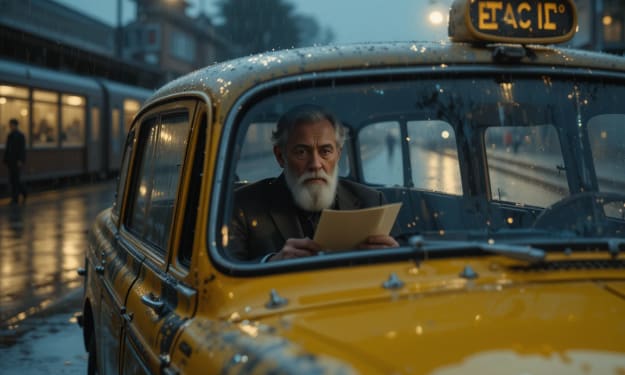
One Last Ride: The Taxi Driver’s Secret Written by Mirza Nobody knew his full name—everyone just called him “Baba Taxi.” For more than thirty years, Baba Taxi drove the streets of Lahore, weaving through its dust, chaos, and colors. His old yellow-and-black cab was a familiar sight—scratched, dented, but somehow proud. His back slightly hunched, white beard trimmed, and smile always kind, Baba was the silent companion of countless passengers.
By Moonlit Letters8 months ago in Fiction
Beneath the Liquid Sky
Silence. A silence so deep it pressed against the shore like the world itself forgot to breathe. The water remained still, its glazed edges shone with an iridescent glow that pulsed with life beneath the burning sun. Dark trunks rose skyward to the heavens, their branches tracing the outline of the world suspended in silence.
By Caylin Watkinsabout 4 hours ago in Fiction
Why Didn't Anyone Tell Us
Men, move along. This is not for you. This is for the women. I was forty-five when I began menopause. It is pretty young for that to be going on in a woman’s life, but I had undiagnosed PCOS, my entire life. Thank you to all the gynecologists I had seen my entire life. That in itself should encourage women to keep seeking second opinions, especially when you are not getting correct answers or any at all.
By Alexandra Grant5 days ago in Humans


Comments
There are no comments for this story
Be the first to respond and start the conversation.