
The Lighthouse at Skagen Point
When the light stopped guiding ships, it began guiding something else.
At the northernmost tip of Denmark lies Skagen Point, where the Baltic Sea and the North Sea collide in endless grey chaos. Waves smash together from opposite directions, creating whirlpools, sudden riptides, and a constant roar that can be heard for miles. For centuries, sailors called it the "Mouth of the Drowned," and they feared the waters almost as much as they feared what stood above them: the lighthouse of Skagen Point.
Built in 1857, the lighthouse was supposed to protect ships from wrecking on the rocks. But instead of saving lives, it seemed cursed to take them. Within twenty years of its construction, nearly forty ships had gone down within sight of its beam. Some fishermen swore the light did not guide them away from danger—it lured them into it. In 1972, after one final tragedy in which an entire crew was lost without trace, the lighthouse was abandoned. Officially, it was said to have been decommissioned. Unofficially, no one in Skagen wanted to go near it again.
Anders Holm, a twenty-eight-year-old maritime historian from Copenhagen, thought otherwise. He was writing his thesis on Scandinavian shipwrecks and had stumbled across the lighthouse records. Most were routine, but the final entries from the last keeper chilled him. In shaky handwriting, the man had written: *"The light does not only shine outward. It shines inward too."* After that, no more notes. Just blank pages.
Locals warned Anders not to waste his time. In the harbor tavern, an old fisherman leaned close and whispered, "The beam still turns, some nights. But it's not meant for ships anymore." Anders smiled politely. He had heard similar superstitions during his studies. To him, this was an opportunity—to uncover the truth behind centuries of fear. He packed his notebook, camera, and a lantern, and set out on a bitter December evening.
The cliffs were treacherous, the wind howling as if the sea itself screamed. The lighthouse loomed above, black against a fading sky, its paint peeled by salt, its windows broken and blind. The heavy wooden door should have been swollen shut after decades of storms, yet fresh scrape marks scarred the frame. Anders pushed, and to his surprise it opened with ease.
Inside, the spiral staircase rose into darkness. Seaweed clung to the stone steps, though the waves crashed far below. The air smelled of brine and rust, and faintly, of smoke—as if a lantern had just been lit. Anders climbed slowly, boots echoing against the walls. Halfway up, he heard it: a murmur beneath the wind. Not in Danish. Not in any language he knew. He stopped, breath held. The whispers ceased. Only the sea thundered outside.
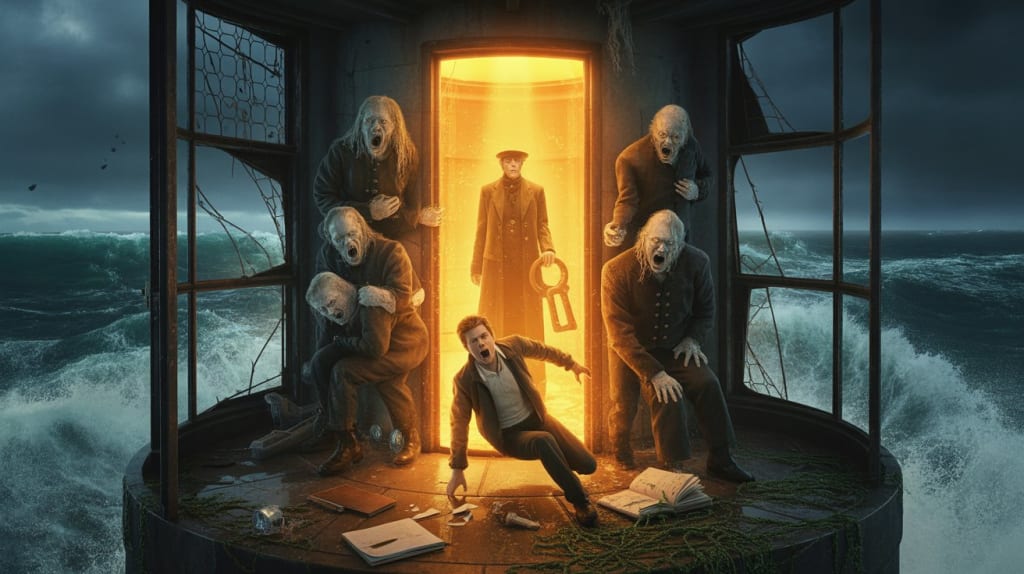
At the top, the lantern chamber was a hollow ruin. The glass lens had shattered decades ago, shards scattered like ice. Yet light filled the room—not outward to the sea, but inward, pouring into the chamber like liquid gold. Anders shielded his eyes. Within the glow, shapes began to form. Figures of men, their hair dripping seawater, their clothes tattered and heavy with rot. Their faces were pale, their eyes clouded as if drowned. They moved their mouths soundlessly, replaying their final screams.
One stepped forward. A tall man in the uniform of a lighthouse keeper, his face bloated, skin grey-green with decay. In his hand he held a rusted key, dripping water onto the floor. He lifted it toward Anders. The whispers returned, now sharp and invasive, pressing against Anders's skull. He understood without knowing the language: *The light takes what it calls. Another must join.*
Anders staggered back, knocking over his notebook. The old logbook slid out of his bag, its final blank pages fluttering open. As the key was raised, letters burned across the paper, glowing faintly in the light: *"Another joins the beam."* The figures closed in, their hands outstretched, wet and skeletal. The light pulsed brighter, pulling him in as if the room itself had become a sea.
Anders screamed, but his voice was swallowed. The last thing he saw was the horizon dissolving into the light, the sea and sky folding inward, dragging him into the endless glow.
Two days later, villagers found his camera and lantern at the base of the cliffs. The logbook was recovered as well, the words on the final page scorched into the paper. His body was never found. The authorities said he had likely fallen into the sea. But the fishermen knew better. They claimed that at midnight, when the seas collide, a new figure can be seen in the glow of the lighthouse. A young man, his eyes wide with terror, forever standing among the drowned, waiting for the next curious soul to climb the stairs.
About the Creator
Wellova
I am [Wellova], a horror writer who finds fear in silence and shadows. My stories reveal unseen presences, whispers in the dark, and secrets buried deep—reminding readers that fear is never far, sometimes just behind a door left unopened.
If You Love Me, You'll Do It
I met Jason when I was five years old. I could say that I loved him from the moment I saw him. He was so handsome to me and I felt in awe by his presence. When they introduced him as the new kid in school, I wanted to be his friend right away. I remember it like it was yesterday. I remember his smile and how he didn't seem shy. He appeared confident and ready to learn. I waved at him and said "hello," before anyone else could even say a word. He sat next to me, and I asked him if he wanted to be friends. He looked so happy as he said, "Yes!"
By Sidney Smith (Sid Smith)7 days ago in Fiction
Instructions for Replacement
These instructions are intended for ordinary use. They are not a guide to reinvention, only adjustment. Follow them carefully and in order. Skipping steps may result in confusion, emotional exposure, or relapse. If done correctly, the transition will appear seamless to others. You will continue to function. You will continue to be addressed by the same name. Only the internal mechanisms will change.
By Courtney Jones5 days ago in Fiction



Comments
There are no comments for this story
Be the first to respond and start the conversation.