
The Bells of Saint Aurelia
When the bells ring after midnight, they are not calling the faithful — they are calling the lost.

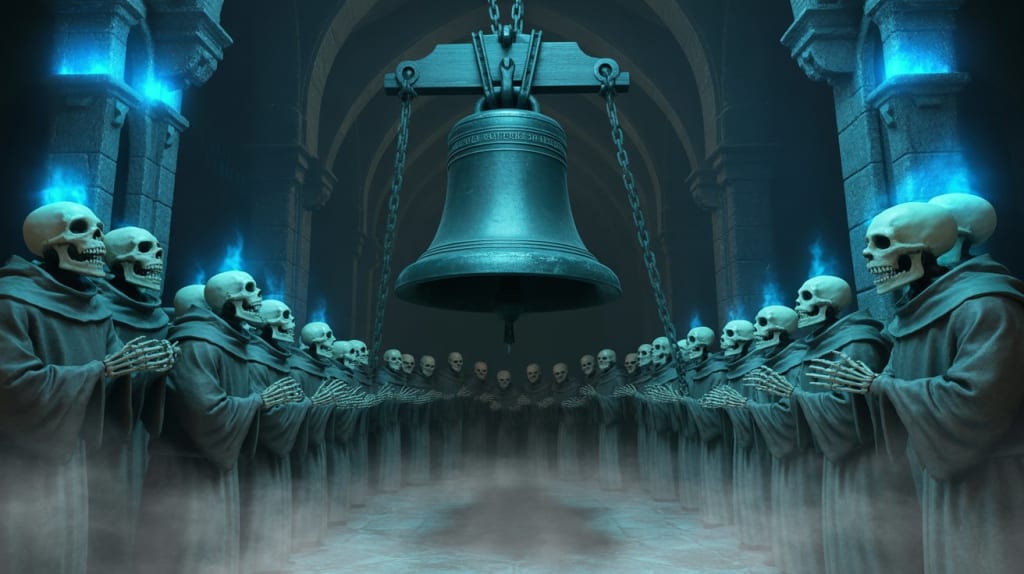
In the quiet hills of southern France stood the ruins of Saint Aurelia’s Abbey. Long ago, it was a place of prayer and devotion, its bells famous across the valleys for their rich, beautiful chime. Villagers said the monks timed their lives by those bells—the rising of the sun, the call to prayer, the solemn toll for the dead. But one stormy night in 1624, the bells rang louder than ever before. The next morning, not a single monk remained. Their beds were empty, their robes neatly folded, as if they had stepped out of their lives and vanished into thin air. The bells fell silent, and for four centuries no one dared to ring them again.
Until last winter.
Elise Moreau, a graduate student in folklore from Lyon, had grown fascinated with the story. She had always believed legends contained a core of truth, and Saint Aurelia’s Abbey was whispered about more than any other ruin. In her research she discovered a troubling pattern: travelers, shepherds, even curious children had gone missing near the abbey across the centuries. The disappearances were never solved, but in each account someone claimed they had heard bells tolling in the distance. Elise suspected there was some rational explanation, perhaps natural acoustics or trickery of sound. Determined to investigate, she packed her camera, recorder, and notebook, and set out on a gray December evening.
The abbey appeared suddenly from behind the trees, a black skeleton against the pale winter sky. Its stone arches were cracked, ivy strangled the walls, and the tower leaned precariously yet still defied time. Elise paused at the gate. The villagers had begged her not to come. “At midnight,” one old woman had whispered, “the bells do not call the faithful. They call the lost.” Elise had smiled politely, but now, as she stood alone before the ruin, the words pressed heavily on her mind.
Inside, the air was colder than outside, filled with the scent of damp earth and rot. Shattered pews littered the nave. Dust coated everything like ash. Elise swept her lantern across the faded frescoes. The saints painted on the walls no longer looked holy; their eyes had blurred into hollow sockets, their smiles twisted into something cruel. She moved closer to the altar, running her fingers over carvings in the stone. They began as Latin prayers but broke apart into jagged symbols that seemed alive in the flickering light. A shiver rippled down her spine.
At exactly midnight, the silence broke.
The bells rang. They did not creak like rusted iron but thundered with impossible strength, each strike resonant, pure, and overwhelming. The sound rippled through the valley, rattling loose stones, vibrating in her chest. Elise froze. The tower above her was empty, she was certain—so who was ringing them?
Her lantern guttered out. Darkness swallowed the nave. Then she heard them: voices. Low chanting, many voices woven into the rhythm of the tolling bells. They rose and fell like waves, in a language Elise could not recognize. She felt herself moving toward the altar, though her mind screamed to stop. Behind it, half-hidden by rubble, she found a narrow staircase spiraling down into the earth.
The crypt was colder still. Moisture dripped from the stone ceiling. Blue flames burned in sconces without fuel, casting an unnatural glow. And in the center of the chamber hung a massive iron bell, suspended from chains, swaying though no hand touched it. Around it stood the monks. They wore tattered robes, but their faces were nothing but skulls, their empty sockets glowing faintly. Their jaws clattered in unison, forming words Elise could not understand. Yet the meaning pressed into her bones with dreadful clarity: *Join us.*
Elise stumbled backward, but the passage behind her no longer led upward. Instead, it twisted and branched, each turn leading her deeper underground. The tolling grew louder, shaking her teeth, blurring her vision. Her camera slipped from her hands, capturing only blurred glimpses of skeletal figures stepping out of the shadows to follow her. Whispers hissed her name. Cold fingers brushed her shoulder though no one was there.
At last she burst into the open air, gasping. But something was wrong. The abbey tower loomed impossibly tall, stretching into the sky like a spire without end. The bells still pealed, their sound filling the valley like thunder. Elise screamed for help, but the sound was drowned in the relentless tolling. The last thing she saw was her own shadow stretching unnaturally across the snow, bending and twisting as if it belonged to someone else.
The next morning, villagers found her car abandoned at the forest’s edge. Her belongings lay scattered near the abbey gates. Her camera was recovered, its final footage filled with distorted chanting, shadowed figures, and the unbroken toll of bells. Elise herself was gone, as though she had stepped out of her life like the monks centuries before.
Since that night, the bells of Saint Aurelia have never been silent. At midnight they ring, clear and powerful, across the valleys. And those who hear them swear they carry more than just sound. Hidden in the tolls is a woman’s voice — not crying, but begging — trapped forever in the echo of the bells.
About the Creator
Wellova
I am [Wellova], a horror writer who finds fear in silence and shadows. My stories reveal unseen presences, whispers in the dark, and secrets buried deep—reminding readers that fear is never far, sometimes just behind a door left unopened.
Miss Persephone's Manual to a Seemingly Ordinary Life
Miss Persephone was found at the dining table, her blue eyes swollen, her tears arriving and retreating like the tides of the ocean. Earlier that day, her family had visited her in the retirement home where she had lived for eight years. It was her eightieth birthday.
By Imola Tóth3 days ago in Fiction




Comments
There are no comments for this story
Be the first to respond and start the conversation.