
The Library of Lost Voices
She couldn’t speak, but in this hidden place, she heard love again.
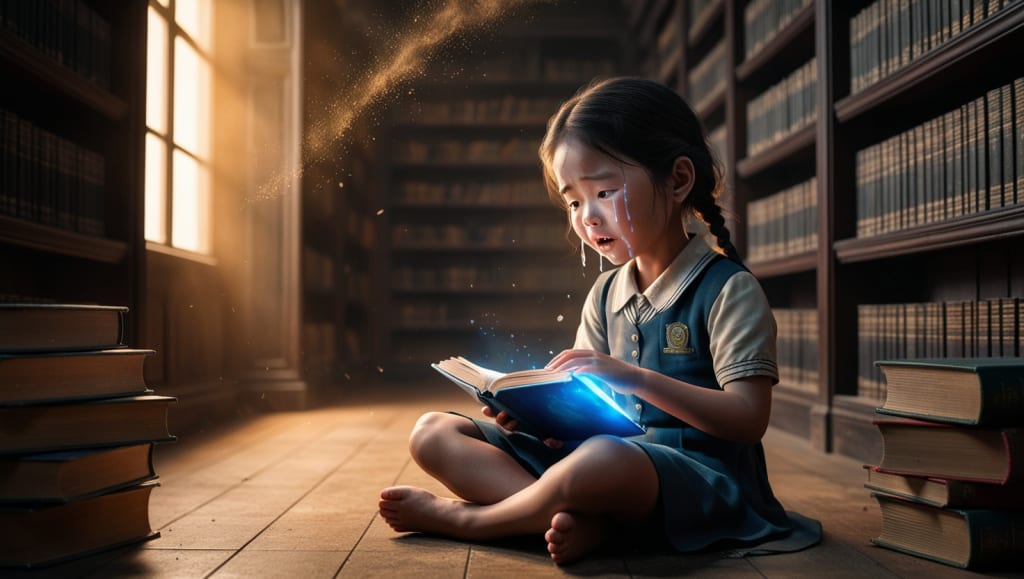
No one ever noticed the little girl with the braid undone, sitting at the back of the classroom, her eyes following words she could not speak. Mira hadn’t spoken a word since the river took her brother last winter. Doctors called it “selective mutism.” Teachers called it “a challenge.” Her mother just called it grief.
Every evening, Mira walked home alone, her satchel bumping against her knees, the world silent except for the rhythmic crunch of gravel under her shoes. The silence was her safety now. If she didn’t speak, she wouldn’t hear the echo of her brother’s voice fading from memory. She wouldn’t hear it… disappearing.
One damp spring afternoon, rain began falling before she was halfway home. Mira ducked into a narrow alley, seeking shelter under a cracked awning. That’s when she saw it.
A thin, weathered sign hung crooked above a dark oak door:
THE LIBRARY OF LOST VOICES
She had never noticed it before, though she’d walked this route for years. The windows were fogged, and the brass handle was shaped like an open mouth, lips parted as if whispering secrets.
Drawn by something she couldn’t name, she pressed her palm against the door. It swung open without a sound.
Inside, the air was warm and scented with old paper and vanilla. Towering bookshelves lined the walls, curving up into the shadows. A frail man with spectacles perched on his forehead sat at a wide mahogany desk, cataloguing thick leather-bound volumes.
He looked up as Mira entered, his eyes gentle. He didn’t ask why she was there, nor why she didn’t speak.
Instead, he gestured to the shelves and said, in a voice like turning pages, “Each book holds a voice that was lost. Some are from centuries ago; others are as recent as yesterday. You may listen, if you wish.”
Mira’s chest tightened. Voices? She moved to the nearest shelf, tracing trembling fingers over the spines. The titles were names: “Elsie Martin, 1927,” “Kiran Patel, 2011,” “Jonas Laird, 1845.”
She walked deeper into the library until she found a thin blue volume tucked between larger tomes:
“Arav Liyanage, 2024.”
Her brother’s name.
Her knees buckled as she pulled it free. It was light, like it was barely there. She opened the cover, and the world around her blurred.
“Hey, Mira-bean.”
His voice. Warm, teasing, alive.
She pressed the book to her chest, tears falling onto the leather. When she placed it near her ear, it spoke again:
You’re such a snail, you know that? Always trailing behind me. Catch up next time, okay?”
She could hear the smile in his words – the smile she hadn’t seen in months. She sat cross-legged on the dusty rug, listening to every fragment: his jokes, his humming while doing homework, his angry outburst about losing at chess, his whispered apology after.
Hours passed unnoticed. The librarian brought her a cup of chamomile tea, setting it silently beside her as if not to disturb the reunion. Mira didn’t drink it. She only listened, her tears pooling on the floorboards.
When she reached the final recording, it was different. His voice was softer, as if speaking directly into her ear.
“Don’t stop talking because I’m gone, okay? Your words… I always loved them. Use them for me too.”
She clutched the book so hard her knuckles whitened.
That evening, as the library’s lamps dimmed to a dusky glow, she stood and approached the librarian. She opened her mouth, but no sound came out. He smiled knowingly.
“Come back anytime, child,” he whispered. “But remember… the voices here are only echoes. You carry the real one inside you.”
Mira walked out into the cool night, the rain long passed. Street lamps flickered against puddles. The world felt louder somehow – the drip of water from gutters, the wings of pigeons rustling under eaves, the distant hum of traffic.
She reached her apartment door, hesitated, then turned and whispered into the empty street, her voice cracking like thawing ice:
“Goodnight, Arav.”
It was small. Barely there. But it was a start.
That night, she dreamt of the library again. But this time, her brother wasn’t just a voice trapped in paper and ink. He was there beside her, shelving books, humming his silly made-up songs. And when she woke up with tears soaking her pillow, she wasn’t afraid of them.
Because she knew grief wasn’t a silence swallowing her whole.
It was a library inside her, full of voices she could visit anytime – not to live in the past, but to gather strength to speak in the present.
And for the first time since winter, Mira felt a flicker of warmth in her chest.
A tiny voice within her own, whispering:
“You’re still here.”
About the Creator
Asim Ali
I distill complex global issues ranging from international relations, climate change to tech—into insightful, actionable narratives. My work seeks to enlighten, challenge, encouraging readers to engage with the world’s pressing challenges.


Comments
There are no comments for this story
Be the first to respond and start the conversation.